
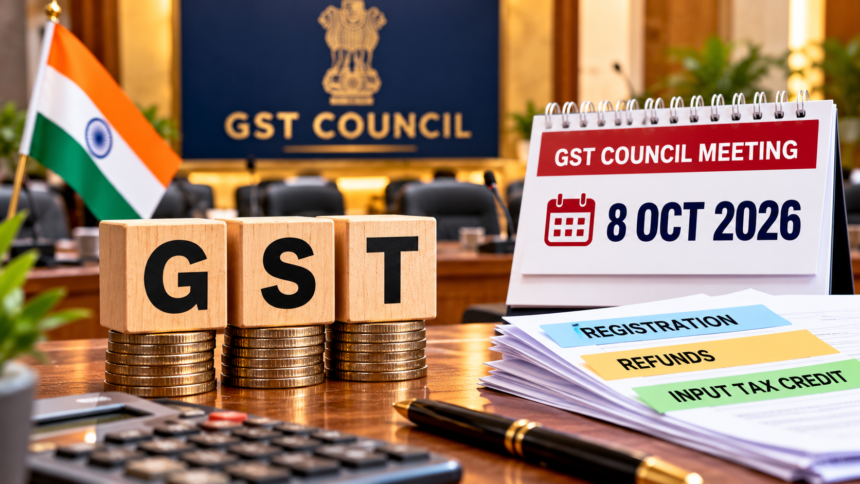
GST Council Meeting: The Goods and Services Tax (GST) regime could see another round of procedural reforms as the GST Council considers a fresh set of measures at its meeting on October 8. The proposals are aimed at making GST compliance simpler and improving the way businesses handle registrations, returns, refunds and input tax credit (ITC).
The proposed changes follow the broader effort to simplify the GST framework and are expected to reduce compliance difficulties for businesses across different sectors.
According to Finance Ministry sources, improved technology, invoice-matching systems and greater revenue certainty for states have created the foundation for the next phase of GST reforms.
Faster GST Registration and Return Filing
One of the key proposals focuses on making GST registration quicker and more efficient. At present, 61% of taxpayers receive registration within three working days without officer intervention.
For the remaining applicants, the process is proposed to be streamlined to reduce unnecessary queries and avoid avoidable rejections.
Changes are also being considered in the return-filing system. The proposed mechanism would allow invoice matching and ITC validation at the time of recording transactions. This could reduce the number of mismatch notices issued to taxpayers.
Refunds Could Be Processed Within 17 Days
The GST Council is expected to consider a proposal aimed at speeding up refunds. Under the proposed system, refund applications would have to be acknowledged within 10 days.
After a risk assessment, 90% of the refund amount could be released, with the remaining amount expected to be paid within seven days of acknowledgement.
The proposal could substantially reduce the time currently required for refund acknowledgement, which can take around 21 to 45 days.
Businesses that are closing down could also get relief under the proposed changes. Physical verification for GST registration cancellation may no longer be required in cases where the taxpayer has cleared outstanding tax liabilities and filed all required returns.
Changes Proposed for GST Litigation and Blocked ITC
The government is also considering measures to reduce GST-related litigation. Common standards for notices, hearings and orders could be introduced, along with a threshold below which certain notices would not be issued.
A proposal to decriminalise certain GST offences is also under consideration, including the removal of the arrest provision. Under the proposed approach, disputes would primarily be dealt with through civil consequences involving recovery of tax, applicable interest and penalties.
Another major area under review is blocked input tax credit. The proposed changes could help businesses unlock working capital by reconsidering ITC restrictions on certain goods and services.
The review may cover tax paid on certain services as well as plant and machinery. Areas being examined include outdoor catering, health and life insurance, telecom towers, pipelines outside factory premises, free samples, certain goods destroyed after expiry, vehicles with seating capacity of up to 13 persons and related insurance and maintenance costs, as well as vehicle leasing and hiring.
Most Changes Likely From April 2027
Although the proposed reforms are expected to be considered at the October 8 meeting, their implementation is likely to happen in phases. Most of the changes are expected to take effect from April 2027.
Rate-related changes are not expected to be part of this meeting. Going forward, GST rate revisions are expected to be considered once a year and implemented from April 1, coinciding with the beginning of the financial year.
The proposals have been prepared by the Law Committee and Fitment Committee, with states consulted during the process. Three National Coordination Meetings have also been conducted over the past year.
Finance Ministry sources said discussions with states on the proposed measures have been ongoing and that most of the proposals are expected to receive approval from the GST Council.
Disclaimer: This article is intended for general informational purposes and is based on the proposals and details provided in the source material. GST rules, procedures, timelines and proposed reforms may change following discussions and final decisions by the GST Council and the government. Businesses and taxpayers should refer to official government notifications and GST authorities for the latest applicable provisions.