
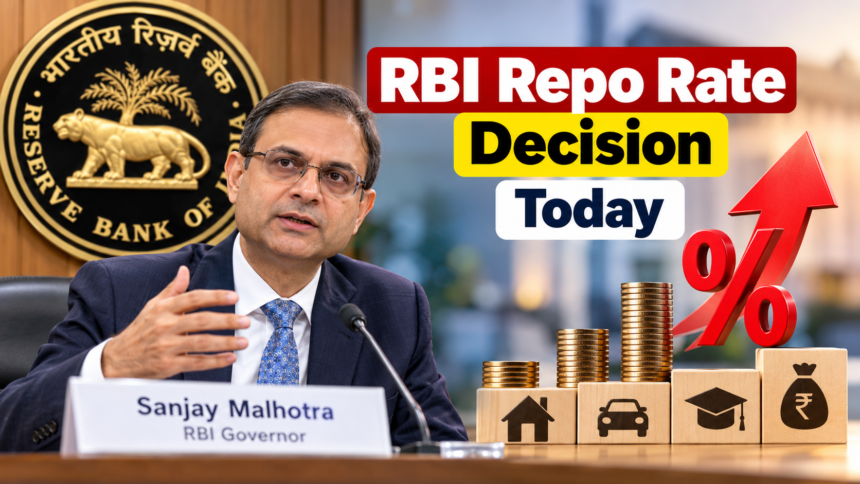
Kolkata: Reserve Bank of India Governor Sanjay Malhotra is set to announce the outcome of the RBI Monetary Policy Committee’s meeting, with the repo rate decision being closely watched by borrowers, depositors and investors.
Economists have suggested that the central bank may consider raising the repo rate to address inflationary pressures driven by external factors, including elevated crude oil prices and higher food prices amid lower rainfall. SBI Research and BoFA Securities have projected a 25-basis-point repo rate hike, with another increase also expected in December.
A change in the repo rate can have a direct impact on household finances. From loan EMIs to fixed deposit returns and stock market sentiment, several areas of personal finance could be affected.
Loans Could Become More Expensive
A repo rate increase generally puts upward pressure on lending rates. This can make different types of loans, including home loans, personal loans, car loans, education loans and business loans, more expensive.
New borrowers could face higher interest rates when taking fresh loans. Existing borrowers with floating-rate loans may also see the impact as lending rates are linked to benchmark rates that respond to changes in the repo rate.
For borrowers, a higher interest rate could result in an increase in the monthly EMI. Alternatively, lenders may extend the loan tenure, increasing the total number of EMIs required to repay the loan.
Even loans linked to the Marginal Cost of Funds-based Lending Rate (MCLR) can see relatively quick transmission of changes in lending rates.
Fixed Deposit Investors Could Benefit
While higher interest rates can increase borrowing costs, they can also provide an advantage to bank depositors. Banks may increase interest rates on fixed deposits across different tenures following a rise in policy rates.
This could benefit customers opening new FD accounts after rates are revised. Existing FD holders may also consider moving their money into a new deposit offering a higher rate.
However, breaking an existing fixed deposit before maturity can attract a penalty or reduction in the applicable interest. Therefore, whether switching to a new FD is financially beneficial will depend on the individual deposit’s terms and the rates offered by the bank.
RBI Faces a Balance Between Inflation and Growth
Interest rate decisions require the central bank to balance inflation control with economic growth. Higher borrowing costs can discourage consumption and investment, which may slow economic activity. A slowdown in growth can also affect employment generation.
The RBI therefore needs to consider both inflationary pressures and the strength of economic growth while deciding its policy rate.
Economists have noted that India’s economic growth remains relatively strong, with several institutions, including the World Bank and the RBI, having revised their growth projections upwards. This could give the central bank more room to focus on inflation compared with a situation where economic growth is weak.
Stock Market Could Also Feel the Impact
Equity investors typically keep a close watch on interest rate movements because higher rates can influence borrowing costs, corporate activity and investment sentiment.
The stock market has already been under pressure in recent weeks. Against this backdrop, an increase in the repo rate could add another factor for equity investors to consider.
The RBI’s policy decision will therefore be important not only for borrowers and depositors but also for businesses and investors across the economy.
Disclaimer: This article is intended for general informational purposes only and should not be considered financial, investment or lending advice. Interest rates, loan costs, deposit returns and market conditions can change based on various factors. Readers should assess their individual financial circumstances and consult a qualified financial adviser before making any investment or borrowing decision.