
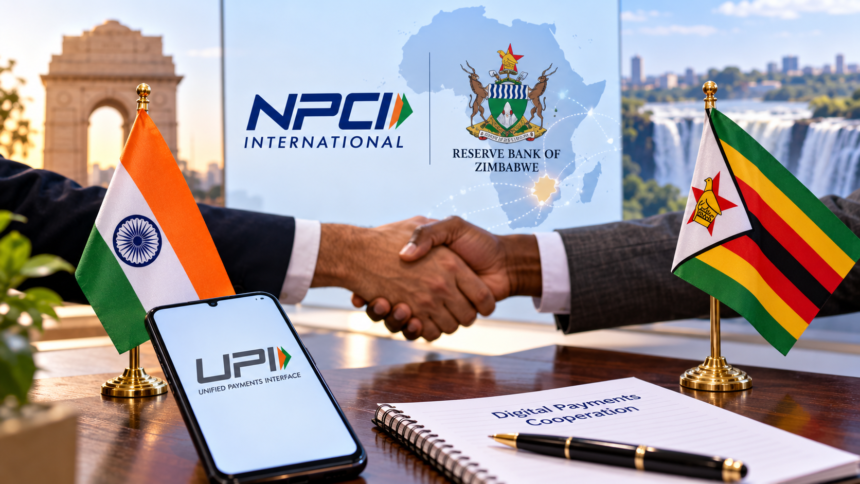
Zimbabwe is reportedly discussing a partnership with NPCI International Payments Ltd (NIPL) to develop a new real-time digital payments system based on India’s Unified Payments Interface (UPI) technology. Negotiations could be completed by October 31, according to Reserve Bank of Zimbabwe Governor John Mushayavanhu.
In emailed responses to Bloomberg, Mushayavanhu said the proposed platform would create a common payment infrastructure linking banks, mobile-money operators, fintech companies and other payment service providers. The system would enable transactions to be processed in real time across Zimbabwe.
UPI Technology Could Transform Zimbabwe’s Payment System
If the agreement is finalised, Zimbabwe would use the technology behind India’s UPI to build its own domestic digital payments infrastructure. The proposal is different from simply allowing Indian travellers to make UPI payments abroad.
According to Mushayavanhu, the planned system could help reduce transaction costs while making digital payments faster. It could also provide a more affordable alternative to card payments for smaller account-to-account transactions.
The common infrastructure may allow banks and fintech companies to develop new financial products and offer lower-cost payment services to merchants.
The governor also said greater use of digital payments could provide better visibility into the economic activities of small and medium-sized businesses. This could help the government obtain more reliable information about their contribution to the economy.
Other Countries Exploring UPI-Based Payment Infrastructure
Zimbabwe would not be the first African country to explore a domestic payment system based on UPI technology.
In May 2024, NPCI International signed an agreement with the Bank of Namibia to support the development of a real-time payments platform modelled on UPI. The proposed system was aimed at improving interoperability between different payment providers and enabling instant person-to-person and merchant transactions.
Similar agreements for UPI-style payment infrastructure have also been signed in Peru and Trinidad and Tobago.
Meanwhile, India has continued expanding the international acceptance of UPI, allowing Indian users to make digital payments at participating merchants in several overseas markets.
‘Cashless Nation’ Book Highlights UPI’s Growth
The growth of UPI was also recently highlighted at an event hosted by IIT-Madras for the launch of Cashless Nation: How UPI Changed Everything. The book examines the development and rapid expansion of India’s Unified Payments Interface and coincides with the 10th anniversary of the UPI ecosystem.
The book has been co-authored by IIT-M alumnus and technologist Santanu Paul and veteran banker B Sambamurthy and published by Penguin Random House.
IIT-M Director V Kamakoti hosted the event, which was attended by former RBI Governor C Rangarajan, former WHO Chief Scientist Soumya Swaminathan, and BSE India MD and CEO Sundararaman Ramamurthy.
Speaking at the event, Rangarajan described the book as a detailed account of the policies, people and developments behind UPI. He also highlighted how the payment system has become widely accessible, ranging from small merchants to high-value users.
Disclaimer
This article is intended for general informational purposes only. The information presented here should not be considered financial, investment, banking or payment-related advice. Readers should verify details through official sources before making any financial or business decisions.