
India’s economic progress should be measured not only by its current income levels but also by how quickly living standards are improving and how rapidly the country is catching up with other economies, according to South Korean economist Kyunghoon Kim.
Kim highlighted the rise in India’s per capita income and the significant reduction in poverty over recent decades, arguing that the country’s economic transformation deserves greater recognition, particularly over the past 10 years.
Kim, Head of the India and South Asia Team at the Korea Institute for International Economic Policy (KIEP), shared his assessment on Sunday after his earlier comments about India’s medium-term growth outlook prompted responses pointing to the country’s continued poverty.
In a detailed post on X, he argued that a more meaningful measure of progress is whether living standards are improving quickly and whether India is narrowing the economic gap with other countries.
India’s Per Capita Income Has Increased Significantly
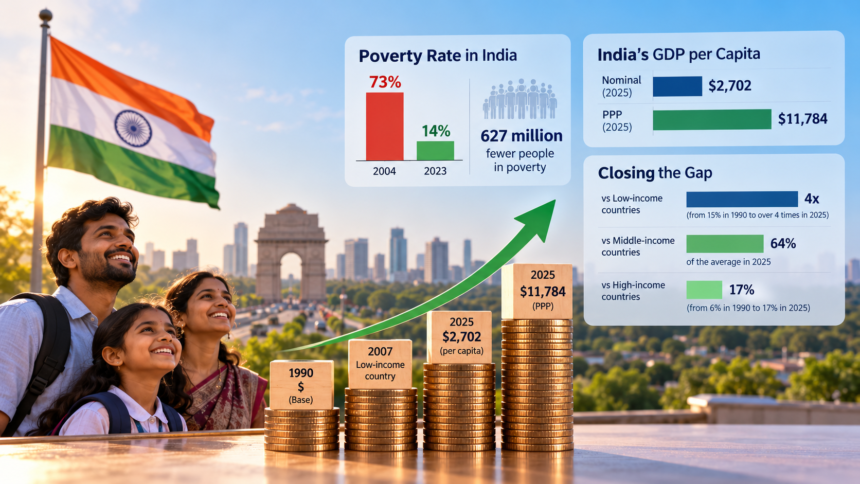
According to figures shared by Kim, India’s GDP per capita reached $2,702 in 2025, equivalent to $11,784 when adjusted for purchasing power parity (PPP).
For comparisons across different years, Kim also referred to GDP per capita measured at constant 2021 PPP prices, which stood at $10,039 in 2025.
India remained classified as a low-income country by the World Bank until 2007. In 1990, its GDP per capita was only 15% higher than the average for low-income countries. By 2025, the figure had grown to more than four times that average.
India has also made progress relative to middle-income economies, a category that includes countries such as China and Vietnam. Its GDP per capita reached 64% of the middle-income country average in 2025, with much of the improvement occurring during the past decade.
These figures highlight the change in India’s relative economic position over time, rather than focusing exclusively on its current income level.
India Is Gradually Closing the Gap With Wealthier Economies
India’s progress compared with high-income countries has been slower, but the relative gap has narrowed over the years, Kim noted.
In 1990, India’s GDP per capita was equivalent to just 6% of the average for high-income economies. By 2025, that proportion had increased to 17%.
Kim attributed part of this change to slower economic growth in several wealthy countries. He also noted that India’s GDP per capita is approaching half of the global average, compared with approximately one-fifth in 1990.
According to the economist, India has moved further ahead of low-income countries while gradually catching up with wealthier economies and making progress towards the middle-income average.
He also cautioned against assuming that developing economies will automatically catch up with richer countries. In his assessment, India’s relative economic trajectory changed significantly around 1990, highlighting that economic convergence is not guaranteed.
Poverty Rate Falls From 73% to 14%
The reduction in poverty is another major indicator of India’s economic progress highlighted by Kim.
Using the $4.40-a-day poverty threshold, the country’s poverty rate fell from 73% in 2004 to 14% in 2023, according to the figures he cited.
This decline represents 627 million fewer people living below that poverty line over less than two decades.
Kim emphasised the significance of this change in a country with a population of around 1.4 billion. The scale of the population means that improvements in income and living standards can have a substantial impact on millions of households.
The figures also underline the importance of examining long-term changes in poverty alongside economic growth when assessing the country’s development.
India’s Long-Term Economic Outlook Remains Important
Kim acknowledged that India continues to face numerous economic and development challenges. However, he maintained that the country’s progress in catching up with other economies, particularly over the past decade, deserves attention.
His assessment focuses on the broader direction of the economy, including rising per capita income, declining poverty and India’s changing position relative to low-, middle- and high-income countries.
For Kim, these developments are important indicators of India’s economic transformation and its medium-term growth prospects.
Disclaimer: This article is based on the economic figures and observations attributed to Kyunghoon Kim. Income comparisons and poverty estimates depend on the measures and thresholds used. The information is intended for general news and informational purposes only.