
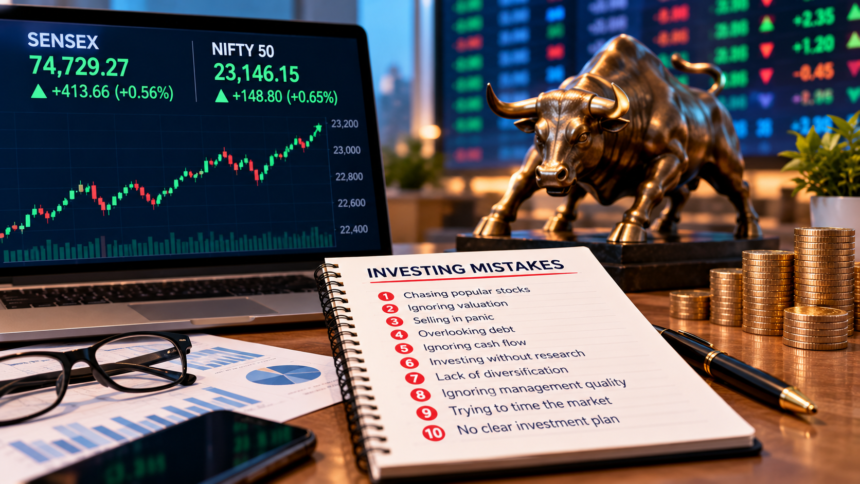
Indian stock markets extended their recovery on Friday, with the Sensex and Nifty 50 recording their second consecutive weekly gains after an eight-week losing streak, the longest such stretch in 25 years.
The Sensex rose 413.66 points, or 0.56%, to close at 74,729.27. The Nifty 50 gained 148.80 points, or 0.65%, to finish at 23,146.15. For the week, the Sensex advanced 3.11%, while the Nifty 50 climbed 2.77%.
The rebound came despite high crude oil prices and continued selling by foreign institutional investors (FIIs). Support from domestic institutional investors (DIIs), a stronger rupee and renewed buying in IT stocks helped improve market sentiment. Tech Mahindra jumped 8.45% after reporting a 32.74% increase in consolidated net profit to ₹1,585.6 crore for the July–September quarter of FY27. Meanwhile, the rupee strengthened to 94.96 against the US dollar, and Brent crude prices slipped 0.30% to $105.6 per barrel.
Market recoveries and corrections can influence investor behaviour. Rising prices may encourage people to buy stocks simply because they are gaining popularity, while falling markets can trigger fear-driven selling. However, short-term price movements alone are not enough to determine whether a stock is worth buying or selling.
Investors should consider a company’s financial health, valuation, debt levels and earnings outlook before making decisions. Here are 10 common investing mistakes that retail investors should avoid.
1. Buying Stocks Just Because They Are Popular
Stocks that attract significant attention can tempt investors to enter the market without conducting proper research. However, a company’s popularity does not necessarily mean its shares are fairly valued or that its business is performing well.
Before investing, examine the company’s business model, earnings performance and future growth potential rather than relying only on market trends or recommendations.
2. Paying Too Much for a Good Company
Even a financially strong company can become an expensive investment if its share price rises beyond a reasonable valuation. Buying at an excessive price can reduce the potential for future returns, even when the business continues to grow.
Investors should assess valuation measures such as the price-to-earnings (P/E) ratio and enterprise value to EBITDA (EV/EBITDA), comparing them with the company’s growth prospects and industry peers.
3. Selling Investments Out of Fear
Market corrections can create uncertainty, particularly when share prices fall sharply. Selling investments purely because of a temporary decline may turn a paper loss into a realised loss.
Instead of reacting immediately, investors should review the company’s fundamentals, current valuation and their original investment goals. An exit decision should be based on the investment’s merits rather than fear alone.
4. Overlooking a Company’s Debt
A high debt burden can create financial pressure when borrowing costs increase, earnings weaken or cash flows decline. Companies with substantial debt may find it difficult to meet their financial obligations during challenging periods.
Investors should review debt levels, interest coverage and the company’s ability to generate enough cash to service its borrowings.
5. Focusing on Profit Without Checking Cash Flow
Accounting profits do not always reflect the amount of cash a business generates. A company may report rising earnings while its operating cash flow remains weak, which can require closer examination.
Free cash flow is another useful measure because it indicates how much cash remains after capital expenditure. Reviewing these figures alongside reported profits can provide a clearer picture of financial performance.
6. Investing in Businesses You Do Not Understand
Buying shares without understanding how a company operates can make it difficult to assess its risks and long-term prospects.
Investors should study annual reports, identify the company’s main sources of revenue and understand its competitive advantages. Familiarity with the business can help them evaluate financial results and make more informed investment decisions.
7. Keeping Too Much Money in One Stock or Sector
Concentrating a portfolio in a single company, industry or investment theme can increase risk. If that particular stock or sector performs poorly, the impact on the overall portfolio may be significant.
Diversifying across companies, sectors and asset classes can help spread risk. However, diversification does not guarantee profits or completely prevent investment losses.
8. Ignoring the Quality of Company Management
A company’s leadership plays an important role in how its resources are used and how shareholder interests are protected. Poor capital allocation, weak corporate governance and questionable related-party transactions can damage a company’s long-term value.
Investors should review management decisions, company disclosures and the leadership team’s track record before committing their money.
9. Repeatedly Trying to Time the Market
Attempting to buy shares at their lowest prices and sell at their highest can be difficult, even for experienced investors. Frequent trading may also increase transaction costs and lead to missed investment opportunities.
A disciplined approach based on financial goals and an appropriate investment horizon can help investors avoid making repeated decisions in response to short-term market movements.
10. Investing Without a Clear Plan
Entering the stock market without defined financial goals, a suitable time horizon or an understanding of personal risk tolerance can encourage impulsive decisions.
Investors should establish an investment strategy, determine an appropriate asset allocation and review their portfolios periodically. Rebalancing when necessary can help keep investments aligned with their financial objectives.
What Retail Investors Should Remember
Successful investing involves more than choosing stocks that are rising in price. Investors need to understand the businesses they own, assess valuations carefully and monitor financial health while keeping emotions under control.
Avoiding common mistakes can support better decision-making and help investors remain focused on their long-term financial goals, even when markets experience sharp rallies or corrections.
Disclaimer: This article is for general informational and educational purposes only and should not be considered investment advice. Stock market investments carry risk, including the possibility of losing capital. Investors should conduct their own research or consult a qualified financial adviser before making investment decisions.