
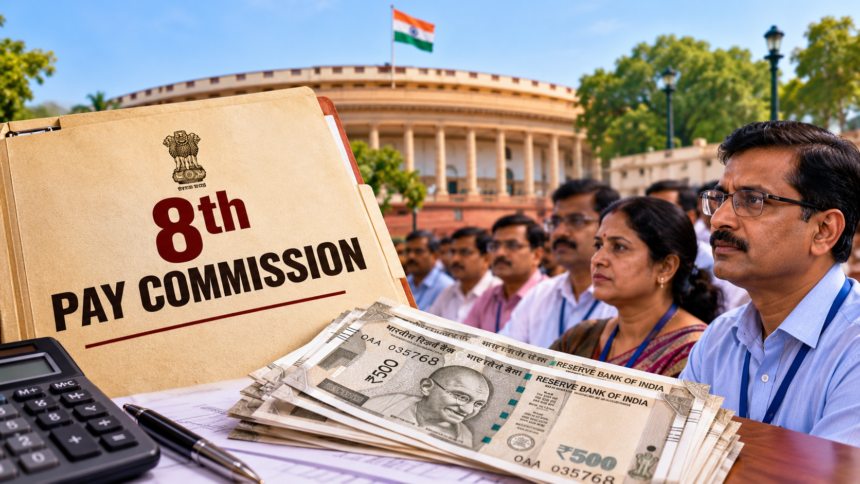
The 8th Central Pay Commission (CPC) is currently gathering views from central government employees, pensioners, unions and other stakeholders before preparing its recommendations, which are expected by May 2027.
The commission will examine possible changes to salary structures, pay matrices, fitment factors, allowances, pensions and other employment benefits. Its review could affect more than one crore people, including approximately 50 lakh central government employees and 65 lakh pensioners, including personnel associated with the defence and railway sectors.
As part of its consultation process, the commission has scheduled a visit to Mumbai on October 22 and 23 to meet employee unions, pensioner associations, federations and other stakeholder groups.
Several organisations have already put forward proposals covering minimum basic pay, Dearness Allowance (DA), fitment factors and the method used to calculate inflation-linked payments.
8th Pay Commission: Key Demands for DA Merger
One of the major issues raised by employee unions is the demand for an official decision on merging Dearness Allowance with basic pay.
Employee representatives have pointed to the 7th Pay Commission’s provisions concerning a possible DA merger when the allowance exceeds 50% of basic salary. According to the source material, DA had reached 60% of basic pay as of its latest update.
However, no official announcement confirming a merger had been made as of June 2026.
The issue matters because basic pay influences several other salary components, including provident fund contributions, pension calculations, allowances and gratuity. If DA is incorporated into basic pay, the resulting changes could affect overall compensation, depending on the rules approved by the government.
Minimum Basic Salary Demands From Employee Organisations
Several employee organisations have proposed increases in the minimum basic pay under the 8th Pay Commission.
Their demands include the following:
- National Council–Joint Consultative Machinery (NC-JCM): ₹69,000.
- Maharashtra Old Pension Organisation: ₹65,000.
- All India Defence Employees Federation (AIDEF): ₹69,000.
- Indian Railways Technical Supervisors Association (IRTSA): ₹52,600.
IRTSA has argued that minimum pay should be revised in line with current economic conditions and has also called for different fitment factors for relevant employee categories.
The Railways Senior Citizens Welfare Society (RSCWS), meanwhile, has proposed that minimum pay calculations should use the price index applicable on January 1, 2026.
These figures represent proposals from employee organisations and should not be interpreted as approved salary revisions.
DA Hike and Fitment Factor: What Employees Want
Apart from higher minimum basic pay, unions have raised demands concerning Dearness Allowance and the fitment factor.
NC-JCM has proposed an inflation-linked wage model. The Maharashtra Old Pension Organisation has sought a minimum 4% DA increase along with a merger of DA with basic pay at the 50% level. AIDEF has called for compensation adjustments that reflect inflation.
IRTSA has also recommended higher fitment-factor indexing for Level 6 posts in safety-related categories within the Ministry of Railways. Its proposed fitment factors are 2.92, 3.50 and 3.80.
The fitment factor is used to calculate revised basic pay when a new pay structure is introduced. The final factor, if any, will depend on the commission’s recommendations and the government’s subsequent decision.
AIDEF Seeks Changes to the DA Calculation Formula
The All India Defence Employees Federation has submitted another memorandum asking the 8th CPC to reconsider the existing method of calculating Dearness Allowance.
The organisation argues that the current formula gives relatively greater weight to expenditure categories where costs tend to remain more stable. According to its submission, employees—particularly those in lower pay grades—spend a substantial proportion of their earnings on essential expenses such as food, education, healthcare, rent and medicines.
AIDEF has therefore called for a calculation method that better reflects the spending patterns and inflationary pressures experienced by employees.
The commission will consider submissions from various stakeholders as part of its consultation process. These demands remain proposals and do not establish what the final DA formula or salary structure will be.
When Will the 8th Pay Commission Recommendations Be Announced?
The commission’s terms of reference provide an 18-month period from its constitution on November 3, 2025, to submit its recommendations. Based on this timeline, the deadline falls in May 2027.
However, submission of the report does not necessarily mean that revised salaries and pensions will be implemented immediately. The government must consider the recommendations and determine the implementation framework.
The rollout could take another two to three years to complete, meaning that revisions announced in 2027 might not be fully implemented until 2029 or 2030.
Central government employees and pensioners should therefore distinguish between demands submitted by unions, recommendations issued by the commission and changes formally approved by the government.
Disclaimer
This article is intended for general informational purposes only and is based on the information provided in the source material. Salary figures, DA merger proposals, fitment factors and other demands discussed here are proposals from employee organisations, not confirmed government decisions. The commission’s recommendations and implementation timeline may change. Employees and pensioners should refer to official government notifications and announcements for confirmed updates.