
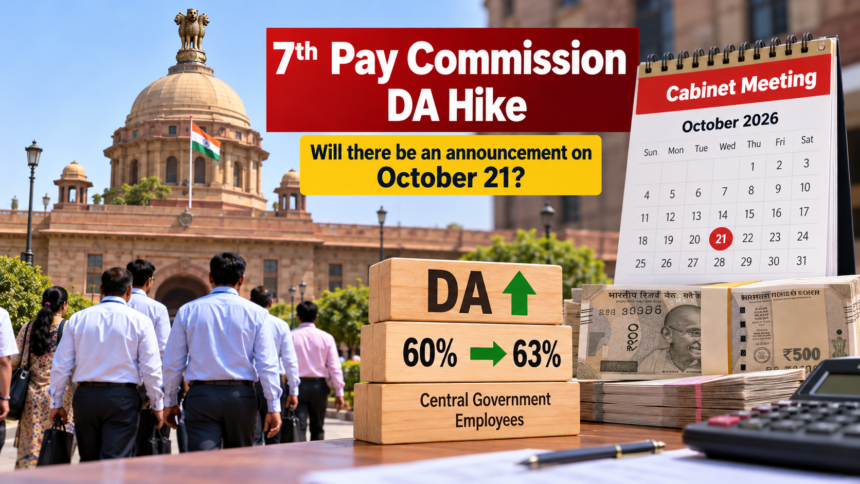
Central government employees and pensioners are waiting for an announcement on the pending dearness allowance (DA) and dearness relief (DR) revision. With Dussehra falling on October 20 and the next Union Cabinet meeting scheduled for October 21, attention is focused on whether the Centre will approve the increase after the festival.
The current DA rate stands at 60% of basic pay following the previous revision, which took effect from January 1, 2026. Based on inflation-related estimates, the next increase could raise DA to 63%. However, the government has not officially confirmed either the proposed rate or the date of the announcement.
DA Hike on October 21: What Can Employees Expect?
The Union Cabinet meeting scheduled for October 21 is being closely watched by central government employees hoping for an update on the pending July 2026 DA instalment.
Expectations had also risen ahead of the Cabinet meeting on October 14, but no DA revision was announced at that time.
The Centre generally revises DA twice a year, with changes taking effect from January and July. However, the actual announcement dates can vary. Although previous increases have been announced around festive periods, there is no guarantee that the pending revision will be approved on October 21.
Employees will need to wait for an official government announcement to confirm whether the proposed increase has received approval.
DA Could Rise from 60% to 63%: Salary Calculation
In April 2026, the Union Cabinet approved a two-percentage-point increase in DA, raising it from 58% to 60%, effective January 1, 2026.
The next revision is expected to take account of changes in the consumer price index used to calculate dearness allowance. Estimates based on the relevant inflation data suggest that DA could increase by another three percentage points, taking the rate to 63%. The final figure will depend on the government’s decision.
Here is how the potential increase would affect an employee with a basic salary of ₹44,900 per month:
| Salary component | DA at 60% | DA at 63% |
|---|---|---|
| Basic salary | ₹44,900 | ₹44,900 |
| Monthly DA | ₹26,940 | ₹28,287 |
| Additional monthly DA | — | ₹1,347 |
| Additional amount over 12 months | — | ₹16,164 |
If the DA rate rises to 63%, an employee drawing a basic salary of ₹44,900 would receive an additional ₹1,347 per month in DA. This would amount to ₹16,164 over 12 months.
These figures are estimates based on the proposed rate. The actual benefit will depend on the final percentage approved and the employee’s basic pay. The calculation does not include deductions or changes to other salary components.
DA and DR Hike: What Pensioners Need to Know
Central government pensioners are also awaiting the pending revision. While serving employees receive dearness allowance, pensioners receive dearness relief (DR), which is revised in line with DA to help offset the impact of inflation.
If the government approves a corresponding three-percentage-point increase in DR, eligible pensioners would receive a higher monthly amount. The additional benefit would depend on their basic pension and the final rate announced by the Centre.
The Confederation of Central Government Employees and Workers held a lunch-hour protest on October 16, demanding the release of the pending DA and DR instalments with effect from July 1, 2026.
When Will the Government Confirm the DA Increase?
The October 21 Cabinet meeting could provide an update on the pending DA and DR revision. However, employees and pensioners should not treat the projected increase to 63% as confirmed until the government issues an official announcement.
The effective date, revised rate and payment arrangements will depend on the decision formally approved by the Centre. Until then, the expected increase remains an estimate rather than a confirmed benefit.
Disclaimer: This article is for general informational purposes only. The proposed DA and DR rates, salary calculations and possible announcement dates are based on the information available in the provided report and are not confirmation of a government decision. Employees and pensioners should refer to official government notifications for confirmed rates, effective dates and payment details.