
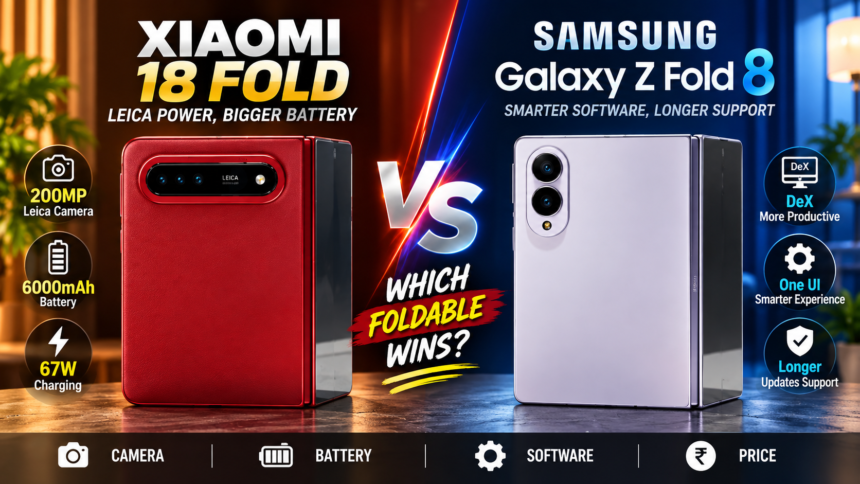
The premium foldable smartphone segment has two notable contenders in the Xiaomi 18 Fold and Samsung Galaxy Z Fold 8. Xiaomi has focused heavily on hardware, offering a 200MP Leica camera, a large 6,000mAh battery and 67W fast charging. Samsung, meanwhile, places greater emphasis on its software experience, DeX functionality, ecosystem and long-term updates.
Both phones offer flagship-level specifications, but there are several differences in their displays, cameras, processors, battery capacity and pricing.
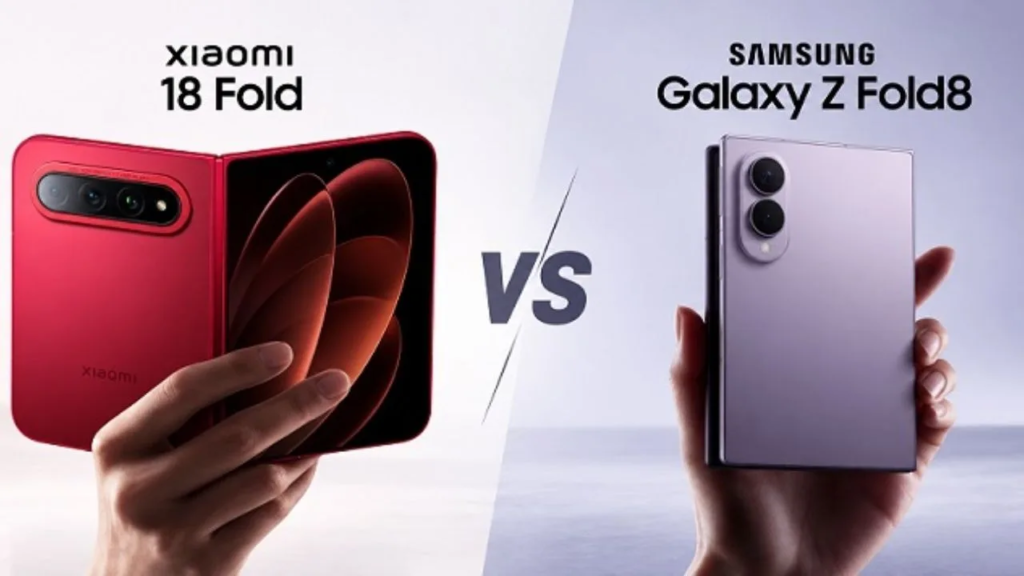
Xiaomi 18 Fold vs Galaxy Z Fold 8: Design and Display
The Xiaomi 18 Fold features a premium construction with Dragon Crystal Glass 3, a glass rear panel and an aluminium frame. It also comes with IP58/IP59 protection against dust and water.
Samsung’s Galaxy Z Fold 8 uses Gorilla Glass Ceramic 3 and Gorilla Glass Victus 2 along with an Armour Aluminium frame.
On the display front, Xiaomi’s foldable features a 7.58-inch LTPO AMOLED inner screen with a 120Hz refresh rate and peak brightness of up to 4,000 nits. The panel also supports HDR10+, Dolby Vision and HDR Vivid.
The Galaxy Z Fold 8 gets a slightly larger 7.6-inch Dynamic LTPO AMOLED 2X inner display with a 120Hz refresh rate and peak brightness of up to 3,000 nits.
For the outer screen, Xiaomi offers a 5.38-inch LTPO AMOLED cover display with a 120Hz refresh rate and up to 4,000 nits brightness. Samsung, on the other hand, features a 5.5-inch Dynamic LTPO AMOLED 2X cover display.
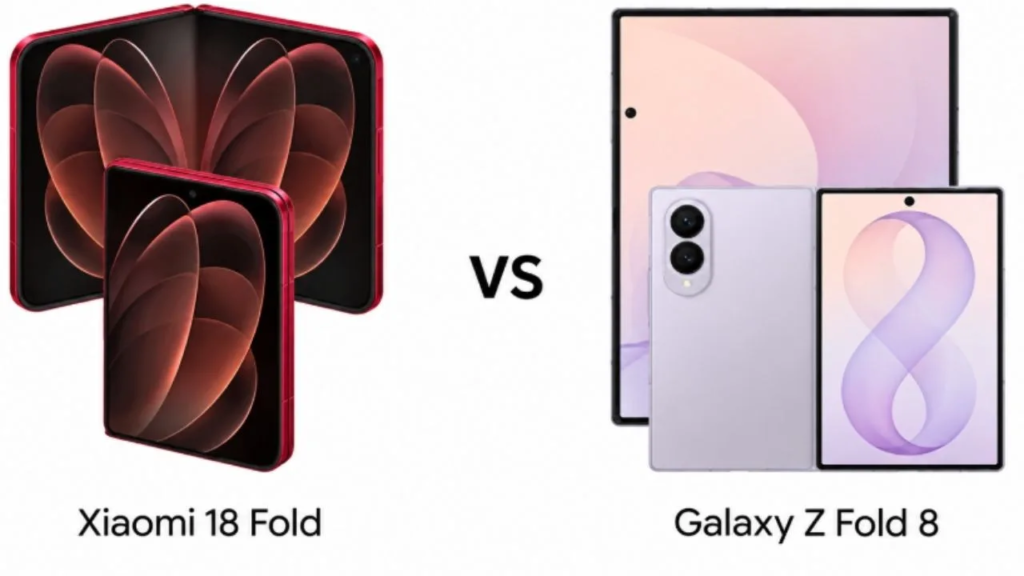
Processor, RAM and Storage
The Xiaomi 18 Fold is powered by the XRing O3 processor, built on a 3nm process and featuring a 10-core CPU. Samsung’s Galaxy Z Fold 8 uses the 3nm Snapdragon 8 Elite Gen 5 chipset.
Both smartphones are designed to handle demanding tasks such as gaming, multitasking and resource-intensive applications.
Xiaomi offers up to 16GB of RAM and up to 1TB of storage using UFS 4.1 technology. Samsung also provides configurations with up to 16GB RAM and 1TB storage. Xiaomi’s use of UFS 4.1 gives it an advantage in storage technology.
Camera, Battery and Charging
Camera hardware is another major difference between the two foldables. The Xiaomi 18 Fold features a 200MP Leica primary camera with OIS, along with a 50MP telephoto camera offering 3x optical zoom and a 50MP ultra-wide camera. A 16MP front camera is available for selfies.
The Galaxy Z Fold 8 comes with a 50MP OIS-supported camera and focuses strongly on video capabilities. It supports video recording at up to 8K at 30fps and 4K at 120fps. Xiaomi supports 8K video at 24fps and 4K at 60fps with Dolby Vision.
Battery capacity is another area where the Xiaomi model has a larger specification. It packs a 6,000mAh battery, compared with the 4,800mAh unit in the Galaxy Z Fold 8.
Xiaomi supports 67W wired charging and 50W wireless charging, while Samsung offers 45W wired and 20W wireless charging.
Xiaomi 18 Fold vs Galaxy Z Fold 8: Price
The Xiaomi 18 Fold is priced at approximately ₹1.55 lakh, while the Galaxy Z Fold 8 costs around ₹1.80 lakh.
The price difference is reflected in the hardware offered by both devices. Xiaomi focuses on features such as the 200MP Leica camera, larger 6,000mAh battery, 67W charging and 3x telephoto camera.
Samsung’s Galaxy Z Fold 8, meanwhile, emphasises its software experience, DeX functionality, long-term update support and broader foldable ecosystem.
Both smartphones therefore offer a different approach to the premium foldable category, with Xiaomi concentrating more on hardware specifications and Samsung putting greater emphasis on software and overall ecosystem integration.