
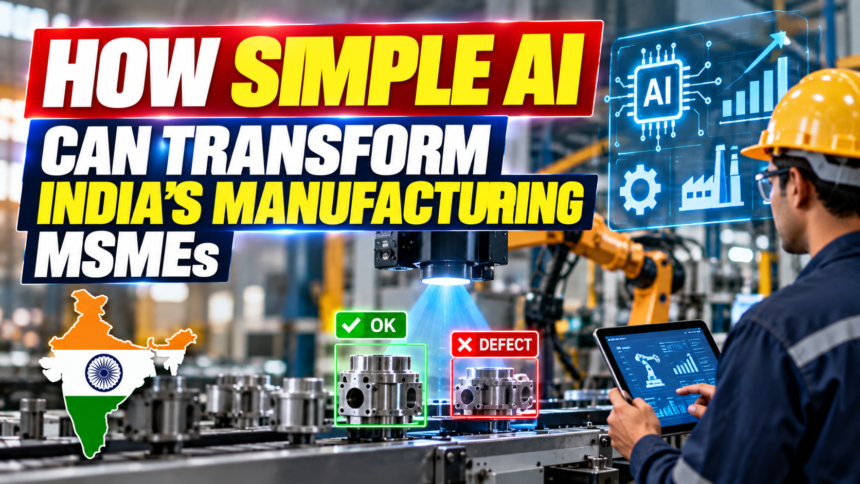
Artificial intelligence in Indian manufacturing is often discussed in terms of advanced models, predictive analytics and sophisticated dashboards. For many micro, small and medium enterprises (MSMEs), however, the more important questions are far more practical: Can AI identify a defect before a product leaves the factory? Can it warn about a shortage of raw materials? Can it be implemented without the need for a dedicated IT team?
These practical challenges could hold the key to AI adoption among MSMEs. Instead of focusing only on increasingly advanced technology, the greater opportunity lies in developing solutions that fit the existing realities of smaller businesses.
Practical AI Applications for MSMEs
MSMEs can use AI to address several operational challenges that have traditionally resulted in higher costs. Quality control is one such area. At many smaller manufacturing facilities, identifying defects still depends heavily on human inspection. This can become more difficult during high-volume production or night shifts, when maintaining consistent inspection can be challenging.
Vision-based AI systems can help identify anomalies in real time without requiring a dedicated data science team to analyse the results. In auto-component clusters, for example, such systems can identify defects as parts move along the production line instead of waiting for periodic manual inspections. This can help reduce rework and rejection rates.
Inventory management is another area where AI can provide practical benefits. Many MSMEs continue to rely on manual stock registers or basic spreadsheets. This can result in excess inventory or production disruptions caused by shortages. Lightweight AI tools that analyse historical order data and forecast consumption can provide smaller manufacturers with greater visibility into their future requirements.
Demand forecasting can similarly help businesses with limited working capital. More accurate estimates can allow MSMEs to better align production and purchasing with expected demand instead of maintaining large buffer stocks. AI-based workforce scheduling and productivity tracking can also help businesses make better use of limited manpower, particularly in labour-intensive industries such as textiles, auto components and food processing.
Infrastructure, Skills and Cost Remain Key Challenges
While the potential applications are relatively clear, AI adoption among MSMEs continues to face several structural challenges.
Digital infrastructure is one of the major constraints. Inconsistent connectivity and older machinery that is not connected to networks can make cloud-based AI systems difficult to deploy on smaller factory floors. Edge-based solutions, which process information on or close to the machine rather than relying on a remote server, can therefore offer a more practical approach.
Skills are another challenge. MSME teams are generally small, and technologies that require extensive training or a dedicated technical employee may struggle to move beyond the pilot stage.
Affordability is also a significant factor. Enterprise-level AI platforms are often designed and priced for large manufacturers, putting them beyond the financial and operational reach of many smaller businesses.
Simplicity Could Accelerate AI Adoption
For MSMEs, successful AI adoption may depend less on using the most sophisticated models and more on choosing solutions that are easy to implement and operate. Technologies that fit existing workflows, work with modest hardware and demonstrate value quickly are more likely to gain acceptance.
Cluster-based deployment could also help accelerate adoption. MSMEs operating within the same industry cluster often face similar challenges and share suppliers and business networks. They can also learn from each other’s experiences. When one company demonstrates measurable results from an AI application, other businesses in the same cluster can see a practical example instead of simply hearing about the technology in theory.
The central question, therefore, is not simply whether AI can function on a factory floor. It is whether AI solutions are being designed around the actual conditions and requirements of that factory floor.
A joint report by PwC India and the Observer Research Foundation estimates that AI could unlock nearly USD 150 billion in value for India’s manufacturing MSME value chain by 2035. The potential is significant, but achieving that value will depend on making AI practical, affordable and easy to use for the businesses that form this part of the manufacturing ecosystem.
Authored by Nakul Jain, CEO and Co-Founder, APLYD
Disclaimer: This article is based on the views and information provided by the author. The perspectives expressed are those of the author and do not necessarily represent the views of the publication.