
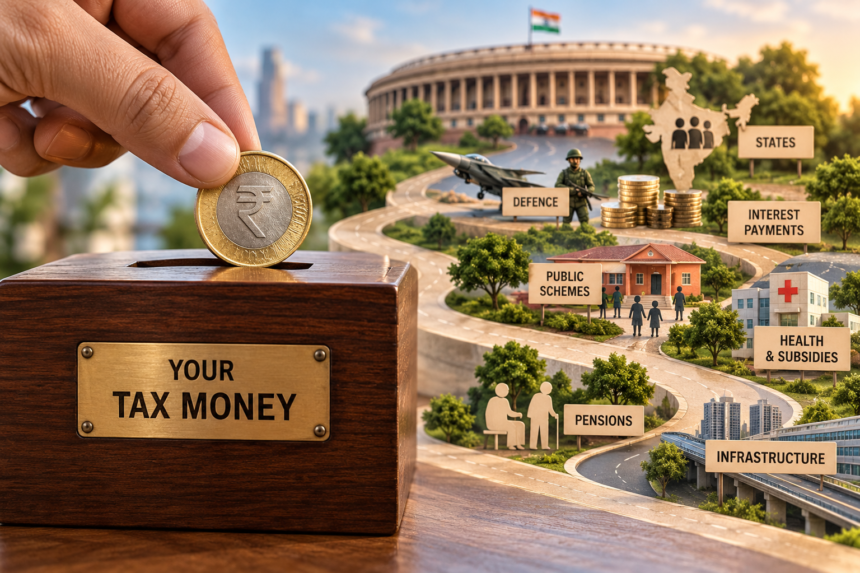
Where does your tax money go? It is a question most people rarely stop to ask. We see money leave our wallets every day, whether through GST on purchases or income tax deducted from our earnings. But once that money enters the government system, its journey becomes much harder to follow.
Consider a simple scene.
A father stops at a roadside tea stall and pays ₹20 for a cup of tea. His son asks him, “Papa, where does this money go?”
“The shopkeeper,” the father replies with a smile.
Technically, he is right. But the story does not end there.
The shopkeeper may use that ₹20 to purchase milk, sugar or tea leaves. The supplier pays another person, who pays a worker, and somewhere along this chain, taxes may also be paid. That single rupee continues moving from one person to another, carrying the value of someone’s work with it.
Public money follows a similar journey — only on a much larger and more complicated scale.
How Does Your Money Become Government Revenue?
Most people do not physically hand over cash to the government. Instead, government revenue is collected through various channels.
GST is included in the price of many goods and services people purchase. Income tax is paid by eligible individuals based on their earnings. Businesses and other economic activities also contribute to government revenues through different taxes and duties.
Millions of these individual contributions eventually become part of the government’s pool of resources.
The important question is: once that money reaches the government, where does it go?
Imagine the Government Has Just ₹1
The Union Budget offers a useful way to understand the broad direction of government spending.
Imagine, for simplicity, that the government has only ₹1 to spend.
Around 22 paise goes to state governments as their share of central tax collections. Roughly 20 paise is used to pay interest on government borrowings. Around 17 paise goes towards centrally sponsored and central sector schemes, while about 11 paise is allocated to defence.
Another 8 paise goes towards schemes implemented jointly with states. Around 7 paise represents other transfers recommended through the Finance Commission. Approximately 6 paise is spent on subsidies, including food and fertiliser subsidies.
The remaining amount goes towards areas such as general government administration and pensions.
These numbers may appear abstract on a Budget document. But viewed differently, they tell a story about how public money travels.
Your Rupee Can Travel Far Beyond Your City
The tax paid by one citizen does not necessarily return to that same person as a direct benefit.
A portion of the money can reach a state government. Another part may support a government scheme. Some may contribute towards national defence, subsidies or the cost of servicing government debt.
That means a person’s contribution can ultimately support something far removed from their immediate surroundings.
A taxpayer in a large city may contribute to a road project in a rural area. Government funds may help provide a school meal to a child in another district. A subsidy may support a family the taxpayer has never met.
This is one of the defining characteristics of public money: the person who contributes is often different from the person who eventually benefits.
Why Government Spending Is Everyone’s Concern
It can be easy to think of government funds as money belonging to someone else.
But public revenue ultimately comes from the economic activity of citizens, businesses and other sources governed by law. The Constitution also establishes that taxes cannot be imposed or collected without legal authority.
Government spending, similarly, operates through constitutional, legislative and legal processes.
The underlying principle is straightforward: public money is supposed to be used for public purposes.
That is why citizens have a legitimate interest in understanding how government revenue is collected and how it is eventually spent.
Should Citizens Question Government Spending?
Imagine handing over ₹100 of your own money and receiving nothing in return. Most people would immediately want to know what happened.
If a shopkeeper charges you more than expected, you would probably ask for an explanation.
So why should that curiosity disappear when money becomes public revenue?
Questioning government spending does not necessarily mean distrusting the government. Nor does responsible citizenship require accepting every government decision without examination.
There is a middle ground: stay informed and pay attention.
Citizens can ask simple but important questions:
- Where did the money come from?
- Where was it allocated?
- What was the money intended to achieve?
- Did the programme or project deliver the promised outcome?
- If it did not, who is responsible for explaining the failure?
These questions are not limited to economists, policymakers or financial experts.
Understanding Public Money Is Part of Citizenship
A farmer can ask where government funds are being spent. A student can question how public schemes work. A shopkeeper can examine how taxes affect business. A retired person can ask how pension spending is determined.
Even a child asking, “Where does the money go?”, is beginning with a question that lies at the heart of public accountability.
Democracy is not limited to casting a vote during an election. It also involves understanding how the institutions we elect function and how the money collected from society is used.
The Money We Don’t See Still Belongs to Our Story
The roads we travel on, government schools, public hospitals, welfare programmes, pensions, subsidies and national security are all connected to public finances.
These are not abstract government activities happening somewhere far away. They form part of the system in which citizens live every day.
We are usually careful about tracking our personal income and expenses. Perhaps we should develop the same habit when it comes to public finances.
Not because every government expenditure should automatically be viewed with suspicion, but because understanding public spending creates accountability.
A rupee does not stop being important simply because it leaves your wallet.
Once it becomes part of the public purse, citizens still have a stake in knowing how it is used.
In a democracy, following the journey of that rupee is not just about money. It is about responsibility, accountability and citizenship.