
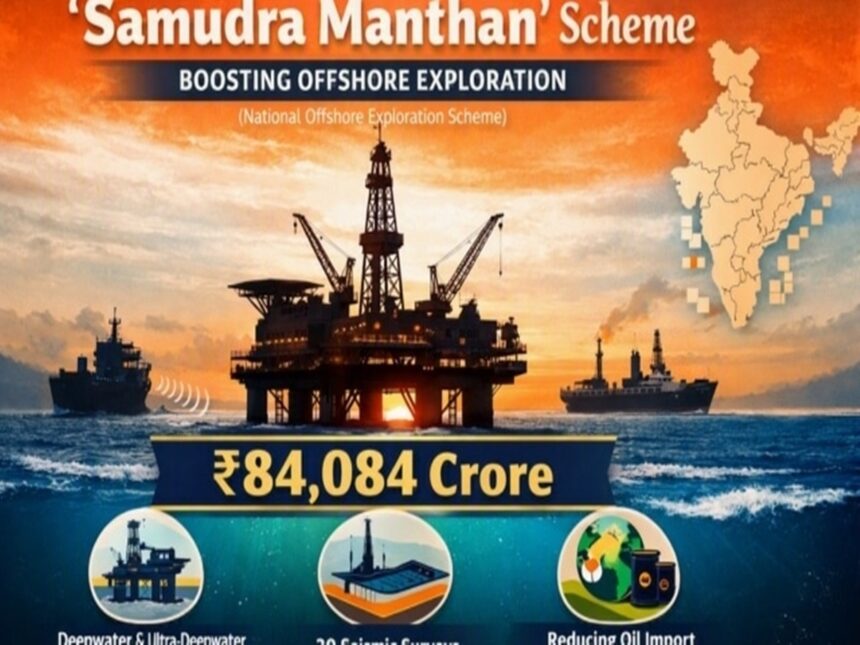
India has unveiled Samudra Manthan, one of its most ambitious offshore energy initiatives, with the aim of discovering new reserves of crude oil and natural gas beneath the country’s seas. Backed by an investment of ₹84,084 crore, the programme is designed to reduce India’s dependence on imported energy and strengthen long-term energy security.
Officially called the National Offshore Exploration Scheme, the project will be implemented until FY 2030-31 and will focus on exploring deepwater and ultra-deepwater regions that are believed to hold significant untapped hydrocarbon reserves.
Why Is It Called Samudra Manthan?
The name Samudra Manthan draws inspiration from the ancient Hindu mythological tale of the “churning of the ocean,” a story that symbolizes the search for hidden treasures. The government says the initiative reflects Prime Minister Narendra Modi’s vision of a modern-day Samudra Manthan, first highlighted during his 2025 Independence Day address, to unlock India’s offshore energy wealth.
Why Does India Need Samudra Manthan?
India remains heavily dependent on imported energy. At present, the country imports nearly 88–89% of its crude oil requirements and around half of its natural gas, making it vulnerable to global price fluctuations and supply disruptions.
Although India has several offshore sedimentary basins with the potential to contain large oil and gas reserves, many of these areas remain unexplored due to the high costs, technological challenges, and risks involved in deep-sea exploration.
Through Samudra Manthan, the government aims to bridge this gap by funding the initial stages of exploration, making offshore projects more attractive for investors and energy companies.
What Will Samudra Manthan Do?
The programme will support a wide range of activities required for offshore exploration and production, including:
- Large-scale seismic surveys to map potential oil and gas reserves
- Geological and geophysical studies of offshore basins
- Exploratory drilling in deepwater and ultra-deepwater regions
- Scientific drilling in frontier offshore areas
- Development of shared offshore production and evacuation infrastructure
- Creation of an Integrated Oil & Gas Manufacturing and Services Zone
- Adoption of advanced exploration technologies and digital monitoring systems
- Capacity building and skill development for the offshore energy sector
By generating high-quality geological data, the government hopes to identify commercially viable hydrocarbon reserves while encouraging greater private and public investment in offshore exploration.
Expected Benefits Of The Mega Project
According to government estimates, Samudra Manthan has the potential to add more than 600 million metric tonnes of oil equivalent (MMTOE) to India’s hydrocarbon reserves over time.
While commercial production is expected to take several years, successful discoveries could deliver multiple long-term benefits, including:
- Reduced dependence on imported crude oil and natural gas
- Improved energy security for the country
- Higher investments across the oil and gas sector
- Job creation in exploration, engineering, manufacturing and related industries
- Stronger offshore infrastructure and technological capabilities
A Strategic Step Towards Energy Independence
Samudra Manthan represents one of India’s largest investments in offshore energy exploration. By combining advanced technology, scientific research and infrastructure development, the government aims to unlock untapped marine resources and build a more resilient energy future.
Although the results will take time, the initiative could play a crucial role in reducing import dependence, strengthening India’s energy ecosystem, and supporting the country’s growing demand for oil and natural gas in the decades ahead.