
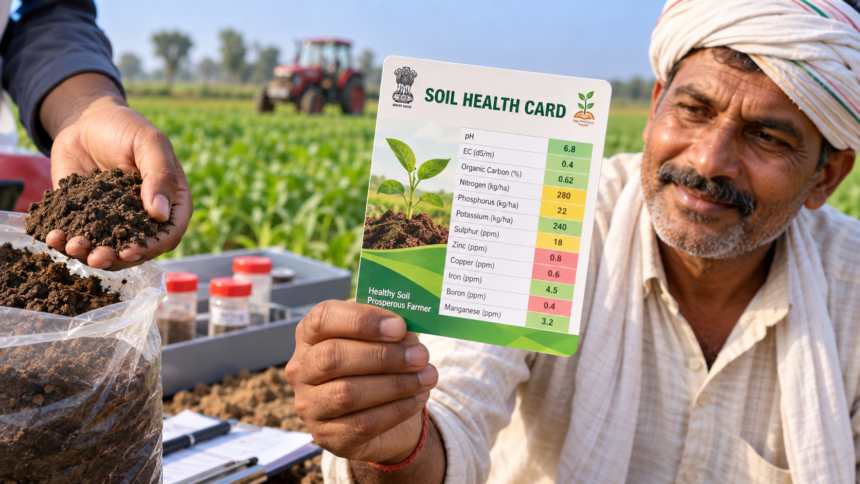
The Soil Health Card Scheme is a Government of India initiative designed to help farmers understand the nutrient condition of their agricultural land and make informed decisions about fertiliser use. The scheme has been implemented across several states and Union Territories, including Uttar Pradesh.
Under the programme, farmers receive information about the nutrients present in their soil, along with recommendations on fertilisers and other measures needed to improve and maintain soil health. The Soil Health Card provides an assessment based on 12 parameters, including pH, electrical conductivity, organic carbon, nitrogen, phosphorus, potassium, sulphur, zinc, copper, iron, boron and manganese.
Based on the test results, recommendations are provided on the quantity of nutrients and fertilisers required for the farmer’s land.
How Is Soil Tested Under the Scheme?
Soil samples are generally collected by trained personnel from a depth of 15 to 20 centimetres. Samples are taken from different points of the field, mixed properly and then a representative sample is sent to a soil testing laboratory for analysis.
The sampling process follows designated grids covering 2.5 hectares in irrigated areas and 10 hectares in rain-fed areas. GPS tools and revenue maps may be used as part of the sampling process.
Testing is carried out at government soil testing laboratories. Depending on the arrangements, samples can also be analysed at ICAR institutions, including Krishi Vigyan Kendras and State Agricultural Universities, as well as other authorised laboratories.
Why Is the Soil Health Card Important for Farmers?
The Soil Health Card helps farmers determine fertiliser requirements based on the actual nutrient status of their soil. This can support more balanced nutrient management and encourage the appropriate use of fertilisers according to the needs of individual fields.
The card also provides recommendations on fertiliser quantities and soil amendments required to improve soil health and fertility.
A Soil Health Card is generally provided once during a three-year cycle. The results from subsequent cycles can help track changes in the nutrient condition of the soil over time.
For farmers in Uttar Pradesh and other participating regions, the scheme provides a soil-testing-based approach to nutrient management, helping them understand the fertiliser requirements and soil-management measures applicable to their fields.
Disclaimer
This article is based on information available through the official Soil Health Card programme and is intended for general informational purposes. Recommendations for fertilisers and soil management may vary according to individual soil-test results, crops and local agricultural conditions. Farmers should follow the recommendations provided on their Soil Health Card and consult the relevant agricultural authorities or experts for field-specific guidance.