
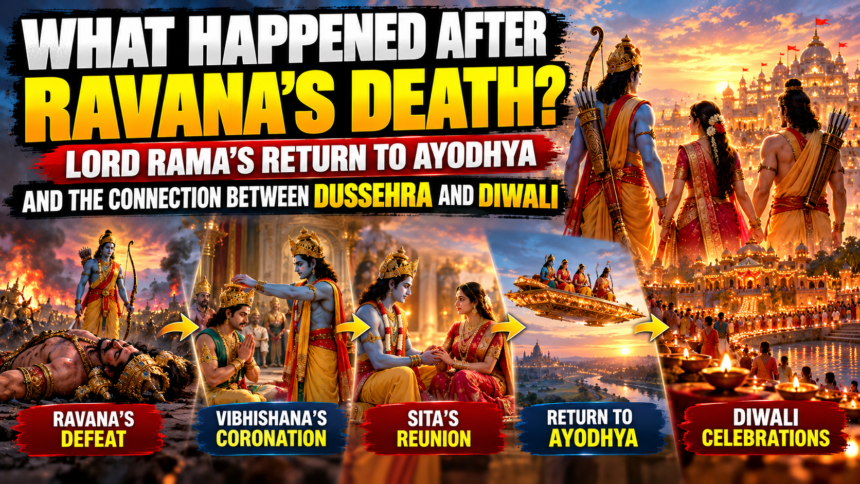
Ravana’s death marked a major turning point in the Ramayana, but it did not bring the story to an immediate close. After defeating the king of Lanka, Lord Rama still had to reunite with Sita, establish a new ruler in Lanka and return to Ayodhya after completing his fourteen-year exile.
The events that followed his victory explain the close connection between Dussehra and Diwali in Hindu tradition. While Dussehra commemorates Rama’s triumph over Ravana, Diwali is traditionally associated with Rama, Sita and Lakshmana returning to Ayodhya.
From Vibhishana’s coronation to the celebrations welcoming Rama home, the story explores the restoration of order, the responsibilities of leadership and the challenges of balancing personal relationships with public duty.
What Happened Immediately After Lord Rama Defeated Ravana?
After a fierce battle, Lord Rama defeated Ravana, bringing the war in Lanka to an end. Ravana’s death symbolised the defeat of the ruler who had abducted Sita and caused suffering through his actions.
Rama then arranged for Vibhishana, Ravana’s younger brother, to become the new king of Lanka. Vibhishana had opposed Ravana’s decision to abduct Sita and had repeatedly urged him to return her. Eventually, he joined Rama’s side.
Vibhishana’s coronation marked the beginning of a new chapter for Lanka under a ruler who had supported Rama’s cause.
The episode also highlights an important aspect of Rama’s victory. The aim was not to destroy the entire kingdom or punish its people, but to defeat wrongdoing and restore just leadership. The establishment of a new king represented the return of order after the war.
What Happened to Sita After Ravana’s Death?
Following Ravana’s defeat, Sita was reunited with Rama. However, the Valmiki Ramayana describes this reunion as a difficult episode rather than a straightforward moment of happiness.
Rama expressed concerns about how the public might view Sita after her time in Ravana’s captivity. In response, Sita entered the fire in the episode traditionally known as Agni Pariksha. According to the narrative, Agni, the deity of fire, affirmed her purity, after which Rama accepted her.
This episode has been interpreted in different ways across Ramayana traditions. It continues to raise questions about honour, gender, public expectations and the responsibilities associated with royal life. Some later devotional versions also present alternative explanations of these events.
The episode makes clear that Ravana’s defeat did not instantly resolve every difficulty. Even after the war, Rama and Sita faced a challenging situation shaped by personal relationships and public perceptions.
How Did Lord Rama Return to Ayodhya?
After the war ended and Sita was reunited with him, Rama prepared to return to Ayodhya with Sita and Lakshmana. They travelled in the Pushpaka Vimana, the celestial aerial vehicle associated with Ravana that came into Rama’s possession following his victory.
The journey marked the conclusion of Rama’s fourteen-year exile. During the return, Rama met the sage Bharadvaja, while Hanuman travelled ahead to inform Bharata that Rama was coming home.
Bharata had been ruling Ayodhya on Rama’s behalf. He had kept Rama’s sandals on the throne as a symbol of his elder brother’s rightful authority and remained committed to handing the kingdom back when Rama returned.
The reunion of the brothers brought an end to their long separation and paved the way for Rama’s return to his responsibilities as king.
Rama’s Return to Ayodhya and the Significance of Diwali
Rama’s arrival in Ayodhya was celebrated with great joy. After completing his exile and defeating Ravana, he returned home to a welcome that marked the end of a long period of separation and uncertainty.
Rama was crowned king in a ceremony known as Pattabhisheka, with Sita beside him. His reign became associated with Rama Rajya, an ideal of governance based on righteousness, justice and concern for the welfare of the people.
In popular Hindu tradition, Rama’s return to Ayodhya is closely linked with Diwali. It is widely believed that people lit rows of oil lamps to welcome Rama, Sita and Lakshmana home. This tradition connects Diwali with homecoming, hope and the triumph of light over darkness.
The two festivals therefore carry related but distinct meanings. Dussehra commemorates Rama’s victory over Ravana, while Diwali celebrates his return and the restoration of rightful rule.
Does the Ramayana End With Ravana’s Defeat?
No. Although Rama’s victory, return to Ayodhya and coronation bring the main war narrative towards its conclusion, the Valmiki Ramayana continues with the Uttara Kanda, its final book.
This section recounts later events, including Sita’s exile, the birth of Lava and Kusha, and the final phase of Rama’s life. These episodes are treated differently across various Ramayana traditions. Some scholars also regard the Uttara Kanda as a later addition to earlier layers of the epic.
The events following Ravana’s death give a deeper meaning to both Dussehra and Diwali. They show that victory is not simply about defeating an enemy; it also involves rebuilding, reconciliation and governing with responsibility.
Rama’s return to Ayodhya completes an important chapter of the Ramayana, while the wider epic continues to inspire reflection on dharma, leadership, duty and the challenges of making difficult choices.
Disclaimer: This article presents traditional accounts from the Ramayana for general informational and cultural purposes. Details and interpretations may vary across religious texts, regional traditions and devotional retellings. Readers are encouraged to explore different versions of the epic to understand its diverse perspectives.