
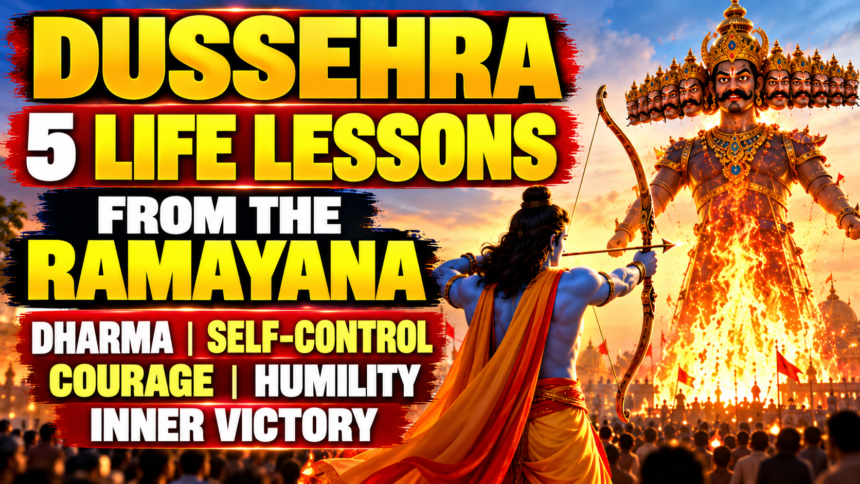
Every year, Dussehra is celebrated across India with the burning of Ravana’s effigies, fireworks and stories of Lord Rama’s victory. While the festival marks the triumph of good over evil, its significance goes beyond the defeat of a powerful king. It also encourages us to reflect on our own actions, choices and weaknesses.
The Ramayana presents an important question: How could Ravana, despite his knowledge, strength and devotion, meet such a tragic end? The story offers enduring lessons about dharma, self-control, courage and humility. These teachings make Vijayadashami an opportunity to look within ourselves and consider how our everyday decisions influence our lives.
1. Dharma Means Doing the Right Thing, Even When It Is Difficult
Dharma is commonly understood as righteousness, duty and moral responsibility. In the Ramayana, Lord Rama repeatedly faces situations that test his commitment to these principles.
The message of Dussehra is that the right choice is not always the most convenient one. It may require admitting a mistake, rejecting an unfair advantage or speaking up when staying silent would be easier.
Life does not always offer simple answers, and people may disagree about the best course of action. However, the lesson remains that convenience and personal benefit should not be the only factors guiding our decisions.
2. Self-Control Is Stronger Than Unchecked Desires
Ravana’s downfall is one of the Ramayana’s most significant warnings. Despite being known for his knowledge, power and devotion to Lord Shiva, his decision to abduct Sita and his refusal to correct his actions ultimately lead to devastating consequences.
His story highlights what can happen when desire takes priority over judgement. Uncontrolled anger, jealousy and selfishness can harm personal relationships, professional lives and peace of mind.
Self-control does not mean ignoring emotions. Instead, it involves pausing before acting, considering the consequences and making thoughtful decisions. Sometimes, the greatest personal achievement is the ability to resist an impulse that could cause harm.
3. True Courage Means Standing Up for What Is Right
Lord Rama’s struggle against Ravana represents courage and determination in the face of a formidable challenge. The story is not only about physical strength but also about the willingness to fulfil a difficult responsibility.
In everyday life, courage can take many forms. It may mean speaking honestly, establishing healthy boundaries, asking for help or supporting someone who is being treated unfairly.
Dussehra reminds us that being courageous does not mean never feeling afraid. It means choosing to act responsibly despite uncertainty or discomfort, rather than turning away from a situation that requires our attention.
4. Humility Is Essential, No Matter How Successful You Become
Ravana is remembered in the Ramayana as a powerful ruler and a learned figure. His downfall demonstrates that knowledge and strength alone cannot protect someone whose decisions are shaped by pride and a disregard for moral boundaries.
The lesson is not that ambition or achievement is wrong. Rather, success can become a weakness when it leads a person to believe that they are always right or have nothing left to learn.
Humility means being willing to accept feedback, consider different viewpoints and acknowledge personal mistakes. Listening to advice, even when it is difficult to hear, can help prevent errors that confidence alone cannot correct.
5. The Greatest Victory Begins Within Us
The burning of Ravana’s effigy is one of the most recognisable traditions of Dussehra. However, the deeper message of the ritual lies in the habits and attitudes that Ravana represents.
Anger, jealousy, resentment and selfishness can influence everyday choices if they are left unchecked. The struggle between right and wrong is therefore not limited to the battlefield described in the Ramayana. It can also appear in our relationships, workplaces and personal decisions.
Changing these patterns requires more than a single day’s celebration. It calls for honest self-reflection, consistent effort and the willingness to accept responsibility for our behaviour. Ravan Dahan becomes more meaningful when its message encourages positive changes in our daily lives.
What Is the Deeper Spiritual Meaning of Dussehra?
Dussehra, also known as Vijayadashami, celebrates Lord Rama’s victory over Ravana. Another major tradition associated with the festival honours Maa Durga’s triumph over Mahishasura. Both stories symbolise the victory of good over evil and the restoration of righteousness.
Their message also encourages people to reflect on how they use their power, respond to temptation, treat others and confront their own shortcomings.
The deeper meaning of Dussehra is not limited to celebrating the defeat of evil in an ancient story. It is also an invitation to recognise harmful habits, make better choices and work towards becoming more responsible and compassionate individuals.
Ultimately, the festival reminds us that meaningful victory begins within. When we learn to control our impulses, remain humble, act with courage and follow the path of righteousness, we bring the message of Dussehra into our everyday lives.
Disclaimer: This article explores the cultural, spiritual and moral lessons traditionally associated with Dussehra and the Ramayana. Interpretations of religious stories may differ across communities and traditions. The content is intended for general informational purposes and should not be taken as a substitute for personal religious guidance.