
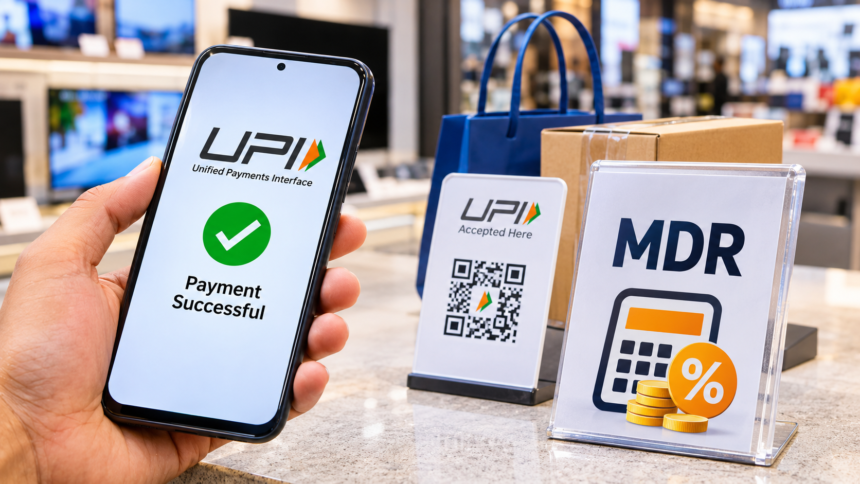
Customers making high-value purchases through UPI may have several questions about refunds and payment charges following the proposed introduction of Merchant Discount Rate (MDR) on certain large transactions. One of the biggest concerns is whether customers will receive their full money back if they cancel an order or return a product after making a UPI payment.
Under the proposed framework, a merchant may have to pay MDR on selected UPI transactions above ₹2,000. However, this charge is intended to be collected from merchants, not customers. Businesses will not be permitted to recover this processing fee separately from buyers.
Here is what customers and merchants need to know about UPI charges, refunds, failed payments and partial cancellations.
UPI MDR Charges Above ₹2,000: How Much Will Merchants Pay?
Under the proposed MDR structure, selected merchant transactions exceeding ₹2,000 will attract a processing charge of 0.4%.
For transactions worth ₹75,000 or more, the MDR will be capped at ₹300. This means the applicable charge will not increase beyond this limit.
For example, if someone purchases a television worth ₹50,000 through UPI, the merchant’s MDR at 0.4% will amount to ₹200.
Similarly, a transaction of ₹1 lakh would normally attract ₹400 at the same rate. However, because of the proposed cap, the merchant would pay only ₹300.
It is important to understand that this charge will not apply to every UPI transaction or every merchant. Small businesses and certain essential services are expected to have different applicable rates and exemptions.
Will Customers Receive a Full Refund After Cancelling an Order?
One of the most common concerns is whether MDR will be deducted from the customer’s refund.
Consider a situation where you purchase a laptop worth ₹50,000 and pay the entire amount through UPI. If you later cancel the order, you should receive the full ₹50,000, subject to the merchant’s applicable cancellation and refund policy.
The MDR of ₹200 is a processing expense payable by the merchant. It cannot simply be deducted from the customer’s refund.
In other words, the merchant should not return ₹49,800 by subtracting the MDR from the original payment. The customer paid ₹50,000, and the merchant’s processing charge is a separate business expense.
However, the exact settlement procedure will depend on the final rules governing the proposed MDR framework.
Will Merchants Get Their MDR Charges Back After a Refund?
The situation is different for merchants. When a customer successfully completes a UPI payment and subsequently returns the purchased product, there is a question about whether the merchant will receive a refund of the MDR already paid.
The proposed framework does not yet provide clear details about how these processing charges will be handled in every refund situation.
Merchants may have to bear the original processing cost even when a transaction is later reversed. Similar concerns also arise with card payments, where merchants generally do not receive the original processing fee back after a product return.
Clear guidelines will be needed to explain how MDR adjustments will work for both full and partial refunds.
What Happens If UPI Money Is Deducted but Payment Fails?
Sometimes, a UPI transaction fails even though the money has already been deducted from the customer’s bank account. In such cases, the merchant may not receive the payment confirmation.
According to the RBI’s prescribed turnaround-time framework, if a UPI payment fails because the beneficiary merchant does not receive confirmation, the amount must be reversed within T+5 days.
If the money is not credited back within the prescribed period, the customer may be entitled to compensation of ₹100 per day for the delay.
Since the merchant has not received the payment in such a failed transaction, there should be no basis for charging MDR on it.
How Will MDR Work in the Case of Partial Refunds?
Partial refunds could create additional complications under the proposed MDR system.
For example, suppose a customer purchases an item worth ₹2,500 and pays through UPI. At an MDR rate of 0.4%, the merchant’s processing charge would be ₹10.
Later, the customer returns an item worth ₹600 and receives a partial refund. The remaining sale value becomes ₹1,900, which is below the proposed ₹2,000 threshold.
This raises an important question: Will the original ₹10 MDR remain applicable, or will the merchant receive a full or partial adjustment?
The proposed framework does not yet provide a clear calculation method for such situations. This could create additional accounting and settlement challenges for merchants and payment service providers.
Will Customers Have to Pay Extra for UPI Transactions?
No. Under the proposed arrangement, MDR is a merchant-side charge and cannot be collected separately from customers.
NPCI has also clarified that customers should not face additional payment charges for using UPI.
According to the government’s estimates, approximately 96% of merchant transactions will remain unaffected by the proposed changes. The revised MDR structure is primarily intended to cover selected high-value merchant transactions.
When Will the New UPI MDR Rules Come Into Effect?
The proposed MDR framework has undergone changes in its implementation schedule. The original rollout was scheduled for October 15, 2026. The supplied report also mentions an October 13 revision and a subsequent plan to introduce the framework after Diwali.
However, as of November 14, 2026, a final official implementation date had not been announced, according to the report.
Customers and merchants are therefore awaiting further clarification regarding the effective date, refund adjustments and detailed payment settlement procedures.
Disclaimer
This article is intended for general informational purposes only. The MDR rates, transaction limits, refund procedures and implementation dates discussed are based on the information provided in the report and may be subject to changes or official clarification. The proposed framework should not be treated as a final regulation unless formally notified by the relevant authorities. Customers and merchants should refer to official RBI and NPCI announcements for the latest applicable rules.