
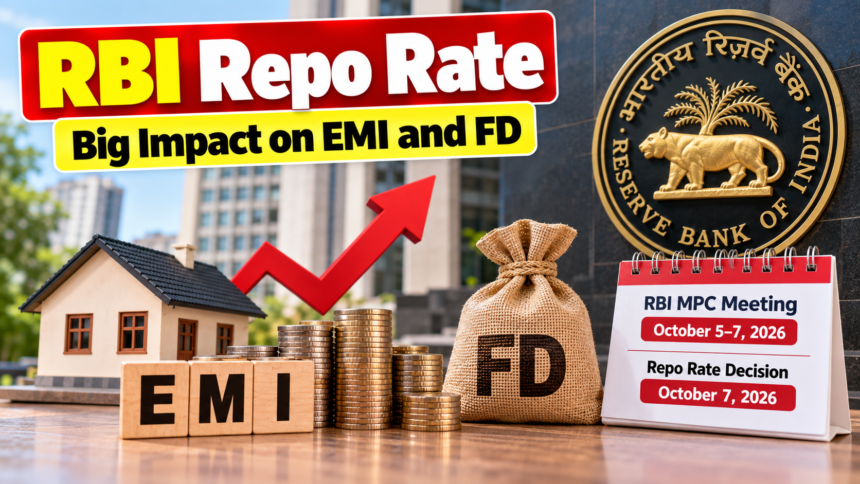
The Reserve Bank of India’s upcoming Monetary Policy Committee (MPC) meeting is being closely watched by borrowers, savers and investors. The six-member MPC is scheduled to meet from October 5 to 7, 2026, with the decision on the policy repo rate expected on October 7.
The repo rate currently stands at 5.25% after the RBI kept it unchanged in its August policy meeting. The October review comes amid concerns around inflation, crude oil prices and external economic pressures. Some analysts have discussed the possibility of a rate hike, but the final decision will be taken by the MPC on October 7.
What Is the RBI Repo Rate?
The repo rate is the rate at which the RBI lends money to banks for short-term requirements. When this benchmark rate changes, it can influence the cost at which banks raise funds and, in turn, affect lending and deposit rates.
A 25-basis-point (0.25 percentage point) increase could put pressure on borrowers with floating-rate loans. However, the exact impact on an individual loan depends on the lender, the loan’s interest-rate structure, outstanding principal and remaining tenure.
For example, on a ₹50 lakh home loan for 20 years, an increase in the interest rate from 8.50% to 8.75% would raise the estimated EMI from around ₹43,391 to ₹44,186. That works out to an increase of roughly ₹795 per month. This is only an illustration, as banks may not immediately or fully pass on every repo-rate change to all customers.
How Could a Repo Rate Hike Affect EMIs?
If the RBI raises the repo rate, floating-rate borrowers could see their borrowing costs increase, depending on how their bank passes on the change.
Home loans are among the major floating-rate loans that can be affected. Certain auto and personal loans may also be linked to benchmarks that respond to changes in the broader interest-rate environment.
Borrowers with fixed-rate loans, however, generally do not see their contracted interest rate change simply because the RBI changes the repo rate.
The impact of a rate hike would therefore vary from borrower to borrower rather than producing the same EMI increase for everyone.
What If the RBI Keeps the Repo Rate Unchanged?
If the MPC leaves the repo rate at 5.25% on October 7, there would be no immediate repo-rate-driven change for borrowers solely because of that decision.
Existing floating-rate loan rates could remain broadly unchanged unless the bank makes a separate adjustment based on its applicable benchmark or other lending conditions. Existing fixed deposits would also continue to earn the interest rate agreed at the time they were booked.
The August MPC meeting had already left the repo rate unchanged at 5.25%, making the October decision an important one for the direction of interest rates in the coming months.
What Could Happen If the RBI Cuts the Rate?
A repo-rate reduction could provide some relief to borrowers with eligible floating-rate loans. Depending on the loan structure and the way the lender passes on the reduction, borrowers could see a lower EMI or a reduction in the remaining loan tenure.
For fixed-deposit investors, however, a lower repo rate could eventually put downward pressure on rates offered on new FDs. This means people opening fresh deposits in the future could receive lower interest rates than those available before a rate-cut cycle.
The existing FD rate generally remains fixed for the agreed tenure, subject to the terms and conditions of the deposit.
The RBI’s October 7 announcement will therefore be important for both borrowers and savers. Until the MPC announces its decision, any expectation of a rate hike, cut or unchanged policy rate remains a forecast rather than a confirmed outcome.
Disclaimer
This article is intended for general informational purposes and does not constitute financial or investment advice. RBI policy decisions, loan rates and FD interest rates can change, and the actual impact on an individual may vary depending on the bank, loan or deposit terms. Readers should check the latest information with their bank or the RBI before making financial decisions.