
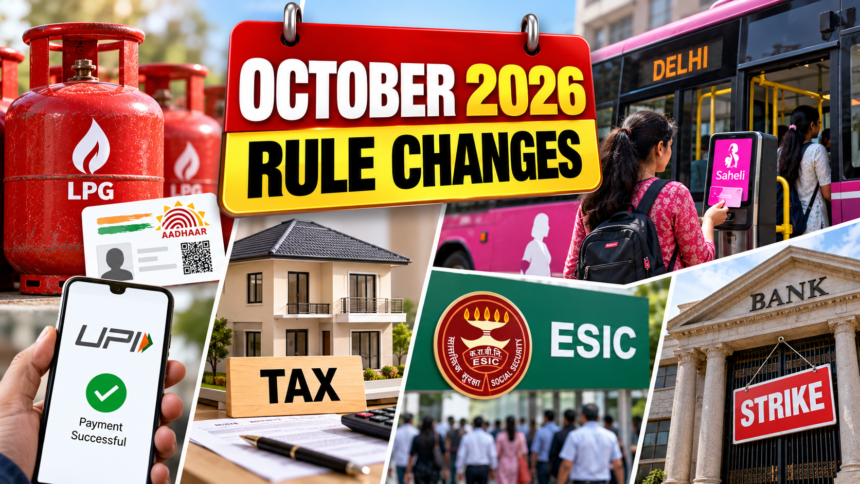
October 2026 is set to bring several changes that could affect household expenses, digital payments, property transactions, employee benefits and public transport. Some of the changes will directly affect consumers, while others are aimed at simplifying compliance or expanding social-security coverage.
Among the key changes are mandatory biometric Aadhaar authentication for subsidised domestic LPG refills, a new MDR framework for certain high-value UPI merchant payments, easier TDS compliance for eligible property buyers dealing with non-resident sellers, expanded ESIC coverage in parts of Madhya Pradesh and a new smart-card requirement for free bus travel in Delhi.
LPG Subsidy to Require Biometric Aadhaar Authentication
From October 1, 2026, domestic LPG consumers will need to have completed Biometric Aadhaar Authentication (BAA) to book refills at the regulated retail selling price with the applicable subsidy.
According to the Ministry of Petroleum and Natural Gas, 27.43 crore active domestic LPG consumers, or 89.9% of the total, had already completed the authentication as of September 19. Consumers who have already completed BAA do not need to repeat the process.
Those who have not completed authentication can do so during LPG delivery, by visiting their distributor’s showroom or through the mobile applications of the respective oil marketing companies. Indane customers can use IndianOil ONE, Bharatgas customers can use HelloBPCL and HP Gas customers can use the HP PAY app.
The government has estimated the implicit subsidy on a 14.2-kg domestic LPG cylinder at around ₹210 for September 2026. Consumers who do not complete the authentication can still obtain LPG, but the government says they will have to receive it at the applicable market price without subsidy, subject to the available supply options.
UPI Rules and Property TDS Process Will Change
Another important change concerns UPI merchant payments. From October 15, a 0.4% Merchant Discount Rate (MDR) will apply to specified person-to-merchant transactions above ₹2,000. For transactions of ₹75,000 or more, the MDR will be capped at ₹300 per transaction.
Regular person-to-person UPI transfers will remain free, while merchant payments of up to ₹2,000 and transactions covered under the zero-MDR framework for small merchants will also remain free. The government estimates that around 96% of P2M transactions will remain unaffected.
The MDR is a payment-system charge shared among participants in the UPI ecosystem and is not a tax collected by the government.
There is also a change in the tax-compliance process for certain property purchases. From October 1, resident individuals and Hindu Undivided Families (HUFs) buying immovable property from non-resident sellers will no longer need to obtain a separate TAN solely for this TDS compliance. Instead, a PAN-based mechanism through the amended Form 141, including a new Schedule E, will be used.
The important point is that the TDS obligation itself continues. The October change simplifies the process for eligible resident individual and HUF buyers; it does not mean that TDS on purchases from non-resident sellers has been abolished.
ESIC Coverage to Expand in 24 Madhya Pradesh Districts
Employees and employers in specified areas of 24 Madhya Pradesh districts will come under the applicable Employees’ State Insurance Corporation contribution framework from October 1, 2026.
The Ministry of Labour and Employment notified the change on September 22. The affected areas are being brought under the ESIC framework, making the relevant establishments and employees subject to the applicable contribution requirements and eligible for benefits under the scheme.
The 24 districts covered by the notification are Agar Malwa, Alirajpur, Anuppur, Ashoknagar, Balaghat, Barwani, Betul, Chhatarpur, Damoh, Datia, Harda, Jhabua, Mandla, Narsinghpur, Panna, Rajgarh, Seoni, Sheopur, Shivpuri, Sidhi, Tikamgarh, Umaria, Vidisha and Dindori.
The expansion primarily concerns health and social-security coverage. Applicable contributions will be made by employers and employees according to the ESIC rules.
Delhi Free Bus Travel to Require Saheli Pink Smart Card
Delhi is also changing the system used for free bus travel. The existing paper-based pink ticket arrangement has been extended until September 30. From October 1, eligible women and transgender residents will need to tap a Saheli Pink Smart Card on the electronic ticketing machine to claim free travel on DTC and Cluster buses.
Passengers who do not have the required smart card will have to purchase a regular ticket and pay the applicable fare.
The first Saheli Pink Smart Card is issued free of charge. A replacement card for one that is lost or damaged costs ₹59, while the card is valid for five years. Applicants need an Aadhaar card and a mobile number linked to Aadhaar.
Bank Strike Proposal May Affect Services in October
Banking services could also face disruption later in October if the proposed indefinite strike by bank unions goes ahead.
The United Forum of Bank Unions and other unions have proposed an indefinite strike from October 26, 2026, with the principal unresolved demand being the implementation of a five-day banking week. The government has held discussions with the unions and has urged them to resolve the remaining issues through dialogue.
A separate three-day strike has already been scheduled for September 28–30. The October 26 action is therefore a proposed future strike and should not be treated as a confirmed bank holiday or closure at this stage.
Customers with important branch-based work should check their bank’s official communication before visiting a branch around the proposed strike dates.
Disclaimer
This article is intended for general informational purposes and is based on government notifications, official announcements and reports available at the time of publication. Rules, implementation procedures and timelines may be updated by the concerned authorities. Readers should verify the latest information through the relevant government department, bank, LPG distributor or service provider before taking any financial or compliance-related action.