
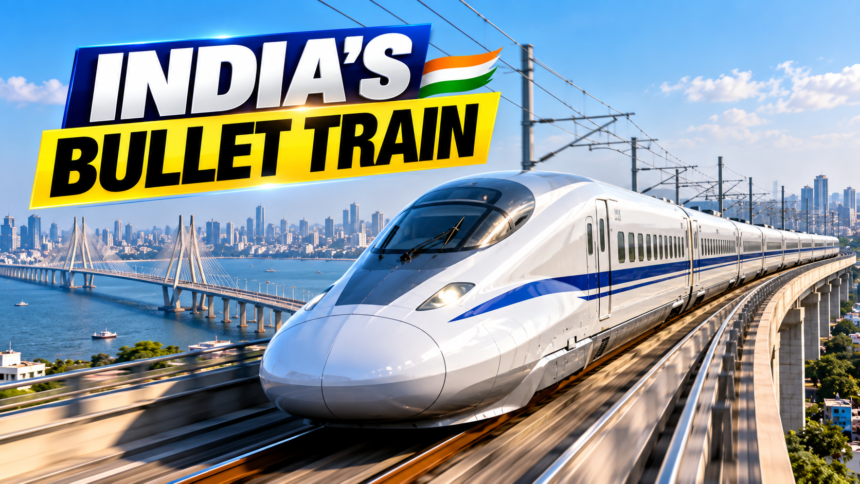
India’s upcoming bullet train project is set to introduce several advanced railway technologies as work continues on the 508-kilometre Mumbai-Ahmedabad High-Speed Rail Corridor.
One of the notable features of the project is the technology being adopted to make track changes smoother, even when trains are travelling at speeds of up to 320 kmph. The system is designed to provide a continuous and stable rail surface so that passengers experience fewer jolts and vibrations when the train moves from one track to another.
Why Will the Bullet Train Have Fewer Jolts During Track Changes?
On conventional railway tracks, a small gap can occur where two rail lines meet at a crossing. When train wheels pass over this area, they can produce vibrations and a noticeable jolt.
At speeds of up to 320 kmph, however, even a small gap can create a major challenge. To address this issue, the Mumbai-Ahmedabad High-Speed Rail Corridor will use advanced systems including movable crossings, also known as swing-nose crossings, along with canted turnouts.
The technology will be used by Indian Railways for the first time on its network.
How Will Movable Crossings Work?
A conventional rail crossing has a gap between sections of rail where tracks intersect. The movable crossing system is designed to remove this discontinuity.
A point machine moves the nose of the rail into position, creating a continuous rail surface at the crossing. As a result, the train wheels can pass across the junction without encountering an open gap.
This continuous surface is designed to reduce vibrations, jolts and stress on the track when trains travel at high speeds.
Canted Turnouts to Improve Passenger Comfort
Canted turnouts are another important part of the high-speed track system. Turnouts allow a train to move from one track to another.
In a canted turnout, the rails are positioned at an angle, with the outer rail placed higher than the inner rail. This arrangement helps manage the sideways forces generated when a high-speed train changes tracks.
By controlling these forces, the system is designed to reduce sudden sideways movement and sharp vibrations, contributing to a more stable ride for passengers.
Digital Systems Will Monitor the High-Speed Track
Safety on the high-speed corridor will also depend on advanced railway control and monitoring systems.
The project will use modern point machines, interlocking systems and automatic train identification technology. These systems will help confirm that the relevant tracks and crossings are correctly positioned and ready before a train passes through.
The Mumbai-Ahmedabad High-Speed Rail Corridor is approximately 508 kilometres long and will connect Mumbai with Ahmedabad. The trains are designed to operate at speeds of up to 320 kmph.
The corridor is planned to have 12 stations. The Mumbai section will include approximately 21 kilometres of underground construction, including an undersea rail tunnel beneath Thane Creek, described as India’s first of its kind.
Disclaimer
The information in this article is based on the project details provided in the source material and is intended for general informational purposes. Project specifications, technology, construction plans and timelines may be subject to changes as work progresses. Readers should refer to official announcements from the relevant authorities for the latest updates.