
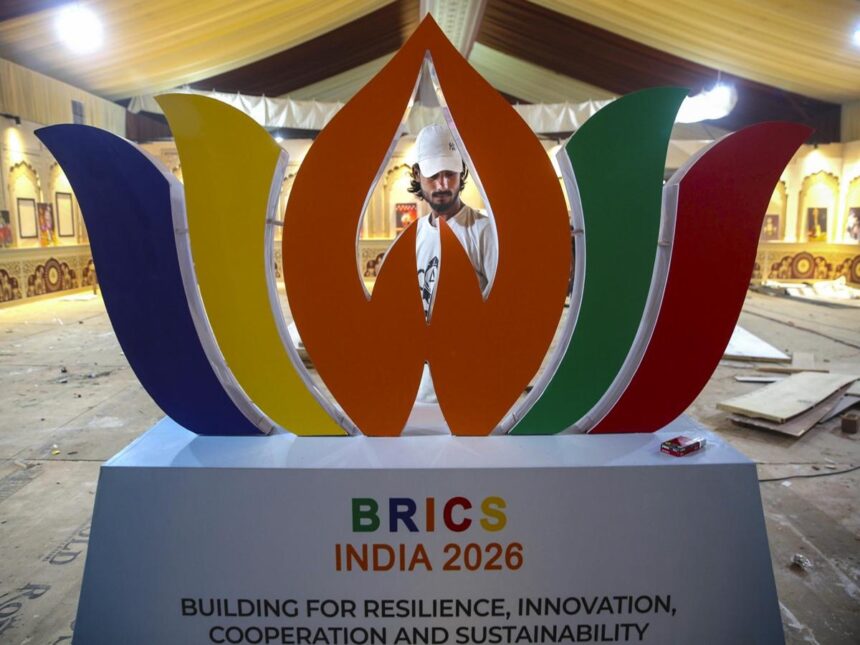
India is preparing to use its 2026 BRICS presidency to push for stronger trade, financial connectivity, technology partnerships and development cooperation. With the grouping expanding and its global ambitions increasing, New Delhi’s leadership will be closely watched for how effectively it can convert diplomatic influence into tangible economic opportunities.
India will host the 18th BRICS Summit in New Delhi on September 12-13, bringing together leaders from one of the world’s most influential groupings of emerging and developing economies.
The summit comes at an important time for BRICS. The bloc is no longer limited to its original five members and is seeking a greater voice in global economic and governance debates. For India, the presidency provides an opportunity to advance initiatives that could directly benefit its businesses and economy.
But the bigger question is: How much economic value can India actually create from its BRICS leadership?
Expanding Trade Opportunities for Indian Companies
Making BRICS more useful for businesses is expected to be one of India’s major priorities.
Although BRICS collectively represents a huge economic market, companies operating between member countries continue to face practical obstacles. Payment-related difficulties, different certification requirements and limited financing options can make cross-border business more complicated.
India is therefore focusing on measures that could simplify trade, strengthen supply chains and give smaller businesses greater access to international markets.
Vaibhav Maloo, managing director of Enso Group and president of Enso Foundation, said India should use its BRICS presidency to address issues such as export payments, certification barriers and infrastructure financing.
According to Maloo, India’s goods exports to BRICS were estimated at $82 billion in FY2025-26, while services exports stood at $31.3 billion in calendar year 2024.
He pointed to sectors such as pharmaceuticals, engineering, digital services, energy security and critical minerals as areas offering significant potential for Indian businesses.
For companies, however, the real test will be whether BRICS cooperation produces simpler and faster business processes. Maloo has suggested greater access to MSME export finance, mutual recognition of testing standards and easier customs procedures.
India Wants Its Digital Payments Model to Go Global
Financial connectivity is another major area where India hopes to make progress during its BRICS presidency.
New Delhi has been pushing for stronger cross-border payment mechanisms and wider use of national currencies for trade among BRICS countries. The proposal is focused on making transactions easier rather than creating a new common BRICS currency.
India’s digital public infrastructure, particularly the Unified Payments Interface (UPI), could play an important role in this effort.
A CareEdge-ORF report examining SME financing across BRICS+ economies highlighted India’s digital financial infrastructure as a potential model for cross-border SME payments and trade finance.
The report proposed a BRICS+ Digital Payments and Open Finance Framework, built around interoperable domestic payment systems, shared technical standards and secure mechanisms for data exchange.
For India, deeper digital-payment cooperation would serve two purposes: it could make cross-border transactions easier while also giving New Delhi an opportunity to demonstrate the capabilities of its digital public infrastructure.
BRICS Could Strengthen India’s Voice in the Global South
India’s BRICS presidency is not only about trade and finance. The grouping also gives New Delhi an important platform to deepen its engagement with developing economies.
BRICS has increasingly become a forum for emerging economies to discuss reforms to the global financial and political system, including institutions such as the United Nations, International Monetary Fund and World Bank.
Speaking at a conference titled An Emerging BRICS Vision for the Global South, Sudhakar Dalela, Secretary (Economic Relations) at the Ministry of External Affairs, said the grouping has moved beyond its original economic focus.
He argued that the next stage of BRICS cooperation would increasingly depend on combining technology and trade strategies.
Dalela also highlighted the potential for BRICS Plus countries to use their combined resources for joint projects involving rare-earth extraction, renewable energy and green manufacturing.
Technology and Energy Could Become Major Areas of Cooperation
India is also looking at BRICS as a platform for expanding collaboration in emerging technologies.
Among the initiatives proposed during its chairship are the BRICS Startup Innovation Fund, BRICS Incubator Network and BRICS Digital Public Infrastructure Repository.
These efforts are aimed at connecting startup ecosystems, exchanging digital solutions and encouraging cooperation in new technology sectors.
Energy is another strategically important area. BRICS brings together some of the world’s major energy producers as well as large consumers, making energy cooperation particularly significant.
At the BRICS Energy Ministers’ Meeting in Gurugram, member countries adopted principles covering smart grids and launched the BRICS Digital Centre of Excellence for Smart Grids and Energy Storage.
The initiative is expected to support cooperation across areas including renewable energy, hydrogen, biofuels, critical minerals and carbon-capture technologies.
India Faces a Complex BRICS Balancing Act
Despite the opportunities, India’s BRICS presidency will not be without challenges.
The expanded grouping now includes Brazil, Russia, India, China, South Africa, Egypt, Ethiopia, Saudi Arabia, Iran, the UAE and Indonesia. These countries have widely differing economic priorities, strategic interests and geopolitical relationships.
That diversity makes BRICS both valuable and complicated for New Delhi.
India will need to balance its own economic interests with the competing priorities of other members. The success of its 2026 presidency will ultimately depend on whether it can turn broad declarations on trade, payments, technology and energy into practical cooperation.
For New Delhi, therefore, BRICS is more than a diplomatic platform. If India can build consensus around easier trade, stronger financial links, technology partnerships and strategic supply chains, its 2026 chairship could create meaningful economic opportunities while strengthening the country’s influence across the Global South.