
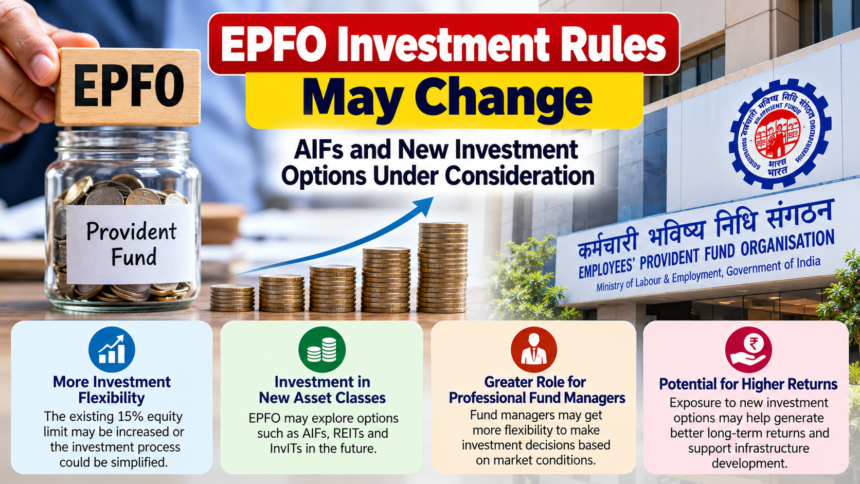
The Employees’ Provident Fund Organisation (EPFO) plays an important role in helping salaried employees build long-term savings for retirement. Now, reports suggest that changes to its investment framework are being considered, including the possibility of investing in Alternative Investment Funds (AIFs).
If such changes are introduced, EPFO could get access to a wider range of investment opportunities. This may influence how employees’ retirement savings are invested and how returns are generated. However, the proposed changes are still subject to the applicable decisions and investment guidelines.
What Is an Alternative Investment Fund (AIF)?
An Alternative Investment Fund, commonly known as an AIF, is an investment vehicle that puts money into assets beyond traditional investment options such as fixed deposits, shares and bonds.
These funds may invest in private equity, venture capital, hedge funds, real estate, infrastructure projects and commodities.
AIFs can offer opportunities for higher returns, but they also involve greater investment risks compared with conventional savings instruments. In India, these funds are regulated by the Securities and Exchange Board of India (SEBI).
What Changes Are Being Considered in EPFO Investment Rules?
According to media reports, EPFO is considering making its investment framework more flexible to provide access to additional investment opportunities.
Some of the changes being discussed include greater flexibility in equity investments. The existing 15% investment limit could be reviewed, or procedures for equity investments may be simplified.
There is also the possibility of exploring additional asset classes, including Real Estate Investment Trusts (REITs) and Infrastructure Investment Trusts (InvITs).
Another area under consideration is fund management. Professional fund managers could receive greater flexibility to make investment decisions based on market conditions and available opportunities.
However, these developments should not be treated as implemented changes until officially confirmed.
How Could the Changes Benefit EPFO Members?
If EPFO receives access to additional investment options, it could create opportunities to diversify its investment portfolio.
Equity investments have historically offered the potential for higher long-term returns compared with several traditional investment options. Greater flexibility could therefore help improve the growth potential of retirement funds, although returns are never guaranteed.
Investments in REITs and InvITs could also provide exposure to real estate and infrastructure-related assets. Such investments may support infrastructure development while offering potential financial returns.
Another possible benefit is protection against inflation. If retirement savings generate returns above the inflation rate, their purchasing power can be better maintained over time.
What Are the Risks of Investing PF Money in AIFs and Equities?
Despite the potential benefits, expanding investments into market-linked assets also involves risks.
Equity markets can experience significant fluctuations. If EPFO increases its exposure to shares and other market-linked investments, a market downturn could affect the value of its investment portfolio.
AIFs can also carry higher risks depending on the type of assets and investment strategies involved.
Therefore, investment diversification, professional fund management and appropriate risk controls will remain important when managing employees’ retirement savings.
For EPFO members, the main point is that any change in investment policy should be evaluated in terms of both potential returns and the protection of long-term retirement savings.
Disclaimer: This article is intended for general informational purposes only and is based on reported developments regarding possible changes to EPFO’s investment framework. The proposed investment options and changes in allocation limits should not be considered officially implemented unless confirmed by EPFO or the government. Investments in equities and alternative assets involve market risks, and returns are not guaranteed. Employees should refer to official EPFO notifications for confirmed updates.