
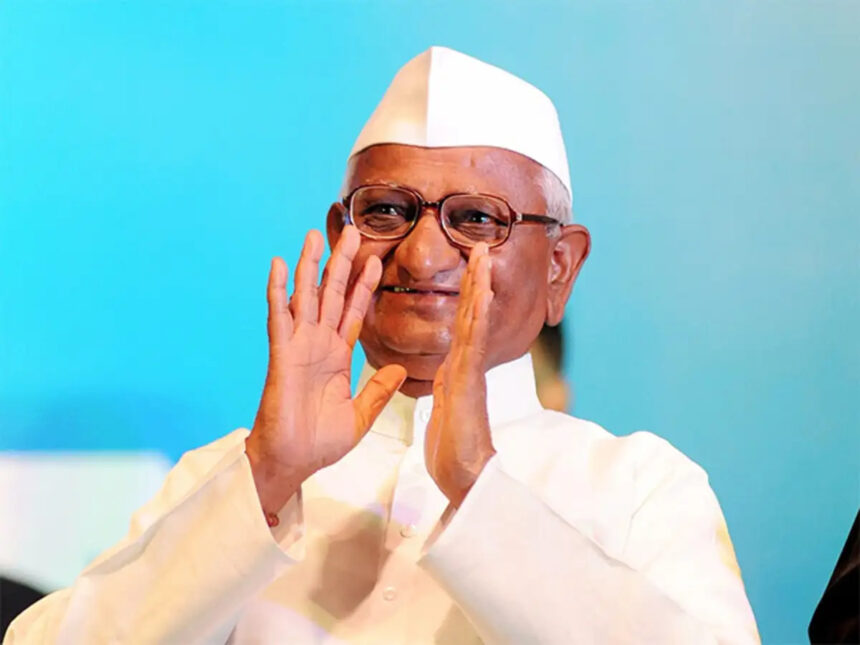
Veteran social activist Anna Hazare has appealed to the Central government to initiate discussions with environmental activist Sonam Wangchuk, urging authorities to resolve the ongoing standoff through dialogue instead of confrontation.
Hazare’s remarks come amid growing concern over Wangchuk’s health after he was admitted to Safdarjung Hospital following nearly three weeks of an indefinite hunger strike.
Anna Hazare Calls for Peaceful Resolution
Speaking on the issue, Hazare said the government should engage directly with Wangchuk rather than allowing tensions to escalate further.
He stated that the Centre has every right to either accept or reject Wangchuk’s demands, but emphasized that holding discussions would be the most constructive approach.
According to Hazare, the matter has broader social significance and should be addressed peacefully instead of through force or prolonged confrontation.
He also warned that any aggressive action against protesters would only make the situation more complicated.
Sonam Wangchuk Hospitalised After Health Deteriorates
Sonam Wangchuk was admitted to Delhi’s Safdarjung Hospital on the 21st day of his indefinite hunger strike after doctors observed a significant decline in his health.
Wangchuk has been fasting while demanding the resignation of Union Education Minister Dharmendra Pradhan over the alleged NEET examination paper leak and calling for wider reforms in India’s education system.
According to Delhi Police, he was shifted from the protest site at Jantar Mantar to the hospital following medical advice and directions issued by the Delhi High Court.
Doctors Report Dehydration and Nutritional Deficiency
Medical officials at Safdarjung Hospital said Wangchuk was admitted with severe weakness caused by prolonged fasting.
Doctors reported that although he remained conscious and his blood pressure, pulse, and oxygen saturation were stable, he was clinically dehydrated.
Medical examinations also revealed several concerning findings, including:
- Low serum potassium levels
- Blood glucose level of 78 mg/dL
- Compensated metabolic acidosis, a condition linked to prolonged fasting and dehydration
- Increased urinary ketone levels, rising from 1+ to 3+, indicating worsening starvation-related ketosis
Doctors warned that these conditions could become life-threatening without timely treatment.
AIIMS Specialist Supports Medical Assessment
An independent specialist from the All India Institute of Medical Sciences (AIIMS) reviewed Wangchuk’s condition and reportedly agreed with Safdarjung Hospital’s medical assessment.
According to the latest health bulletin, the AIIMS expert recommended immediate administration of fluids and electrolytes, either orally or intravenously, to prevent further complications.
Hospital authorities also confirmed that an AIIMS doctor has joined the medical team to continuously monitor Wangchuk’s health.
Wangchuk Declines Medical Treatment
Despite repeated counselling by doctors, Wangchuk has reportedly refused intravenous fluids, oral rehydration solution, and prescribed medications.
Doctors stated that while he remains conscious and haemodynamically stable, visible signs of dehydration continue to persist.
The medical team is making continued efforts to convince both Wangchuk and his family to approve the recommended treatment.
Family Questions Hospital’s Medical Evaluation
Meanwhile, Wangchuk’s wife, Gitanjali J. Angmo, has raised concerns regarding the medical assessment conducted at Safdarjung Hospital.
In a post on social media platform X, she alleged that the family was denied permission to have Wangchuk’s blood samples independently tested at another laboratory.
She also wrote to the hospital administration requesting that Wangchuk be discharged so he could receive treatment at a medical facility chosen by the family.
Family Opposes Treatment Without Consent
Angmo further requested that no oral medication or intravenous treatment be administered without the family’s consent and approval from the doctors who had been monitoring Wangchuk throughout the first 20 days of his hunger strike.
In another communication, she claimed the family had not been provided access to laboratory reports and was prevented from obtaining an independent medical opinion after being informed that Wangchuk’s potassium level had reportedly dropped sharply from 4.3 to 2.9 within a day.
She also alleged that doctors who had been supervising Wangchuk during the protest at Jantar Mantar were not being allowed to meet him inside the hospital.
Situation Remains Closely Monitored
As concerns over Wangchuk’s health continue to grow, hospital authorities, medical experts, and family members remain engaged in discussions regarding his treatment.
Meanwhile, Anna Hazare’s call for dialogue has added to demands for a peaceful resolution, with growing voices urging the government to engage in discussions and address the concerns surrounding Wangchuk’s ongoing protest.