
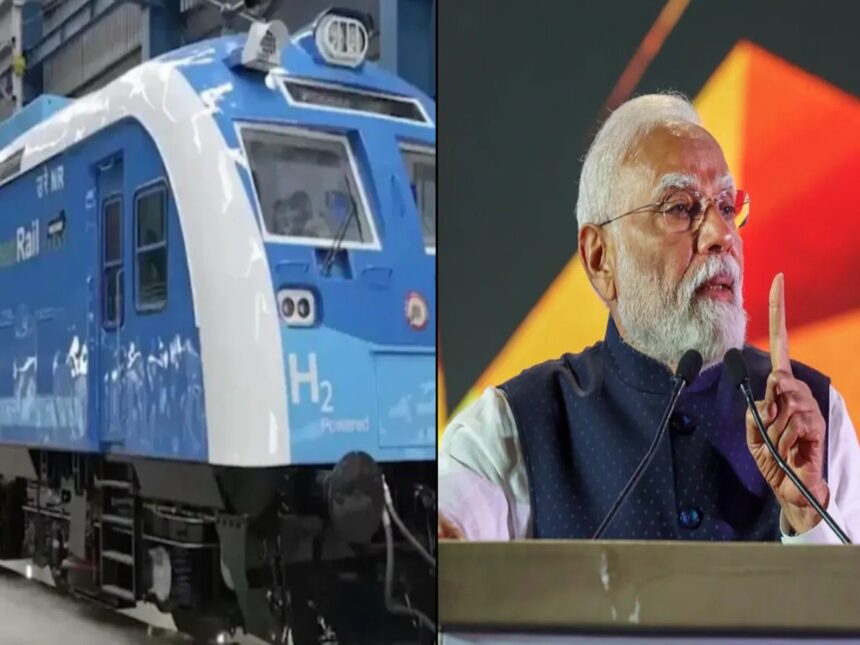
India is set to achieve a major milestone in sustainable transportation as Prime Minister Narendra Modi flags off the country’s first hydrogen-powered passenger train from Jind, Haryana, today. The launch marks a significant step in Indian Railways’ efforts to reduce carbon emissions and adopt cleaner energy technologies.
The hydrogen train will operate on the Jind–Sonipat route in Haryana, placing India among a select group of nations that have introduced hydrogen-powered passenger rail services.
India’s First Hydrogen Train: A Big Leap Towards Green Mobility
Unlike conventional diesel locomotives, the new train generates its own electricity using hydrogen fuel cell technology. Instead of burning fossil fuels, it produces electricity through a chemical reaction, making it an environmentally friendly alternative.
One of the biggest advantages of the train is its near-zero emissions. The only by-products generated during operation are water vapour and heat, making it a cleaner option for public transportation.
The project also stands out globally because of its size. While many hydrogen-powered passenger trains operating worldwide typically have two or three coaches, the Indian Railways version features 10 coaches with the capacity to carry approximately 2,600 passengers.
Key Features of India’s Hydrogen-Powered Train
The newly launched train comes equipped with several advanced technologies designed to improve efficiency, safety, and passenger comfort.
Major highlights include:
- Operates using hydrogen fuel cell technology instead of diesel
- Initial service on the 89-kilometre Jind–Sonipat route
- Operational speed of 75 kmph
- Maximum design speed of 110 kmph
- Passenger capacity of around 2,600 people
- Multiple safety systems to detect hydrogen leaks, smoke, flames, and overheating
- Produces almost zero carbon emissions during operation
The project is expected to showcase the practicality and safety of hydrogen-powered trains for regular passenger services in India.
How Does a Hydrogen Train Work?
Unlike diesel engines that rely on fuel combustion, a hydrogen-powered train generates electricity through an electrochemical process.
Hydrogen stored inside high-pressure cylinders reacts with oxygen from the surrounding air inside a Proton Exchange Membrane (PEM) fuel cell.
This reaction produces electricity, which powers the train’s traction motors connected to the wheels. Since there is no combustion involved, the system operates much more quietly than traditional diesel locomotives.
The process produces only water vapour and heat, eliminating harmful exhaust emissions.
Train Design and Power System
The hydrogen train has been designed with 10 coaches, including:
- Two Hydrogen Driving Power Cars (DPCs) positioned at both ends
- Eight passenger coaches placed between them
Each driving power car houses:
- Hydrogen fuel cell systems
- Hydrogen storage cylinders
- Lithium Iron Phosphate (LFP) battery packs
Each power car generates approximately 1,200 kilowatts (around 1,600 horsepower). Together, the two units provide enough power for the train to achieve speeds of up to 110 kmph while carrying nearly 2,600 passengers.
Its large passenger capacity makes it one of the biggest hydrogen-powered passenger trains introduced anywhere in the world.
Route of India’s First Hydrogen Train
The hydrogen-powered train will initially operate on the Northern Railway’s Jind–Sonipat section in Haryana.
Along with the two main stations, the train will stop at several intermediate stations and halts, including:
- Jind City
- Pandu Pindara Junction
- Lalit Khera Halt
- Bhambhewa
- Isapur Kheri Halt
- Butana Halt
- Khandrai Halt
- Rabrah Halt
- Lath Halt
- Mohana
- Barwasni Halt
- Sonipat New
- Sonipat Junction
Indian Railways selected this route to evaluate the performance, safety, and operational reliability of hydrogen-powered trains under regular passenger service conditions.
If the pilot project proves successful, similar trains may be introduced on additional routes across the country.
How Is the Hydrogen Train Refuelled?
To support the new service, Indian Railways has established India’s largest railway hydrogen refuelling facility at Jind.
The refuelling process begins with the production of hydrogen through electrolysis, a method that uses electricity to separate water into hydrogen and oxygen.
After production, the hydrogen is stored in specially designed tanks before being compressed to 500 bar, allowing more fuel to be stored efficiently.
The train itself is refuelled using two hydrogen dispensers operating at 350 bar, enabling both Hydrogen Driving Power Cars to be filled simultaneously and reducing turnaround time.
The Jind facility has the capacity to store around 3,000 kilograms of hydrogen, ensuring uninterrupted operations. The storage and dispensing infrastructure has also received approval from the Petroleum and Explosives Safety Organisation (PESO), meeting the required safety standards.
A Milestone for Indian Railways
The launch of India’s first hydrogen-powered passenger train represents a major advancement in the country’s clean transportation ambitions. By replacing diesel with hydrogen fuel cell technology, Indian Railways aims to reduce emissions, improve energy efficiency, and move closer to its long-term sustainability goals.
If the project performs successfully on the Jind–Sonipat route, it could pave the way for the wider adoption of hydrogen-powered trains across the Indian railway network in the years ahead.