
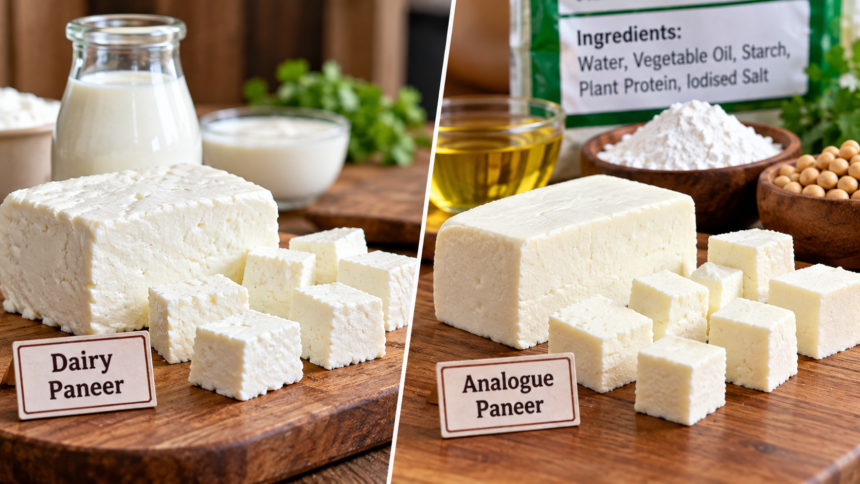
Paneer is a popular source of protein in many Indian diets, but not every product that looks like paneer is necessarily made entirely from milk. Some products are formulated using non-dairy ingredients and are known as analogue paneer. Their nutritional profile can therefore be different from that of traditional paneer made from milk.
For consumers, the key issue is not simply how the product looks or feels, but what ingredients it contains. Dr. Shalini Garwin Bliss, Head-Dietetics at PSRI Hospital, New Delhi, explains what analogue paneer is, how its nutritional composition can differ and what buyers should check before purchasing it.
What Is Analogue Paneer?
Analogue paneer is manufactured to resemble conventional paneer in appearance and texture, but its ingredients may include components that do not come from milk.
According to Dr. Bliss, depending on the formulation, milk ingredients may be replaced or supplemented with vegetable fats, starches or plant proteins. Traditional paneer, in comparison, is made by coagulating milk, meaning its nutritional composition is primarily derived from milk.
The difference between the two may not always be noticeable from their appearance alone. A product can closely resemble regular paneer, making the ingredient list an important source of information for consumers.
Is Analogue Paneer Harmful?
According to Dr. Bliss, consuming an analogue product occasionally does not automatically mean that it will cause a health problem. The concern is more relevant when people regularly consume such products while believing they are eating conventional dairy paneer.
The nutritional value of an analogue product depends on the ingredients used in its preparation. Some products may contain less dairy protein and comparatively more vegetable fat or starch. This can matter for people who specifically include paneer in their diet as a protein source.
Dr. Bliss explained that regularly replacing dairy paneer with an analogue product without knowing the difference could mean that a person does not receive the nutritional value they expect from dairy paneer.
She emphasised that analogue paneer should not automatically be considered harmful. Instead, consumers need to consider the product’s ingredients, quantity and labelling to understand what they are actually eating.
How Can You Identify Analogue Paneer?
Appearance alone is not a reliable way to distinguish analogue paneer from dairy paneer. Colour, softness and texture can all be similar, so consumers should not depend only on these characteristics.
For packaged products, checking the ingredient list is one of the most useful ways to identify what the product contains. Consumers should pay attention to ingredients such as vegetable oil, vegetable fat, starches or plant proteins, particularly when these are used alongside or instead of milk-derived ingredients.
It is also important to check the product name and packaging for any declaration that identifies it as an analogue product or states that it does not contain milk fat or milk protein.
What About Loose Paneer?
Identifying analogue paneer can be more difficult when buying loose paneer because such products generally do not come with an ingredient label that consumers can check.
In these situations, buyers have less information about the composition of the product. Dr. Bliss therefore recommends paying particular attention to the source and purchasing loose paneer from a reliable and properly licensed seller.
Disclaimer: This article is based on information and expert comments provided in the source material and is intended for general awareness. Individual nutritional needs can vary. Readers should check product labels carefully and consult a qualified healthcare or nutrition professional for personalised dietary advice.