
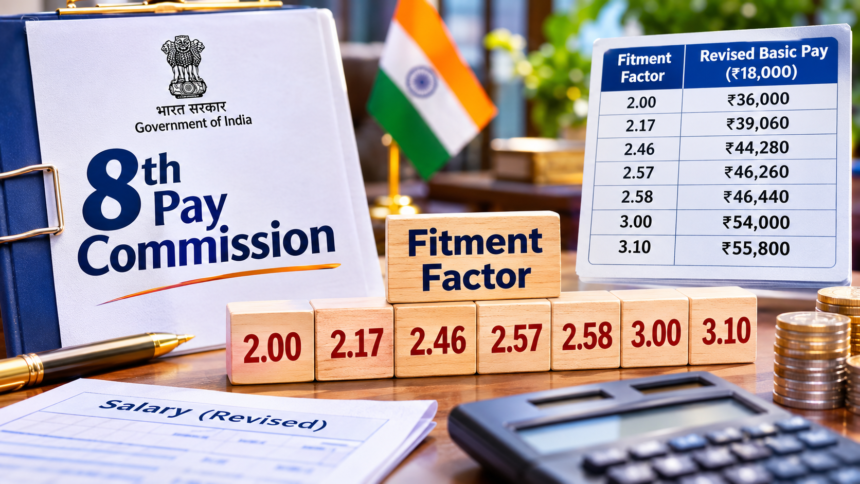
The fitment factor is expected to be one of the most important elements of the 8th Pay Commission, as it will play a major role in determining the revised basic salaries of central government employees. Millions of employees and pensioners are waiting for clarity on this multiplier because it could have a significant impact on their future salaries and pensions.
Different fitment factor possibilities are being discussed, with each multiplier producing a different revised basic pay. Understanding how the calculation works can help employees estimate what their salaries might look like under the proposed pay structure.
What Is the Fitment Factor in the 8th Pay Commission?
The fitment factor is a multiplier used to calculate revised basic pay when a new Pay Commission’s recommendations are implemented. Under this method, an employee’s existing basic salary is multiplied by the approved factor to arrive at the revised basic pay.
For example, if an employee currently receives a basic salary of ₹18,000 and the approved fitment factor is 2.57, the calculation would be:
₹18,000 × 2.57 = ₹46,260
This means the revised basic pay would become ₹46,260 under this example.
However, the final salary structure will depend on the recommendations of the 8th Pay Commission and the government’s approval. The fitment factor is not the only component that affects an employee’s overall salary. Dearness Allowance (DA), House Rent Allowance (HRA) and Transport Allowance may also be revised as part of the new pay structure.
8th Pay Commission: Different Fitment Factor Scenarios
The multiplier selected by the government will make a considerable difference to revised basic salaries. Even a small change in the fitment factor can produce a noticeable difference in the final calculation.
The following ranges illustrate different possible scenarios:
1. Below 2.17 – Lower scenario
A fitment factor below 2.17 would result in a comparatively smaller increase in basic pay. Employees expecting a substantial salary revision may find this outcome less favourable.
2. Between 2.17 and 2.46 – Moderate scenario
If the fitment factor falls between 2.17 and 2.46, employees would receive a moderate increase in their basic salaries. The overall financial benefit would also depend on revisions to DA and other allowances.
3. Between 2.47 and 2.57 – Higher scenario
A multiplier in the range of 2.47 to 2.57 would produce a larger increase in basic pay compared with the lower ranges mentioned above.
4. Between 2.58 and 3.00 – Strong scenario
A fitment factor between 2.58 and 3.00 would lead to a more substantial revision in basic salaries. The actual benefit would depend on the final pay matrix and the government’s implementation decisions.
5. Above 3.00 – Higher-end scenario
If the fitment factor exceeds 3.00, the revised basic salary could increase considerably. However, this remains a possible scenario and should not be treated as a confirmed government decision.
How Different Fitment Factors Could Change an ₹18,000 Basic Salary
To understand the impact of different multipliers, consider an employee whose current basic pay is ₹18,000. The revised salary would vary according to the fitment factor approved by the government.
| Fitment factor | Revised basic pay |
|---|---|
| 2.00 | ₹36,000 |
| 2.17 | ₹39,060 |
| 2.46 | ₹44,280 |
| 2.57 | ₹46,260 |
| 2.58 | ₹46,440 |
| 3.00 | ₹54,000 |
| 3.10 | ₹55,800 |
These calculations show how the same existing basic salary can produce different revised amounts depending on the multiplier used.
It is important to remember that these figures are illustrative calculations, not confirmed salary figures under the 8th Pay Commission. The final fitment factor, revised pay matrix, allowances and implementation details will depend on the commission’s recommendations and the government’s approval.
Disclaimer: This article is intended for general informational purposes only. The fitment factors and salary figures discussed are hypothetical examples and do not represent confirmed recommendations or official government announcements. The actual salary and pension revisions will depend on the final decisions of the 8th Pay Commission and the approval of the Central Government.