
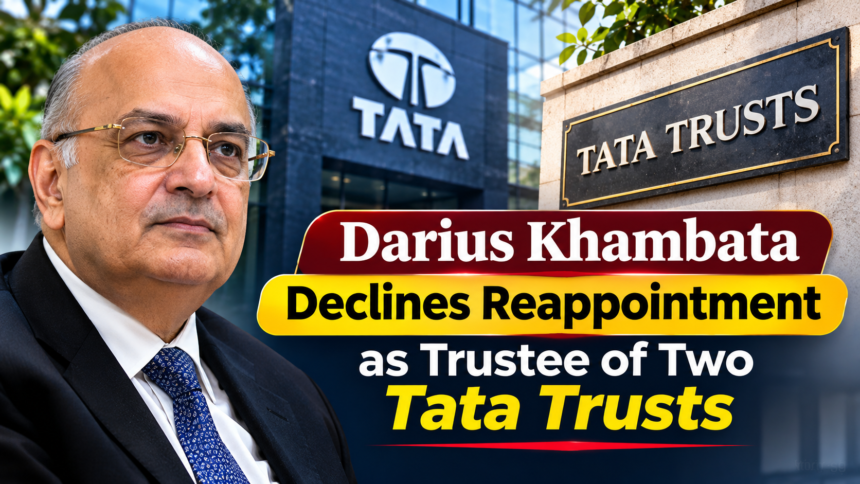
In a significant development involving Tata Trusts, senior advocate Darius Khambata has decided not to seek another term as a trustee of the Sir Dorabji Tata Trust (SDTT) and Sir Ratan Tata Trust (SRTT). He communicated his decision in a letter dated November 2, addressed to Tata Trusts Chairman Noel Tata and CEO Siddharth Sharma.
In his letter, Khambata recalled that he had accepted both trustee positions at the request of the late Ratan Tata. However, he also expressed concerns over developments within the Tata Sons board, particularly the decisions taken during its September 17 meeting.
His decision comes at a time when differences between Tata Trusts and Tata Sons have attracted attention, making his exit from the trustee positions an important development within the Tata Group.
Why Has Darius Khambata Refused Reappointment?
Khambata’s decision comes against the backdrop of a controversial Tata Sons board meeting held on September 17. During the meeting, the board approved the extension of N Chandrasekaran’s tenure as executive chairman through a 4-1 vote and decided to move forward with plans for listing the company.
Noel Tata was the only board member who voted against the proposal. Following the decision, Tata Trusts questioned the legality of the resolution approving Chandrasekaran’s reappointment.
According to media reports, Khambata also referred to this development in his letter. He questioned whether the Tata Sons board would have made the same decision if Ratan Tata had been alive.
He reportedly wrote, “If Ratan Tata were alive today, would the Tata Sons board have taken the same decision on September 17 as it did? Absolutely not.” He further emphasised that institutions should remain more important than individuals, recalling Ratan Tata’s belief that institutions are always bigger than the people associated with them.
Khambata also clarified that continuing as a trustee requires the agreement of the other trustees. He acknowledged that his views had differed from those of some fellow trustees, including Noel Tata, on certain occasions.
His tenure at Sir Dorabji Tata Trust is scheduled to conclude on November 9, 2026, while his term at Sir Ratan Tata Trust is also due to end this month.
Who Is Darius Khambata?
Darius Khambata is among India’s well-known senior lawyers, with extensive experience in constitutional law, corporate disputes and commercial arbitration. He regularly practises before the Supreme Court, Bombay High Court and several other High Courts and tribunals across the country.
According to the Bahrain Chamber for Dispute Resolution (BCDR), Khambata practises through his Mumbai-based chambers. He is also associated with One Essex Court in London.
He holds a Master of Laws (LLM) degree from Harvard Law School. Over the years, his legal practice has covered important constitutional matters, corporate and commercial litigation, as well as domestic and international commercial arbitration.
Darius Khambata’s Career as Maharashtra Advocate General
Khambata has also held several important positions during his legal career. He served as the Advocate General of Maharashtra between 2012 and 2014. Before that, he worked as the Additional Solicitor General of India for three years.
During his professional journey, he has represented clients in several significant constitutional, corporate and commercial cases. His experience also extends to arbitration proceedings in India and other countries.
His contribution to the legal profession has earned him several awards and recognitions. In 2014, he received the Arya Chanakya Puraskar in the field of law. Legal Era named him Senior Counsel of the Year in 2017. In 2019, the Bar Association of India honoured him with the prestigious Living Legend of Law award.
Khambata’s decision not to seek another term as trustee marks an important development at Tata Trusts, particularly amid the ongoing differences surrounding the governance and future direction of Tata Sons.
Disclaimer
This article is based on publicly available information and media reports regarding developments at Tata Trusts and Tata Sons. The statements and positions mentioned have been presented in the context of the reported developments. This content is intended for general informational purposes only and should not be considered legal, financial or professional advice.