
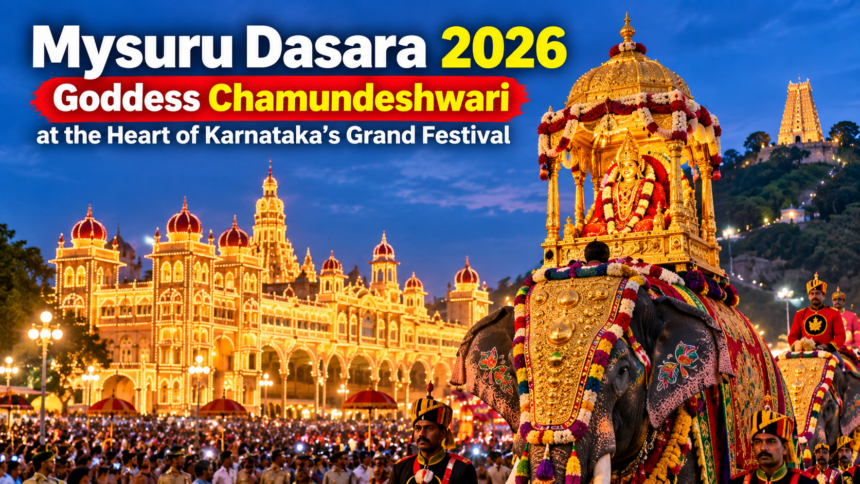
New Delhi: Mysuru Dasara is renowned for its illuminated palace, colourful cultural programmes and the grand Jumboo Savari procession featuring a decorated elephant carrying a golden howdah. At the centre of these celebrations is Goddess Chamundeshwari, whose victory over the demon king Mahishasura forms the foundation of the festival.
Unlike Dussehra celebrations in many parts of North India, where the burning of Ravana’s effigy marks Lord Rama’s victory, Mysuru Dasara commemorates the triumph of Goddess Chamundeshwari over Mahishasura. The festival brings together Karnataka’s religious traditions, royal heritage and cultural identity.
Why Is Goddess Chamundeshwari Worshipped During Mysuru Dasara?
According to local legend, Mahishasura was a powerful buffalo-headed demon who ruled the region and troubled the gods. In response to their prayers, Goddess Parvati appeared in the form of Chamundeshwari and fought the demon on the hill overlooking the city. She eventually defeated him, restoring peace and balance.
Chamundeshwari is worshipped as a powerful form of Goddess Durga, also known as Mahishasura Mardini, the slayer of Mahishasura.
The legend is closely connected with Mysuru’s traditional identity. The city’s name is associated with Mahishur, or Mahishasurana Ooru, a Kannada expression referring to the town of Mahishasura.
For devotees, the festival represents more than a mythological victory. It honours the Goddess as a protector and a central figure in the spiritual and cultural life of the region.
How Is Mysuru Dasara Different From Other Dussehra Celebrations?
The central theme distinguishes Mysuru Dasara from many other Dussehra festivities across India. While Ravan Dahan is a major attraction in several northern states, Mysuru’s celebrations focus on Chamundeshwari’s victory over Mahishasura.
The festival begins with worship at the Chamundeshwari Temple on Chamundi Hills and continues with religious ceremonies, cultural performances, sporting events and public programmes. Mysuru Palace becomes one of the main attractions, with its façade illuminated during the celebrations.
Known as Nada Habba, or Karnataka’s state festival, Mysuru Dasara combines religious observances with folk performances, royal customs and community celebrations. Its traditions have helped establish it as one of the region’s most prominent annual festivals.
What Is the Significance of the Golden Howdah?
The Jumboo Savari procession on Vijayadashami is among the most anticipated events of Mysuru Dasara. During the procession, the idol of Goddess Chamundeshwari is placed inside the ceremonial golden howdah, known as Chinnada Ambari, which is carried by the lead elephant.
Built on a teak frame and plated with gold, the howdah weighs approximately 750 kilograms, including the idol. It reflects the festival’s royal history and the importance of Chamundeshwari as the patron deity of the former Mysuru rulers.
The procession traditionally travels from the palace towards Bannimantap. Decorated elephants, traditional performers, cavalry, police contingents and tableaux representing Karnataka’s districts accompany the ceremonial journey.
Although the procession attracts large crowds, its principal religious significance remains the honouring of Goddess Chamundeshwari as the presiding deity and protector of Mysuru.
Mysuru Dasara 2026: Dates and Royal History
Mysuru Dasara has a history spanning more than four centuries. Raja Wadiyar I celebrated Dasara at Srirangapatna in 1610, and subsequent rulers of the Wadiyar dynasty continued the tradition, developing it into an elaborate royal celebration featuring ceremonial durbars and processions.
Over the years, the festival expanded beyond royal palace events. Since the 1970s, the Karnataka government has organised Dasara as the state’s official festival, incorporating a wider range of cultural and public programmes.
One notable change in the procession’s tradition was the prominence given to the Goddess in the golden howdah rather than the ruler. This helped preserve the festival’s religious focus while opening its celebrations to people from different backgrounds.
Mysuru Dasara 2026 is scheduled to take place from October 11 to October 21. The programme includes temple worship, palace illumination, cultural performances and other public events.
The grand Jumboo Savari procession is scheduled for October 21, Vijayadashami, following the ceremonial worship of Goddess Chamundeshwari in the golden howdah.
Ultimately, the Goddess remains central to Mysuru Dasara because her story connects the city’s traditional origin legend with its cultural identity. The illuminated palace and elaborate procession draw attention, but the festival’s enduring significance lies in the victory of Chamundeshwari over Mahishasura, symbolising the restoration of righteousness and the triumph of good over evil.
Disclaimer: This article is intended for general informational purposes and is based on the cultural traditions and historical details provided in the source material. Festival dates, schedules and event arrangements may be subject to change. Readers should refer to official Mysuru Dasara announcements for the latest programme details.