
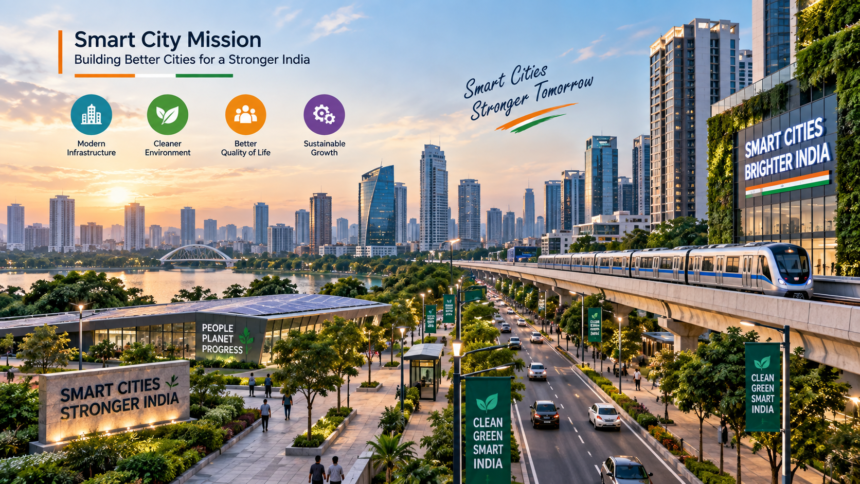
India’s cities are playing an increasingly important role in the country’s economic development. According to the figures cited in the Smart City Mission framework, around 31% of India’s population lived in urban areas in 2011, contributing about 63% of the country’s GDP. By 2030, the urban population is projected to reach nearly 40%, with cities expected to contribute around 75% of GDP.
To address the growing requirements of urban populations, the Central Government launched the Smart Cities Mission on June 25, 2015. The programme focuses on improving urban infrastructure, making cities more liveable and using technology to deliver better public services.
What Is the Smart City Mission?
The Smart Cities Mission is a flagship urban development programme designed to improve the quality of life in selected Indian cities through better infrastructure, efficient public services and sustainable development.
A total of 100 cities were selected through a competitive process. The mission adopted an area-based development approach along with city-wide smart solutions. These included retrofitting existing areas, redevelopment, greenfield development and technology-based initiatives.
Under the original funding structure, the Central Government was to provide financial assistance of up to ₹48,000 crore for the 100 cities, averaging ₹500 crore per city. Funding from the Centre was supplemented by contributions from state governments, urban local bodies and other sources, including public-private partnerships.
Key Features of the Smart City Mission
One of the major aims of the mission is to support economic growth while making urban areas more inclusive, efficient and sustainable.
The programme promotes area-based development, giving cities flexibility to plan and utilise land according to local requirements. Urban planning and development are also expected to take environmental considerations into account.
Housing is another important area of focus. The mission seeks to support better housing opportunities for different sections of society, including people from lower-income groups.
Improving urban mobility is also part of the programme. Projects include better roads, pedestrian facilities and cycling infrastructure, with the broader objective of improving mobility, reducing congestion and supporting safer travel.
Cities are also encouraged to develop parks, playgrounds, open gyms and other public spaces. Such facilities are intended to provide residents with better recreational areas while encouraging greater social interaction.
Technology plays an important role as well. Digital systems and smart solutions are being used to improve services such as transport management, water supply, waste management and citizen services.
Online Services and Better City Governance
The Smart City Mission also places emphasis on technology-driven governance. Citizens can access several services digitally instead of having to visit municipal offices for every requirement.
Integrated Command and Control Centres have been established in all 100 Smart Cities. These centres use technologies such as data analytics, artificial intelligence and the Internet of Things to support city operations, including transport, water supply, waste management and public safety.
The mission also recognises that every city has its own identity based on areas such as education, healthcare, food, culture, sports and local industries. Smart solutions are therefore designed according to the needs and characteristics of individual cities.
Smart City Mission Completed in March 2025
The Smart Cities Mission was officially extended until March 31, 2025, to allow cities to complete ongoing projects. The extension was granted without additional cost beyond the already approved financial allocation.
As reported by the government after the mission period, 7,555 of the 8,067 projects had been completed by May 9, 2025, representing about 94% of the total projects. These completed projects were valued at ₹1,51,361 crore, while 512 projects worth ₹13,043 crore were in advanced stages of implementation.
The mission has therefore focused on combining infrastructure development with technology and improved governance to address the changing needs of India’s rapidly growing urban population.