
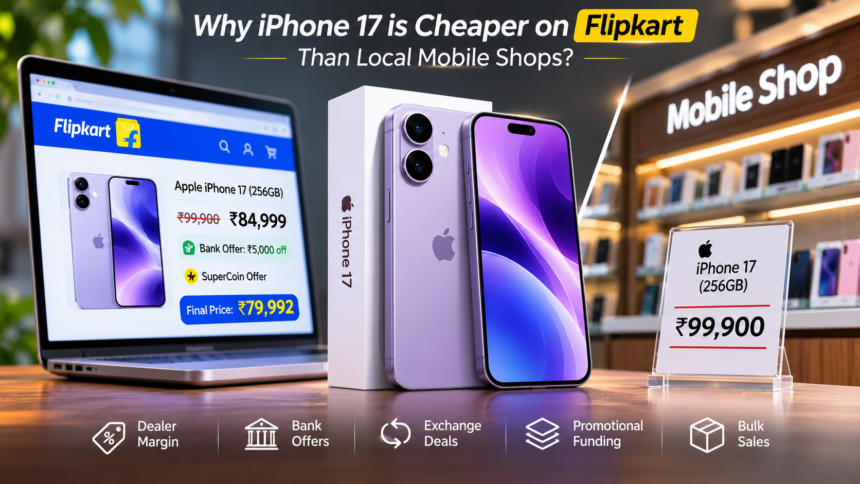
Have you noticed that the iPhone 17 is often available at a lower price on Flipkart compared with local mobile shops? The difference can become even bigger when bank offers, exchange benefits and special sale discounts are applied.
This pricing gap often raises questions among buyers. Are online platforms selling iPhones at a loss, or do local mobile retailers charge higher prices? The reality is that several factors influence smartphone pricing, including dealer margins, promotional funding, bank partnerships, exchange offers and bulk sales.
Here is a closer look at why the iPhone 17 can cost less online and whether buying from Flipkart or a local mobile store offers better value.
Why Is the iPhone 17 Cheaper on Flipkart?
Online shopping platforms regularly introduce promotional campaigns in collaboration with smartphone manufacturers, banks and other financial partners. These offers help attract customers by reducing the effective purchase price.
One example was Flipkart’s Big Billion Days sale in October 2026. During the sale, the 256GB iPhone 17 was available for ₹84,999, compared with its original launch price of ₹99,900.
Customers could reduce the price further by using an eligible bank offer worth ₹5,000. Additional benefits through the SuperCoin promotion brought the effective price down to ₹79,992.
Such discounts are possible because different companies may contribute to promotional campaigns. As a result, the entire discount does not necessarily come from the retailer’s own profit margin.
How Much Margin Do Local Mobile Dealers Get?
Local mobile shops generally purchase smartphones through authorised distribution networks. Their selling prices depend on the purchase cost, dealer margins and promotional benefits offered by manufacturers.
Apple reportedly provides local retailers with an approximate margin of 10% on the iPhone 17. However, this does not mean that shop owners earn a net profit of 10% on every phone sold.
Retailers also have to manage regular business expenses, including shop rent, employee salaries, electricity bills and payment processing charges. These operating costs reduce the actual profit earned from each smartphone sale.
As a result, local retailers may find it difficult to offer the same discounts as large online platforms.
Does GST Make iPhones More Expensive at Local Shops?
GST is another factor that buyers often consider while comparing smartphone prices.
Smartphones sold in India attract 18% GST, which is already included in the listed retail price or MRP. Registered businesses can claim eligible input tax credits on purchases made for business purposes, subject to applicable GST rules.
However, this tax benefit does not automatically become an additional discount that retailers can pass directly to customers.
Therefore, GST alone does not explain why the iPhone 17 may have different prices across online platforms and local mobile stores.
Why Are Flipkart Bank and Exchange Offers So Attractive?
Bank discounts are among the biggest reasons behind the difference between online and offline smartphone prices.
Flipkart partners with selected banks to provide instant discounts and cashback during promotional sales. The actual benefit depends on the bank, card type, offer conditions and duration of the promotion.
Exchange deals can reduce the effective purchase price even further. Customers trading in their old smartphones may receive an exchange value based on the device’s brand, model, age and physical condition.
Some promotional campaigns also provide additional exchange discounts on top of the regular exchange value. However, these benefits are usually available only under specific offer conditions.
When multiple eligible promotions are combined, the final online price can become considerably lower than the regular retail price.
Can Local Mobile Shops Match Flipkart Prices?
In some situations, local mobile retailers can offer prices close to those available online.
This may happen when manufacturers introduce special promotional schemes or when local shops run their own discounts. Retailers may also offer attractive deals to customers purchasing accessories along with a new smartphone.
However, matching every online offer is not always financially practical for smaller retailers. Large e-commerce platforms generally operate at higher sales volumes and can combine different promotional benefits to attract customers.
This gives online platforms greater flexibility when running large discount campaigns.
Online vs Local Mobile Shops: Where Should You Buy the iPhone 17?
Both purchasing options have their own advantages.
Buying through Flipkart can be beneficial when bank discounts, exchange offers and special sale promotions are available. Customers looking for the lowest possible effective price may find online deals more attractive.
Local mobile shops, on the other hand, allow buyers to physically inspect the smartphone before purchasing. They can also offer immediate delivery and direct interaction with the seller.
Before making a decision, compare the final amount payable rather than focusing only on the advertised discount. Also check the seller’s authenticity, warranty coverage, exchange conditions and applicable charges.
Ultimately, the difference between Flipkart and local mobile shop prices is not simply about one seller earning more profit than another. Dealer margins, promotional funding, bank partnerships, exchange benefits and sales volumes all play an important role. This is why a local retailer may not always be able to match the price offered by a major online platform.
Disclaimer: The prices, discounts and dealer margin figures mentioned in this article are based on the information available at the time of writing and may vary depending on offers, sellers and market conditions. Bank and exchange benefits are subject to their respective terms and eligibility requirements. Buyers should verify the latest prices, warranty details and promotional conditions before purchasing.