
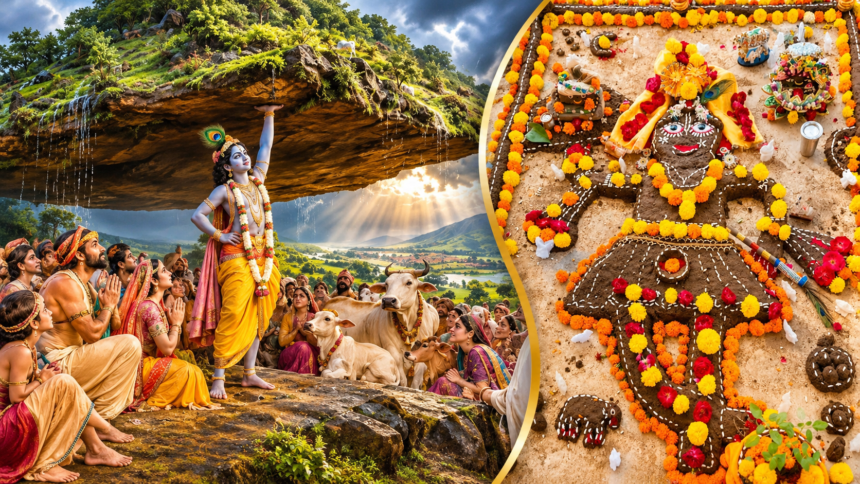
Govardhan Puja, an important part of the five-day Diwali celebrations, will be observed on Tuesday, November 10, 2026. On this occasion, devotees worship Lord Krishna and offer a special collection of 56 food items, popularly known as Chappan Bhog or 56 Bhog.
According to the Hindu calendar, the festival will be celebrated on November 10 because Pratipada Tithi continues at sunrise, following the Udaya Tithi tradition. The morning puja muhurat in New Delhi is scheduled from 6:39 AM to 8:49 AM. However, some calendars mention November 9, so devotees are advised to check their local panchang for the correct date and timings.
The tradition of preparing 56 different dishes has a special connection with Lord Krishna’s childhood and the legendary Govardhan Hill episode.
Why Do Devotees Offer 56 Bhog to Lord Krishna?
The tradition of Chappan Bhog is associated with the story of Govardhan Hill in the Braj region. According to Hindu mythology, the residents of Braj traditionally worshipped Lord Indra, seeking his blessings for rainfall and a good harvest. However, Lord Krishna encouraged them to worship Govardhan Hill instead, as it provided essential resources such as water, fruits, grass for cattle and shelter.
This decision angered Lord Indra, who responded by sending heavy rainfall and powerful storms across Braj. To protect the villagers and their cattle, Lord Krishna lifted the entire Govardhan Hill on his little finger and provided shelter beneath it for seven consecutive days.
During this period, Krishna did not eat anything. According to the popular legend, Mother Yashoda usually served him eight meals every day. When the rainfall finally stopped and Krishna placed the hill back in its original position, the people of Braj became concerned that he had remained without food for an entire week.
To make up for the missed meals, they prepared 56 different food offerings. The calculation was based on eight meals per day over seven days, resulting in 56 offerings. This is believed to be the origin of the Chappan Bhog tradition.
Spiritual Meaning of 56 Bhog in Hindu Tradition
The offering of 56 dishes represents devotion, affection, gratitude and respect towards Lord Krishna. It reflects the love of the people of Braj for Krishna, who protected their lives and livestock during the devastating storm.
The number 56 also holds spiritual significance in another traditional belief. It is associated with the divine lotus of Goloka, where Lord Krishna is believed to reside with Goddess Radha. According to this belief, the lotus petals are arranged in different layers, and the 56 food offerings symbolically represent these layers.
Thus, Chappan Bhog is not simply a collection of food items but a symbolic expression of devotion and thankfulness.
What Is Annakut and How Is It Connected to Govardhan Puja?
Govardhan Puja is also widely known as Annakut, a term that translates to a mountain of food. On this occasion, devotees prepare and arrange numerous dishes in a mountain-like formation as an offering to Lord Krishna.
Temples and households organise special Annakut celebrations, where a variety of sweets, savoury preparations and other food items are presented before the deity. After the religious offering, the food is distributed among devotees as prasad.
In many households, devotees also create a symbolic Govardhan Hill using cow dung. The structure is decorated with flowers, earthen lamps and small figures of cows. Families perform prayers and circumambulate the symbolic hill as part of the traditional rituals.
What Foods Are Included in a 56 Bhog Thali?
There is no universally fixed menu for Chappan Bhog. The selection of dishes varies according to regional customs, family traditions and temple practices.
A traditional 56 Bhog spread generally includes sweets such as kheer, rabri, laddoo, jalebi, malpua and halwa. Savoury preparations like puri, kachori, khichdi and kadhi are also commonly included.
The remaining offerings may consist of fresh fruits, dry fruits, chutneys, pickles, papad, curd, butter and various milk-based preparations. Makhan Mishri holds particular importance in many households because butter is traditionally associated with Lord Krishna’s childhood.
A tulsi leaf is also placed on the food offerings, as it is considered an essential element of worship in many Vaishnav traditions.
Where Is Govardhan Puja Celebrated?
Govardhan Puja is celebrated with great enthusiasm in Mathura, Vrindavan and Govardhan, which are closely connected with the life and legends of Lord Krishna.
Several temples in Nathdwara, Rajasthan, along with ISKCON centres and Vaishnav temples across India, organise elaborate Annakut celebrations. These events feature large displays of food offerings and special religious ceremonies.
In Gujarat, Govardhan Puja also marks the beginning of the traditional New Year celebrations.
Can You Offer 56 Bhog at Home?
Devotees can perform Chappan Bhog rituals at home without arranging an elaborate spread of 56 dishes. The tradition does not require an expensive or grand preparation, as devotion and sincerity are considered more important than the number of food items.
Families can prepare a selection of homemade sweets, savoury dishes, fruits and dry fruits according to their convenience. These offerings can be placed before an idol or picture of Lord Krishna, accompanied by tulsi leaves and prayers during the puja.
Once the rituals are completed, the food is distributed as prasad among family members, relatives and neighbours.
The Significance of Govardhan Puja
Beyond its religious traditions, Govardhan Puja conveys an important message about respecting nature and appreciating the resources that sustain life. Through the Govardhan Hill episode, Lord Krishna encouraged people to recognise the importance of hills, rivers, cattle and the natural environment.
The tradition of offering 56 Bhog adds another meaningful dimension to the celebration by highlighting gratitude and devotion. It represents the collective appreciation of devotees towards Lord Krishna for his protection and blessings.