
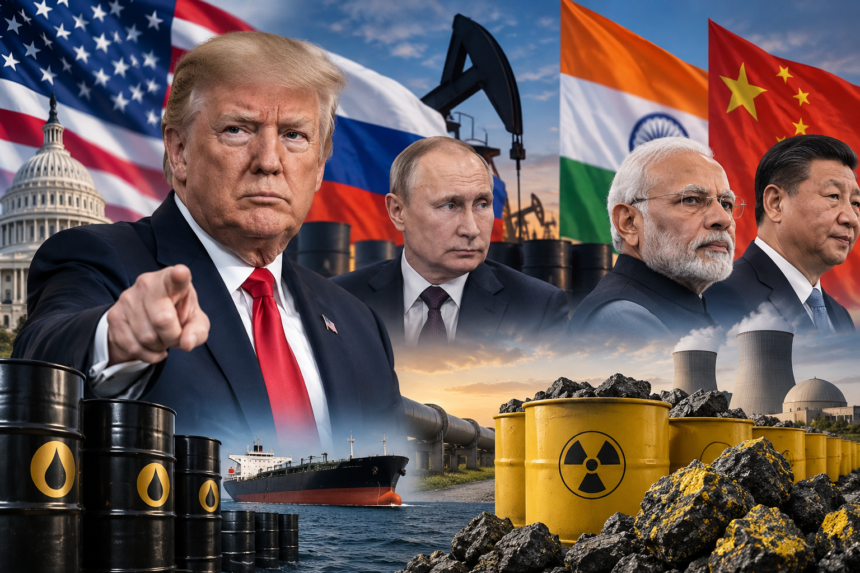
The United States is preparing to increase economic pressure on countries that continue purchasing Russian oil and gas under the Lindsey O. Graham Sanctioning Russia and Iran Act of 2026.
The legislation gives President Donald Trump the authority to impose tariffs of up to 100% on countries that meet the conditions outlined in the measure. At the same time, provisions related to civilian nuclear cooperation and certain Russian low-enriched uranium (LEU) imports remain in place.
The Senate approved the legislation by 86-11 in August, followed by House passage with a 262-159 vote. A White House official told news agency ANI that Trump intends to sign the bill, although no specific timeline was given.
The measure targets Russia’s energy and defence industries, financial networks and its so-called shadow fleet. It also includes additional sanctions provisions concerning Iran.
India and China, both major buyers of Russian energy, could potentially face tariffs of up to 100% under the legislation. The tariff would not be automatic and would depend on presidential action.
Russian Uranium Remains Subject to Limited Exceptions
The nuclear fuel provisions are more complicated than the broader restrictions on Russian energy.
The US had already banned imports of Russian low-enriched uranium under legislation signed into law in 2024. However, that law allows the US Energy Secretary, after consulting the State and Commerce departments, to grant waivers in certain circumstances.
Such waivers can be considered when alternative supplies are unavailable to support a US nuclear reactor or nuclear company, or when allowing the imports is determined to be in the national interest. Under the existing framework, these waivers cannot continue beyond January 1, 2028.
US officials have also acknowledged the country’s reliance on overseas uranium enrichment capacity. Before efforts to reduce that dependence began, Russia supplied roughly 20% to 25% of the enriched uranium used by the United States.
The latest US Energy Information Administration figures show that Russian enrichment continues to account for a significant share of the US market. In 2025, Russian-origin enrichment represented 26% of the separative work units (SWU) purchased by US civilian nuclear reactor operators.
US suppliers accounted for 23%, while France, the UK and the Netherlands supplied much of the remaining enrichment services.
New Sanctions Do Not Create a Complete Uranium Ban
The Graham sanctions legislation directs the administration to enforce existing restrictions on Russian uranium, including uranium associated with Rosatom, Russia’s state-owned nuclear corporation, and its subsidiaries.
However, the measure does not remove the existing exceptions covering certain civilian nuclear activities and specified LEU imports for reactors. Those provisions operate alongside the waiver mechanisms already contained in US law.
As a result, the legislation does not amount to an unrestricted opening for Russian uranium. Instead, limited exceptions remain available under specific circumstances.
The issue is significant because replacing nuclear fuel supplies can be more complicated than replacing many other commodities. Nuclear fuel passes through several stages, including conversion and enrichment, and Russia has substantial enrichment capacity.
The US has therefore been pursuing two objectives at the same time: reducing dependence on Russian nuclear fuel while ensuring that its nuclear reactors have access to sufficient supplies.
Washington has announced billions of dollars in support for expanding domestic uranium enrichment and nuclear fuel production as it works to develop alternative sources.
India Under Pressure Over Russian Oil Purchases
The provisions concerning Russian oil and gas have particular significance for India.
The legislation gives the US President authority to impose tariffs of up to 100% on countries that continue purchasing Russian oil and gas under the conditions specified in the bill. India is among the major countries that could potentially be affected.
The measure does not automatically introduce a 100% tariff. Any such action would require a decision by the President.
Washington had already imposed an additional 25% tariff on Indian goods in August, citing India’s purchases of Russian oil. According to reports, that measure took the total US tariff burden on some Indian exports to 50%.
India has defended its continued purchases of Russian energy by pointing to its energy-security requirements.
Indian Ambassador to the US Vinay Mohan Kwatra has described energy sourcing as a “fundamental national responsibility,” highlighting India’s position as the world’s third-largest energy consumer and its relatively low per-capita energy consumption.
India’s Ministry of External Affairs has said it is monitoring developments and remains committed to securing energy supplies through diversified sources.
Why US Uranium Policy Matters
The different treatment of Russian energy and nuclear fuel reflects the structure of the US nuclear supply chain rather than an absence of restrictions on Russian uranium.
Washington has already taken legislative steps to reduce Russian uranium imports, while retaining mechanisms that permit limited imports when supply concerns or national-interest considerations apply.
The new sanctions legislation strengthens restrictions on Russian uranium but does not eliminate those existing exceptions.
This allows the US to maintain significant economic pressure on countries purchasing Russian crude while preserving limited access to Russian-origin nuclear fuel or enrichment services for its own nuclear sector under specified conditions.
The situation also highlights the difficulty of quickly ending economic dependence on Russia in strategically important industries. While the US continues to develop alternative nuclear fuel sources, Russian enrichment accounted for 26% of the SWU purchased by US civilian nuclear reactor operators in 2025.