
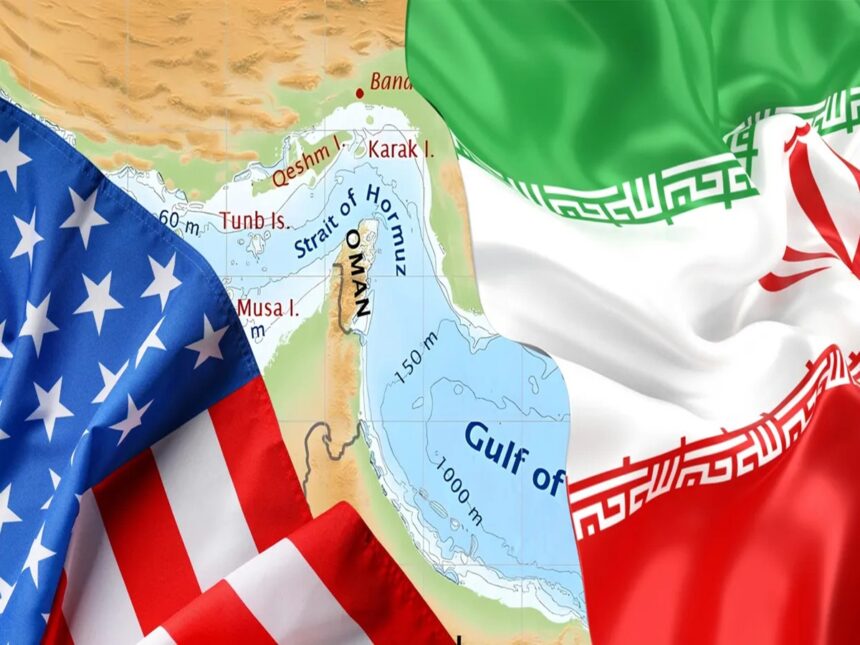
The United States and Iran have intensified their war of words over control of the Strait of Hormuz following a new wave of military strikes across the Middle East. The latest escalation has renewed fears of a broader regional conflict and raised concerns about the future of diplomatic efforts aimed at ending the war.
The strategically important waterway returned to the spotlight after Iran reportedly attacked a container ship near the coast of Oman on Sunday, prompting renewed military action and competing claims over who controls one of the world’s most critical shipping routes.
Strait of Hormuz Remains Central to the Conflict
The Strait of Hormuz, located at the entrance to the Persian Gulf, is one of the world’s busiest energy corridors. Around one-fifth of global oil and liquefied natural gas shipments pass through the narrow passage, making it vital to international trade and energy security.
Since the conflict began, the strait has witnessed repeated disruptions, with attacks on commercial vessels and military operations increasing tensions in the region.
The latest developments come as the US and Iran approach the midpoint of a 60-day interim agreement that was intended to pave the way for broader peace negotiations. Instead of easing tensions, the temporary arrangement has been overshadowed by continued military confrontations.
UN Warns Against Further Escalation
United Nations Secretary-General António Guterres expressed concern over the worsening situation, warning that a return to full-scale conflict would have devastating consequences for the region and beyond.
His remarks come amid growing international efforts to prevent the crisis from escalating further.
US Launches New Military Strikes
According to the US Central Command (CENTCOM), American forces carried out strikes on multiple targets inside Iran on Monday.
The military said the operations targeted:
- Air defence systems
- Radar installations
- Missile launch sites
- Drone infrastructure
- Fast attack boats
CENTCOM stressed that the Strait of Hormuz remains an international maritime route and rejected Iran’s claim of exclusive control over the waterway.
Iran Rejects US Position
Iran’s Islamic Revolutionary Guard Corps (IRGC) responded by asserting that the Strait of Hormuz falls within Iran’s territory and vowed to resist what it described as foreign interference.
Iranian officials reiterated that the country intends to protect its interests in the strategically important shipping lane, maintaining that outside military involvement is unacceptable.
Missile Alerts Across the Gulf Region
The latest exchange of attacks triggered security alerts across several Middle Eastern countries.
- Bahrain, home to the US Navy’s Fifth Fleet, activated missile warning sirens twice.
- Kuwait reported intercepting incoming hostile projectiles.
- Jordan’s military said it successfully shot down four Iranian missiles without casualties or property damage.
Meanwhile, Iranian state media reported explosions in several parts of the country and confirmed at least one fatality following the latest strikes.
Regional Spillover Continues
The conflict has increasingly affected neighbouring countries surrounding the Persian Gulf.
Iranian strikes reportedly extended into areas near Qatar, Jordan, and Oman, while Oman—long regarded as a diplomatic bridge between Iran and Western nations—summoned an Iranian diplomat to protest the reported attack near its territorial waters.
In northern Iraq’s Kurdistan region, drones targeted a military base linked to an Iranian Kurdish opposition group. Local officials confirmed the attack but did not immediately release details regarding casualties or damage.
Trump Claims Major Military Success
US President Donald Trump described the latest military operation as one of the most significant strikes carried out during the conflict.
Speaking after the operation, Trump said the United States had inflicted heavy damage on Iranian military infrastructure.
In response, Iran warned that countries hosting US military bases could face further retaliation while continuing to insist that it has the authority to regulate navigation through the Strait of Hormuz.
Strait of Hormuz Dispute Raises Energy Security Concerns
The ongoing confrontation has renewed concerns about global energy supplies.
Although Iran has repeatedly threatened shipping through the Strait of Hormuz, the United States has continued supporting commercial vessels travelling along alternative routes closer to Oman’s coastline.
Despite periodic attacks on ships, international shipping has continued, helping prevent a prolonged disruption to global energy markets.
Oil prices, which had previously surged during the conflict, have eased from their peak levels as traders continue monitoring developments closely.
Diplomatic Efforts Continue Despite Rising Tensions
Although military operations have intensified, diplomatic channels remain active.
Several regional countries, including Pakistan, Qatar, and Egypt, continue working to encourage dialogue between Washington and Tehran.
Pakistan confirmed that its foreign minister recently held discussions with Iran’s top diplomat, urging both sides to pursue de-escalation and avoid further military escalation.
Meanwhile, Iran’s newly appointed Supreme Leader, Ayatollah Mojtaba Khamenei, issued a public statement promising to respond to the killing of his father, Ayatollah Ali Khamenei, signalling that tensions remain far from resolved.
What’s Next?
As military exchanges continue and diplomatic negotiations struggle to gain momentum, the Strait of Hormuz remains at the centre of both the military confrontation and international mediation efforts.
Given the waterway’s importance to global oil and gas transportation, any further escalation could have significant consequences not only for the Middle East but also for international energy markets, global trade, and geopolitical stability.