
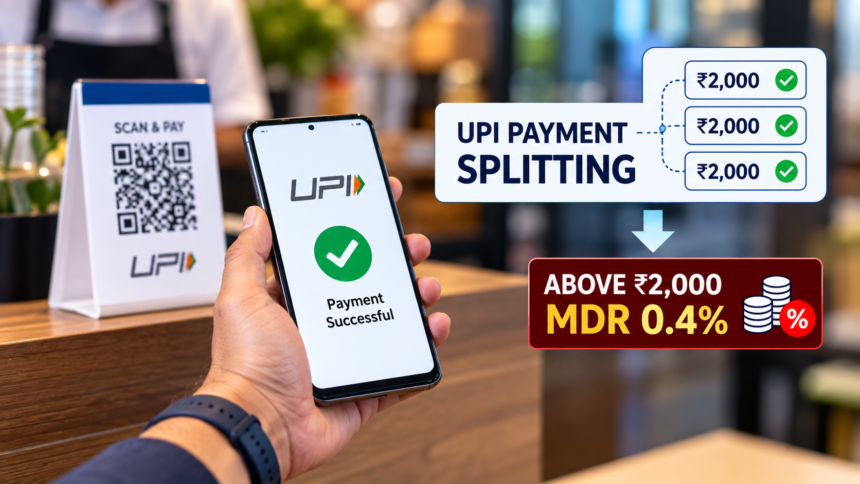
Splitting a large UPI bill into multiple payments of ₹2,000 may appear to be an easy way to stay below the proposed Merchant Discount Rate (MDR) threshold. However, making several identical payments to the same merchant within a short period could attract the attention of a bank’s fraud-monitoring system, experts have cautioned.
From October 15, person-to-merchant (P2M) UPI transactions above ₹2,000 are proposed to attract an MDR of 0.4%. For transactions exceeding ₹75,000, the MDR would be capped at ₹300 per transaction. Payments of up to ₹2,000 and person-to-person (P2P) UPI transfers would remain outside the proposed MDR.
This has raised a practical question for customers. For example, if a bill is ₹6,000, can the customer make three separate payments of ₹2,000 instead of paying the full amount at once?
Under the proposed structure, MDR would be calculated separately for each transaction. As a result, three individual ₹2,000 payments would each remain within the threshold, while a single eligible ₹6,000 transaction would attract MDR of 0.4%, equivalent to ₹24 at the merchant level.
However, repeatedly splitting payments may still carry operational and security-related risks.
Multiple UPI Payments Could Trigger Fraud Checks
Adhil Shetty, CEO of BankBazaar, told Financial Express that there is currently no official daily limit specifically prohibiting such payment splitting under National Payments Corporation of India guidelines.
At the same time, banks routinely monitor transaction behaviour to identify potentially suspicious activity. Several identical payments made to the same merchant within a short period could appear unusual and may trigger automated security checks.
Shetty said such activity could potentially lead to temporary transaction restrictions or suspension of UPI services. Bank accounts may also have daily transaction-count limits, meaning repeated payments could quickly consume the permitted number of transfers.
Therefore, while each ₹2,000 payment may individually fall within the proposed threshold, repeatedly using the method for larger purchases could result in practical restrictions.
Can a Merchant Reject Split UPI Payments?
The proposed framework does not specifically prohibit customers from making multiple smaller UPI payments for a single purchase. However, this does not automatically mean that a merchant must accept payments in that format.
A merchant may prefer a single payment against an invoice for accounting, reconciliation, refund processing or fraud-control purposes.
Prabhat Ranjan, Senior Director at Nexdigm, said the payment method should primarily be based on the actual commercial transaction rather than being structured around the MDR threshold.
In practical terms, a customer may be able to make three ₹2,000 payments for a ₹6,000 purchase, but may not be able to insist that the merchant accept the bill through multiple transactions.
MDR Is a Merchant-Side Cost
Consumers should also understand that MDR is a cost associated with the merchant side of a transaction. Customers ordinarily should not be asked to pay an additional amount simply because the merchant has incurred MDR.
If a merchant separately demands a charge from a customer under the name of “UPI MDR”, the customer can refuse and report the matter through the relevant UPI application or acquiring bank.
At present, the proposed ₹2,000 threshold is applied at the individual transaction level. However, if payment splitting becomes widespread, additional aggregation or anti-circumvention measures could potentially be introduced in the future.
UPI Payment Splitting: Key Points for Consumers
| Issue | What it means |
|---|---|
| ₹2,000 threshold | Proposed MDR applies to eligible P2M UPI transactions above ₹2,000 |
| ₹6,000 bill | Three separate ₹2,000 payments would be assessed individually |
| Fraud monitoring | Repeated identical payments to the same merchant could trigger automated checks |
| Temporary restrictions | Unusual patterns could potentially result in transaction blocks or UPI service suspension |
| Daily limits | Multiple payments could quickly use the applicable daily transaction-count limit |
| Merchant’s choice | A merchant may require one payment against a single invoice |
| Customer MDR | MDR is a merchant-side cost and should not ordinarily be passed to customers |
| Reporting charges | Customers can report merchants attempting to recover MDR through their UPI app or acquiring bank |
Disclaimer
This article is intended for general informational purposes and is based on the proposed UPI MDR framework and expert comments cited in the source material. Rules and implementation details may change. Readers should check official notifications and guidelines from the relevant authorities, banks and UPI service providers for the latest information.