
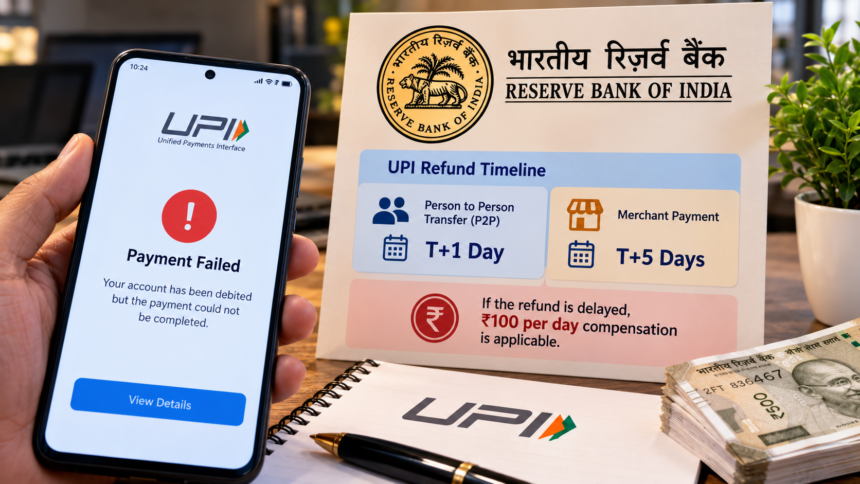
Millions of people across India use the Unified Payments Interface (UPI) for everyday transactions. However, sometimes a payment fails even after the money has been deducted from the sender’s bank account. In such cases, customers do not have to wait indefinitely for their money to be returned or make the payment again without checking its status.
Reserve Bank of India (RBI) rules prescribe specific timelines for reversing failed UPI transactions. If a bank fails to meet the applicable deadline, compensation of ₹100 per day is prescribed for the delay.
Why UPI Payments Fail After Money Is Debited
A UPI transaction involves multiple systems, including the sender’s bank, the recipient’s bank, the National Payments Corporation of India (NPCI) payment network and the UPI application. A technical problem at any stage can interrupt the transaction.
As a result, the sender may see the amount deducted from their account even though the recipient has not received the money or the merchant has not received payment confirmation.
RBI Rules for UPI Refunds and Delayed Payments
The RBI’s framework for turnaround times and customer compensation establishes deadlines for reversing failed digital transactions.
For a failed person-to-person UPI transfer, where the sender’s account is debited but the beneficiary’s account is not credited, the amount must be automatically reversed within T+1 day if the transfer cannot be completed. Here, “T” refers to the transaction date.
For merchant transactions, where the customer’s account is debited but confirmation is not received by the merchant, the prescribed automatic reversal period is T+5 days.
If the applicable deadline is missed, compensation of ₹100 per day is prescribed for the delay. According to the framework, this compensation should be credited automatically, without requiring the customer to submit a separate claim.
What to Do If Your UPI Refund Is Delayed
If your money has been deducted but the transaction has not been completed, avoid making the payment again until you have verified its status. Follow these steps to get the issue resolved.
First, open your UPI application and check whether the transaction is marked as successful, failed or pending. Note down the transaction reference number and confirm with the recipient whether the money has arrived.
Next, raise a complaint through the app’s help section or the support option for the specific transaction. Keep the complaint or ticket number for future reference. NPCI’s UPI FAQs explain that users can raise grievances and check transaction status through participating UPI applications.
If the issue remains unresolved, contact the bank from which the payment was made. Provide the transaction details and complaint reference number, and request that the bank trace the payment.
Customers can also escalate the matter through NPCI’s Register a Complaint portal, which directs complaints to the relevant institution.
If the bank rejects the complaint, provides an unsatisfactory response or fails to respond within the prescribed period, customers can approach the RBI’s Complaint Management System under the Integrated Ombudsman framework. The RBI’s 2026 scheme came into effect on 1 July 2026.
Documents to Keep and Ways to Avoid UPI Fraud
Keep all records related to the failed transaction, including the reference number, transaction date, amount, debit confirmation, recipient details and complaint acknowledgement numbers. These details can help the bank investigate the issue more efficiently.
Be cautious while waiting for a refund. Fraudsters may take advantage of failed payments to trick customers into revealing confidential information. Never share your UPI PIN, one-time password (OTP), account passwords or other authentication credentials with anyone.
Disclaimer: This article is for general informational purposes only and should not be treated as financial or legal advice. RBI rules, complaint procedures and applicable timelines may vary according to the type of transaction and the circumstances of the case. Customers should refer to official RBI, NPCI and bank resources for the latest guidance and requirements.