
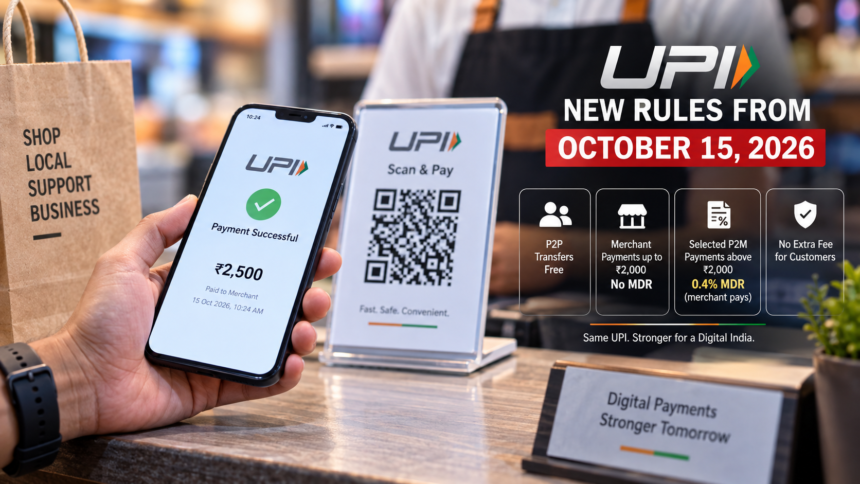
India’s UPI payment system is set for a major change from October 15, 2026, with a Merchant Discount Rate (MDR) being introduced on selected high-value person-to-merchant (P2M) transactions. However, customers will not have to pay a separate UPI transaction fee under the new framework.
According to the Ministry of Finance, a 0.4% MDR will apply to specified P2M transactions above ₹2,000. The charge is part of the merchant payment ecosystem rather than a fee collected directly from customers. Person-to-person (P2P) UPI transfers will continue to remain free, while payments to merchants up to ₹2,000 will also have zero MDR.
The new framework also provides exemptions for eligible small merchants. Small businesses receiving up to ₹1 lakh per month through UPI QR under the P2PM category will continue to receive zero-MDR treatment. The government estimates that around 96% of P2M transactions will remain unaffected.
How the New UPI MDR Rule Will Work
For a qualifying merchant transaction above ₹2,000, the standard MDR will be 0.4%. For transactions of ₹75,000 or more, the charge will be capped at ₹300 per transaction.
For example, if an eligible customer makes a ₹10,000 purchase, the 0.4% MDR would amount to ₹40. Under the framework, this is a merchant-side charge and the customer should not see an additional UPI fee added to the payment.
The main categories under the new framework are:
| Payment category | MDR from October 15, 2026 |
|---|---|
| P2P UPI transfers | No MDR |
| Eligible P2M payments up to ₹2,000 | Zero MDR |
| Specified P2M payments above ₹2,000 | 0.4% MDR |
| Transactions of ₹75,000 or more | 0.4%, capped at ₹300 |
| Eligible small merchants under P2PM | Zero MDR |
| Selected essential sectors above ₹2,000 | Flat ₹5 MDR |
| Mutual funds, securities, stockbrokers and dealers | 0.02%, capped at ₹300 |
The government has also specified different rates for certain sectors. Transactions above ₹2,000 involving areas such as railways, telecommunications, insurance, fuel and agricultural inputs will attract a flat ₹5 MDR. Capital-market transactions involving mutual funds, securities, stockbrokers and dealers will carry an MDR of 0.02%, subject to a ₹300 cap.
Will UPI Users Have to Pay More?
For ordinary users, the direct payment experience is expected to remain largely unchanged. The new MDR is not a customer transaction fee. Banks have been advised to ensure that merchants do not directly pass the MDR on to customers, while UPI application providers are prohibited from imposing platform or hidden transaction charges under the framework.
P2P payments will remain free regardless of the amount transferred. Similarly, eligible merchant payments up to ₹2,000 will continue without MDR. The ₹2,000 threshold therefore does not mean that every UPI payment above that amount will automatically result in a customer fee.
The government has said that only about 4% of merchant transactions are expected to fall under MDR, leaving approximately 96% outside the charge because they are either below the threshold or covered by the zero-MDR provisions for small merchants.
Retailers Raise Cost Concerns
The introduction of MDR has also triggered concerns among sections of the retail industry. The Retailers Association of India has warned that the additional payment cost could encourage some businesses to favour cash, particularly during the festive shopping period when transaction values can rise.
At the same time, representatives from the payments industry have argued that MDR revenue can help support the wider UPI ecosystem. Payments Council of India Chairman Vishwas Patel said the revenue could contribute to investment in technology infrastructure, cybersecurity and the continued expansion of UPI.
The government has clarified that MDR is neither a tax nor money collected by the government or NPCI. Instead, it is distributed among participants in the payment ecosystem, including banks and payment application providers.
Why Is UPI Moving to a Selective MDR Model?
UPI had operated under a zero-MDR framework for several years. The latest policy creates a different structure in which everyday users and smaller transactions remain protected, while selected higher-value merchant payments contribute to the cost of operating the payment ecosystem.
The Department of Financial Services published its detailed MDR FAQs on September 15, 2026, alongside the government’s announcement of the new framework. The new rules are scheduled to take effect on October 15, 2026.
For consumers, the key point remains straightforward: UPI itself is not becoming a paid service for ordinary users. P2P transfers remain free, eligible payments up to ₹2,000 remain outside MDR, and qualifying small merchants continue to receive zero-MDR protection.
The impact of the new system will mainly be felt within the merchant payment ecosystem, particularly for specified transactions above ₹2,000. How individual businesses respond to the additional cost will become clearer after the framework takes effect.
FAQs
Will customers pay 0.4% when making a UPI payment above ₹2,000?
No. The 0.4% MDR applies to specified merchant transactions and is not a customer transaction fee under the framework.
Will sending more than ₹2,000 to a friend attract MDR?
No. Person-to-person UPI transfers will remain free regardless of the amount transferred.
Will every merchant pay 0.4% on payments above ₹2,000?
No. The framework includes zero-MDR protection for eligible small merchants and separate rates for specified sectors and capital-market transactions.
Can merchants directly add MDR to a customer’s UPI bill?
The framework treats MDR as a merchant-side charge, and banks have been advised to ensure that merchants do not pass it directly to customers.
When will the new UPI MDR rules take effect?
The new framework is scheduled to come into effect on October 15, 2026.
Disclaimer: This article is for general informational and educational purposes only. UPI rules, charges, exemptions and payment policies may change. Readers should verify the latest information through official government, NPCI or bank sources before making financial decisions.