
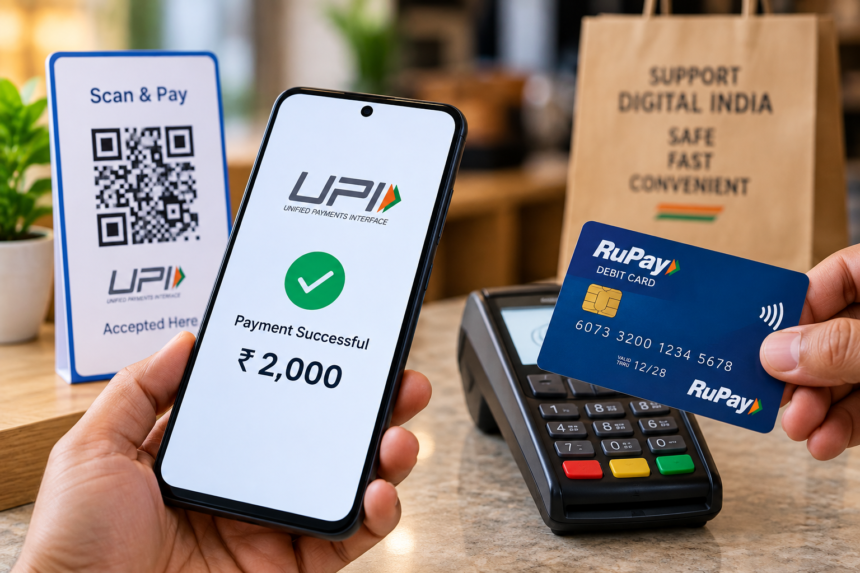
Digital payment users in India have received an important clarification from the central government regarding charges on UPI and RuPay debit card transactions.
The Ministry of Finance has confirmed that UPI payments of up to ₹2,000 and transactions made using RuPay debit cards are covered under the statutory protection for electronic payments. Banks, payment system operators and other financial intermediaries cannot impose direct or indirect charges on customers for these transactions.
The clarification is significant for millions of consumers as well as merchants who rely on digital payments for everyday transactions.
UPI Payments Up to ₹2,000 Will Not Attract Customer Charges
Under the latest government notification, customers will not have to pay an additional fee when making eligible digital payments of up to ₹2,000 through UPI.
The notification has been issued under Section 10A of the Payment and Settlement Systems Act, 2007. It establishes the legal framework under which specified electronic payment methods are protected from charges being passed on to users.
This means banks, payment service providers and other participating entities cannot recover such costs from customers through either direct fees or indirect charges.
RuPay Debit Card Payments Also Covered
The government has also included RuPay-powered debit card payments within the protected electronic payment modes.
As a result, users making eligible payments through RuPay debit cards will not be charged a separate transaction fee by participating banks or payment system providers under the applicable provisions.
The move is expected to provide greater clarity to consumers and businesses while supporting the continued expansion of digital payments across India.
Why Is the Government’s Clarification Important?
UPI has already become one of India’s most widely used digital payment methods, and consumers generally do not pay a transaction fee for regular UPI payments.
However, questions had emerged following changes to the legal framework surrounding electronic payments. There were concerns about whether charges could eventually be introduced for certain digital transactions and how the Merchant Discount Rate (MDR) could apply.
The latest notification aims to remove this uncertainty by clearly identifying the payment methods covered by the statutory no-charge protection.
What Is MDR and Why Does It Matter?
MDR, or Merchant Discount Rate, is a fee associated with processing certain digital or card-based payments.
Depending on the payment system and arrangement, the fee can be distributed among different participants, including:
- Issuing banks
- Acquiring banks
- Card networks
- Payment service providers
Importantly, MDR is generally a merchant-side cost. It should not be confused with a transaction fee directly deducted from a customer’s bank account.
The government has indicated that even if an MDR mechanism is considered for eligible digital payments, the cost would not be passed directly to consumers.
What Does Section 10A of the Payment and Settlement Systems Act Say?
Section 10A of the Payment and Settlement Systems Act, 2007 provides the legal foundation for protecting specified electronic payment methods from charges.
A recent amendment gave the central government the authority to identify, through an official notification, the electronic modes of payment that would receive this protection.
The amendment itself did not mean that a new charge had been introduced on UPI transactions.
The subsequent notification has now clarified the payment methods covered under the provision.
Three Important Points for UPI and RuPay Users
Here are the key takeaways from the government’s clarification:
1. No Additional Customer Fee for Eligible Payments
Customers will not be required to pay additional charges for eligible digital payments of up to ₹2,000.
2. Direct and Indirect Charges Are Restricted
Banks, payment system providers and participating financial entities cannot pass the applicable financial burden to users through direct or indirect charges for the protected payment modes.
3. The Protection Has a Statutory Basis
The no-charge framework is linked to Section 10A of the Payment and Settlement Systems Act, 2007, giving the provision a formal legal basis.
Will Customers Have to Pay MDR?
For customers, the important point is that MDR is not intended to become a direct charge on their bank accounts.
Finance Minister Nirmala Sitharaman had previously indicated that if an MDR mechanism is introduced or applied, customers would not be required to bear the cost.
The broader argument is that a suitable MDR structure could provide banks and fintech companies with additional resources to invest in digital payment infrastructure, innovation and security.
What This Means for Everyday Digital Payments
For consumers, the clarification provides greater certainty when using UPI and RuPay debit cards for everyday purchases.
For merchants and the wider digital-payment ecosystem, it also establishes clearer regulatory boundaries around transaction costs and how those costs can be handled.
India’s digital-payment ecosystem has expanded rapidly, and maintaining affordable payment options remains an important part of encouraging consumers and businesses to adopt electronic transactions.
UPI and RuPay Payment Charges: Key Takeaways
The government’s latest notification makes it clear that eligible UPI transactions up to ₹2,000 and RuPay debit card payments covered under the notification cannot attract direct or indirect charges on customers.
The protection comes under Section 10A of the Payment and Settlement Systems Act, 2007.
While discussions around MDR and the economics of digital payments may continue, customers should know that the notification does not introduce a new charge on UPI transactions.
For everyday users, the key message is simple: eligible UPI payments up to ₹2,000 and covered RuPay debit card transactions remain protected from customer-facing charges under the notified framework.