
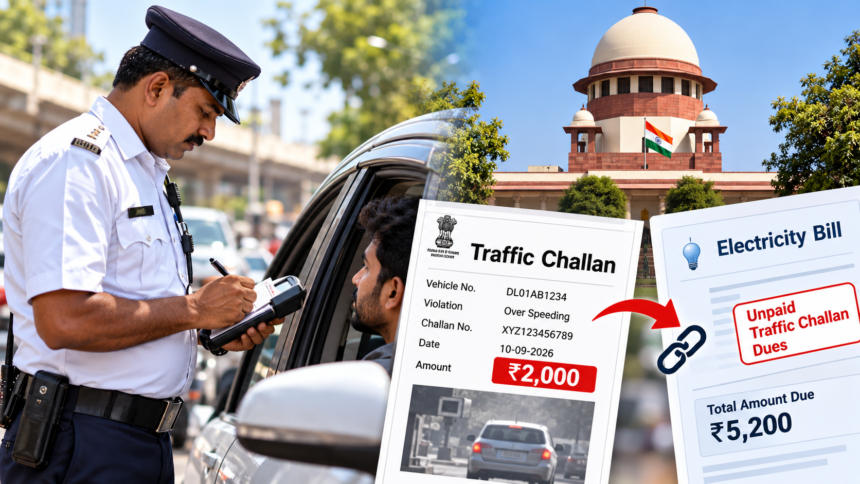
Motorists with unpaid traffic challans could face stricter recovery measures in the future. During a hearing on Monday, the Supreme Court suggested that states and Union Territories explore linking outstanding e-challan dues with electricity bills as a possible way to recover unpaid fines. The suggestion came during proceedings concerning the electronic enforcement of traffic violations and recovery of pending penalties.
The court, however, has not issued a final nationwide rule directing electricity connections to be disconnected over unpaid traffic fines. The electricity-bill proposal was discussed as one possible recovery mechanism during the hearing.
₹45,000 Crore in E-Challan Dues Under Discussion
A bench comprising Justice JB Pardiwala and Justice KV Viswanathan was informed that states and Union Territories have around ₹45,000 crore in e-challan dues, while approximately ₹25,000 crore has been recovered so far. The court emphasised that simply issuing large numbers of e-challans is not enough and that authorities also need effective mechanisms to recover the fines.
Against this backdrop, the bench discussed several possible steps that could make recovery of unpaid traffic penalties more effective.
Vehicle Services Could Face Restrictions
The Supreme Court also discussed restricting various vehicle-related services when challans remain unpaid. These measures included preventing the renewal of registration certificates, restricting ownership transfers and duplicate registration certificates, and withholding fitness certificates until outstanding dues are cleared.
The court also suggested flagging vehicles with unpaid challans on the Parivahan portal. Restrictions on driving licence renewals and action involving existing licences were also discussed, along with withholding Pollution Under Control (PUC) certificates in cases involving unpaid fines.
Another proposal involved conducting random vehicle checks. If a vehicle was found to have an unpaid e-challan, authorities could consider taking steps to impound it, according to the discussion during the hearing.
These Are Suggestions, Not Final Rules
The measures discussed by the Supreme Court are aimed at improving the recovery of pending traffic fines. However, they should not currently be interpreted as new nationwide rules that automatically allow electricity disconnection or vehicle confiscation for every unpaid challan.
Any implementation of such measures would depend on further decisions and action by the concerned authorities. For now, the court’s observations highlight the need for states and Union Territories to develop more effective systems for recovering outstanding e-challan dues.
Disclaimer
The information in this article is based on reports concerning observations and suggestions made during a Supreme Court hearing. The measures discussed by the court are not presented as final nationwide rules unless formally notified by the competent authorities. Traffic penalties, recovery procedures and vehicle-related restrictions may vary according to applicable laws and government notifications. Readers should verify the latest official information before taking any action.