
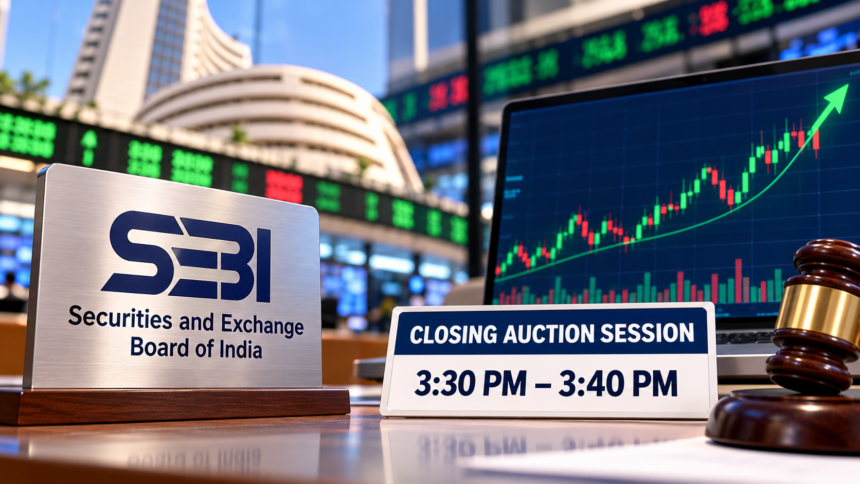
The Securities and Exchange Board of India (SEBI) has finalised the framework for the Closing Auction Session (CAS), introducing changes to equity market closing procedures and derivatives trading schedules. The regulator has retained the 30-minute volume-weighted average price (VWAP) methodology for calculating the expiry-day settlement price of index and stock derivatives.
The revised framework also changes CAS timings and introduces new rules governing order handling, price bands and margin requirements. The proposal received approval from SEBI’s Secondary Market Advisory Committee.
30-Minute VWAP Method Retained for Derivatives Settlement
Under the framework, the settlement value for index derivatives will be linked to the underlying index value, calculated using the VWAP of the constituent stocks during the final 30 minutes of continuous cash market trading.
For stock derivatives, the settlement calculation will use the VWAP of the relevant stock across all exchanges during the same period. Stock exchanges will make indicative values available in real time to help market participants track potential settlement levels.
VWAP is a measure of a security’s average traded price that accounts for the volume traded at different prices. It helps indicate the average price at which a stock changed hands during a specified period.
New Closing Auction Session Timings
Under the revised schedule, the Closing Auction Session will run from 3:30 PM to 3:40 PM on trading days. The new timings are scheduled to take effect on December 7, 2026. However, provisions relating to the transfer of eligible unexecuted limit and iceberg orders from the continuous trading session will apply from February 8, 2027.
The session will follow a phased process:
- 3:30 PM to 3:31 PM: Reference-price calculation and transition period.
- 3:31 PM to 3:36 PM: Investors can place limit and market orders.
- After 3:36 PM: Only limit orders will be accepted. Market orders cannot be modified or cancelled.
- Between 3:38 PM and 3:40 PM: The session will close at a randomly selected time, followed by order matching.
The current CAS schedule runs from 3:15 PM to 3:35 PM.
Changes to Derivatives Trading and Closing Prices
SEBI’s framework also specifies separate trading cut-off times for index and stock derivatives.
On normal trading days, index derivatives trading will continue until 3:45 PM. On expiry days, however, trading in contracts expiring that day will end at 3:30 PM. Stock derivatives trading will continue until 3:45 PM, including on expiry days.
The cash market’s post-close session will operate from 3:50 PM to 4:00 PM, with transactions taking place at the closing price.
During the final 30 minutes of continuous trading, exchanges will publish indicative underlying index values based on the VWAP of the securities included in the index. This information will help traders estimate potential settlement levels before the market closes.
The final settlement value will be determined using the applicable index value at the end of trading, in line with the prescribed methodology.
Reference Prices, Order Transfers and Margin Rules
The CAS reference price for a security will generally be based on the VWAP of trades executed during the final 15 minutes of continuous trading. If no transactions take place during that period, the day’s last traded price will be used. If the security remains untraded throughout the day, the previous session’s closing price will apply, with adjustments where necessary for corporate actions.
Between 3:30 PM and 3:45 PM, stock futures will follow the same price bands as those applicable to CAS. Dynamic price-band adjustments will not operate during this period. Margin requirements will generally apply to CAS orders, although certain eligible orders transferred from the continuous session will receive specified relaxations.
Eligible unexecuted limit orders will generally move into CAS, excluding stop-loss orders and orders outside the permitted price band. Eligible iceberg orders will be converted into fully disclosed limit orders unless the investor opted out of this conversion when placing the order.
Orders carried forward from the previous session will receive priority over newly placed CAS limit orders. Converted iceberg orders will rank below other limit orders transferred from the previous session.
New iceberg and stop-loss orders will not be permitted during CAS. Applicable margin requirements will generally apply to orders and modifications made during the session, subject to the specified exemptions for eligible carried-over orders.
Disclaimer: This article is intended for general informational purposes only and does not constitute investment or trading advice. The framework and implementation dates are based on the information provided. Market participants should consult SEBI’s official circulars and the relevant stock exchange notices for the complete rules, applicable exceptions and latest updates before making trading decisions.