
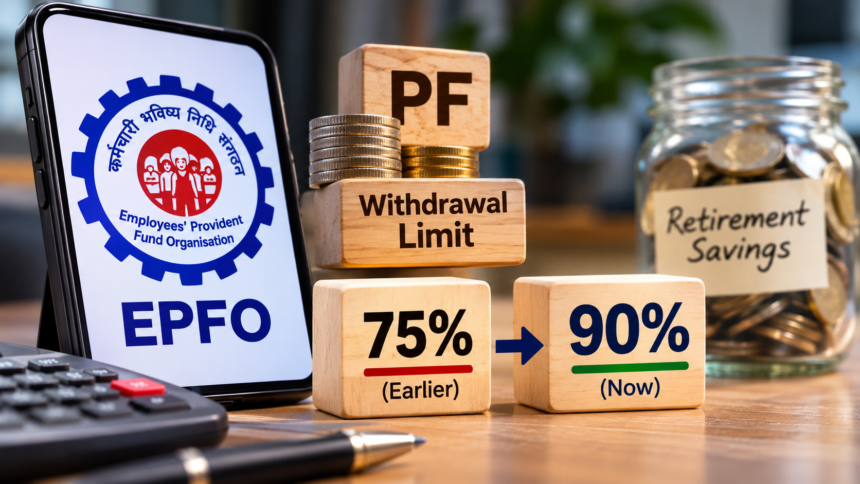
The Employees’ Provident Fund Organisation (EPFO) has introduced proposed changes to its PF withdrawal rules that could give employees greater access to their retirement savings. Under the revised framework described in the available information, members may be allowed to withdraw up to 90% of their EPF balance, compared with the earlier limit of 75%.
This means employees could access an additional 15% of their accumulated savings when required. However, withdrawing a larger amount today may reduce the money available after retirement. The remaining PF balance continues to earn interest, and the power of compounding can make a significant difference over several years.
According to estimates reported by The Economic Times, choosing a 90% withdrawal instead of 75% could reduce the retirement corpus by lakhs of rupees, depending on the employee’s age and existing PF balance.
Withdrawing 90% of PF at Age 50 Could Reduce Retirement Savings by ₹26.87 Lakh
Consider an employee who has accumulated ₹95 lakh in their PF account at the age of 50.
Under the 75% withdrawal option, the employee would receive ₹71.25 lakh. If the withdrawal limit is increased to 90%, the amount available would rise to ₹85.50 lakh.
Although the higher withdrawal provides an additional ₹14.25 lakh immediately, the amount left invested in the PF account becomes smaller. Based on the estimates, this could result in a retirement corpus that is approximately ₹26.87 lakh lower by the age of 58.
This difference highlights how withdrawing more money from a retirement account can affect long-term savings.
How Much Could Employees Lose at Different Ages?
The estimated impact of choosing a 90% withdrawal instead of 75% varies according to the employee’s age and existing PF balance.
| Age | Existing PF Balance | 75% Withdrawal | 90% Withdrawal | Estimated Reduction by Age 58 |
|---|---|---|---|---|
| 30 years | ₹5 lakh | ₹3.75 lakh | ₹4.50 lakh | ₹6.90 lakh |
| 35 years | ₹15 lakh | ₹11.25 lakh | ₹13.50 lakh | ₹13.93 lakh |
| 40 years | ₹30 lakh | ₹22.50 lakh | ₹27 lakh | ₹18.75 lakh |
| 45 years | ₹55 lakh | ₹41.25 lakh | ₹49.50 lakh | ₹23.12 lakh |
| 50 years | ₹95 lakh | ₹71.25 lakh | ₹85.50 lakh | ₹26.87 lakh |
These projections illustrate that withdrawing a larger portion of PF savings can have a substantial effect on the amount available at retirement.
How Have These PF Withdrawal Calculations Been Made?
The estimates are based on an assumed annual EPF interest rate of 8.25%.
The calculations assume that employees leave their remaining PF balance invested until they reach 58 years of age. They also assume that the interest rate remains unchanged throughout the period.
Actual retirement savings may differ depending on future interest rates, additional contributions, withdrawals and the period for which the money remains invested.
Two Major Changes in EPFO Withdrawal Rules
The proposed changes described in the report cover two important aspects of PF withdrawals.
1. Higher withdrawal limit: Earlier, employees were required to retain at least 25% of their PF balance until the age of 55. Under the proposed revised arrangement, this minimum retained amount would be reduced to 10%, potentially allowing withdrawals of up to 90%.
2. Shorter waiting period after unemployment: Previously, employees who lost their jobs had to wait 12 months to withdraw their entire PF balance. The reported revised provision reduces this waiting period to just two months.
These changes are intended to provide employees with greater flexibility when they need access to their accumulated PF savings.
Should Employees Withdraw 90% of Their PF Money?
Although greater withdrawal flexibility can be helpful during financial emergencies, employees should carefully consider the long-term impact before taking out a large amount.
EPF savings are designed to support individuals after retirement. The money remaining in the account continues to earn interest, which can help build a larger retirement corpus through compounding.
Therefore, employees should avoid withdrawing additional funds simply because the permitted limit has increased. It may be better to withdraw only the amount genuinely required and allow the remaining savings to continue growing.
A PF withdrawal decision should take into account immediate financial needs as well as future retirement requirements.
Disclaimer: This article is intended for general informational purposes only and should not be treated as financial or investment advice. The withdrawal limits and waiting-period changes discussed are based on the information provided and reported proposals. Employees should check the latest official EPFO notifications and applicable eligibility conditions before submitting a PF withdrawal claim. The estimated retirement losses are illustrative calculations and actual results may vary depending on interest rates, contributions and withdrawal timing.