
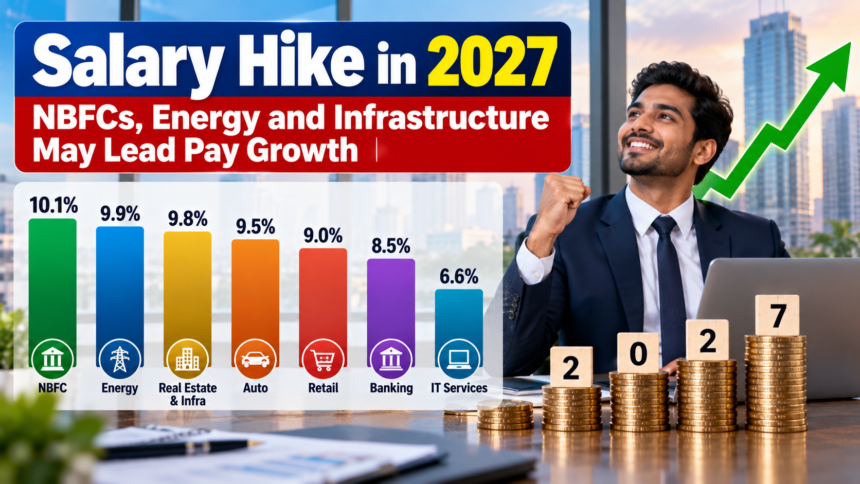
Employees planning to switch jobs in 2027 may find better salary opportunities in certain industries than others. India’s average salary increase is projected to reach 9.1% in 2027, slightly above the estimated 9% growth in 2026. However, the expected hike will vary depending on the sector, job role and skills in demand.
Non-banking financial companies (NBFCs), energy, real estate and infrastructure are among the sectors projected to offer comparatively higher salary increases. Meanwhile, technology consulting and services may record more modest overall growth, although professionals with specialised technical skills could continue to command higher pay.
NBFCs and Energy May Offer the Highest Salary Hikes
NBFCs are projected to record the highest salary growth in 2027, at 10.1%. The energy sector follows with an expected increase of 9.9%, while real estate and infrastructure are projected to see salary growth of 9.8%.
These industries could offer attractive opportunities for employees seeking better compensation or considering a job change. However, actual salary increases will depend on individual performance, experience, employer policies and prevailing hiring conditions.
The automobile and vehicle manufacturing sector is expected to record salary growth of around 9.5% in 2027. Retail salaries may rise by approximately 9%, while banking employees could see an increase of about 8.5%, slightly below the projected national average.
IT Sector Salary Growth May Remain at 6.6%
The technology consulting and services industry is projected to record salary growth of 6.6% in 2027, matching the estimate for 2026.
However, this figure does not necessarily mean that every technology professional will receive the same level of increase. Employees with specialised expertise in artificial intelligence (AI), machine learning and data science may have access to better-paying opportunities because of demand for these skills.
For professionals considering a move within the technology industry, developing relevant technical capabilities could be an important factor in improving their earning potential.
AI and Data Science Skills Could Improve Salary Prospects
As businesses expand their use of artificial intelligence, demand for employees who can work with emerging technologies is increasing. The proportion of companies adopting AI-based productivity tools is projected to rise from approximately 46% in 2025 to 56% in 2026.
Around 60% of companies are also focusing on employee upskilling. Meanwhile, the reported salary premium for professionals with AI, machine learning and data science skills has increased by nearly 10%.
These trends highlight the importance of continuous learning for job seekers. Rather than relying solely on a change of employer or industry, employees may benefit from strengthening their technical knowledge and developing skills that employers increasingly need.
Employee Retention and Wage Code Changes
Despite projected salary increases, retaining experienced employees remains a challenge for employers. Employee attrition is projected to reach 18% in 2026, compared with 16.2% in 2025 and 17.1% in 2024.
Competition for skilled workers may encourage companies to focus on better compensation, career development and training opportunities to retain employees.
Businesses are also preparing for the implementation of the new Wage Code. According to the survey figures provided, 65.4% of companies are already prepared, while another 20.9% expect to be ready within the next six months. Approximately 42.8% of companies expect the Wage Code to increase their payroll costs by at least 1%.
These adjustments could influence how organisations structure compensation and manage employee costs.
Should You Change Jobs in 2027?
Employees planning to switch jobs should consider more than the headline salary growth figures when choosing an industry. Factors such as career progression, relevant experience, job stability, skill requirements and the employer’s growth prospects can also influence long-term earnings.
NBFCs, energy, real estate and infrastructure are projected to offer higher average salary increases, while specialised skills may help technology professionals improve their prospects even in a sector with lower overall salary growth.
Carefully comparing job offers and investing in relevant skills can help employees make better-informed career decisions in 2027.
Disclaimer
This article is intended for general informational purposes only. Salary growth figures, industry projections and survey findings are based on the information provided and may not reflect the actual salary increase received by every employee. Individual compensation depends on factors such as skills, experience, role, employer and market conditions. Readers should consult the original survey or report for verified data before making career or financial decisions.