
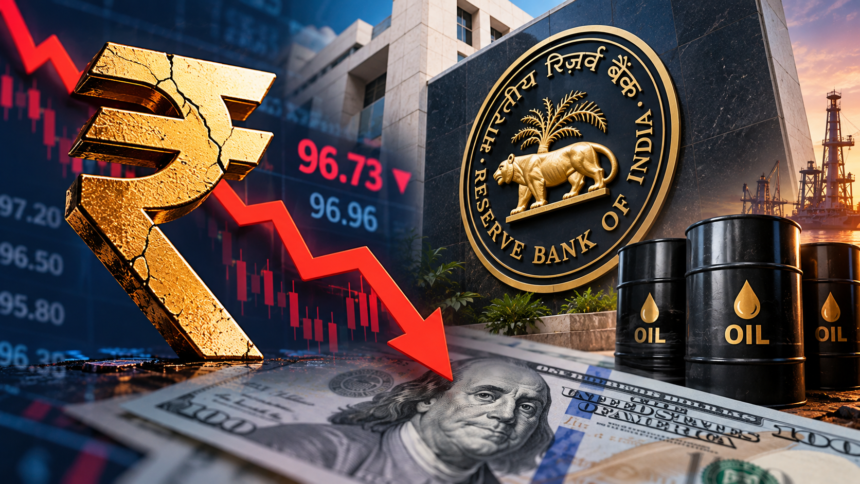
New Delhi: The Reserve Bank of India (RBI) has introduced a series of measures to ease pressure on the Indian rupee after the currency weakened to a record low against the US dollar. The rupee closed at 96.73 per dollar on Friday, approaching its previous all-time low of 96.96 recorded in May.
To manage dollar demand and limit further volatility, the central bank has introduced a special arrangement allowing three major public-sector oil companies to access dollars directly from its foreign exchange reserves. The RBI has also tightened rules governing currency derivatives in an effort to discourage speculative activity.
RBI Allows Three Oil Companies to Access Dollar Reserves
According to a Reuters report, crude oil imports account for a significant share of India’s demand for US dollars. To reduce the pressure created by these purchases, the RBI has established a mechanism for Indian Oil Corporation (IOCL), Hindustan Petroleum Corporation (HPCL) and Bharat Petroleum Corporation (BPCL) to meet their daily dollar requirements.
Under the arrangement, the companies will be able to borrow dollars directly from the RBI’s reserves starting Monday, rather than purchasing the currency in the open market.
The move is intended to reduce sudden increases in market demand for dollars and help limit sharp movements in the rupee’s exchange rate. By providing these oil companies with an alternative source of foreign currency, the central bank aims to ease some of the pressure on the domestic foreign exchange market.
RBI Tightens Currency Derivatives Rules
Alongside the oil-company arrangement, the RBI has introduced stricter measures for the currency derivatives market to curb speculative activity.
The central bank has reduced the position limit for exchange-traded currency derivatives from $100 million to $5 million. Foreign exchange dealers have also been barred from rebooking foreign exchange derivative transactions for clients.
In addition, traders must set aside 20% of the notional value of each transaction as a foreign exchange risk reserve. These measures are intended to discourage excessive positions and reduce the possibility of artificial volatility in the currency market.
Rupee Remains Under Pressure Against the Dollar
The rupee’s latest closing level of 96.73 against the US dollar leaves it close to the record low of 96.96 reached in May. The currency’s performance has prompted the RBI to take steps aimed at managing dollar demand and stabilising trading conditions.
The impact of the central bank’s measures was also reflected in the non-deliverable forward (NDF) market on Saturday. During relatively subdued trading, the one-month dollar-rupee contract declined by around 40 paise.
The measures mark an effort by the RBI to address pressure on the rupee through both dollar-supply management and tighter oversight of currency derivatives. Their broader effect on exchange-rate stability will depend on how market conditions develop.
Disclaimer
This article is based on the information provided in the source material, including details attributed to Reuters. Foreign exchange rates, RBI policies and market conditions can change rapidly. The information is intended for general news purposes only and should not be treated as financial or investment advice. Readers should refer to official RBI announcements and reliable financial news sources for the latest updates.