
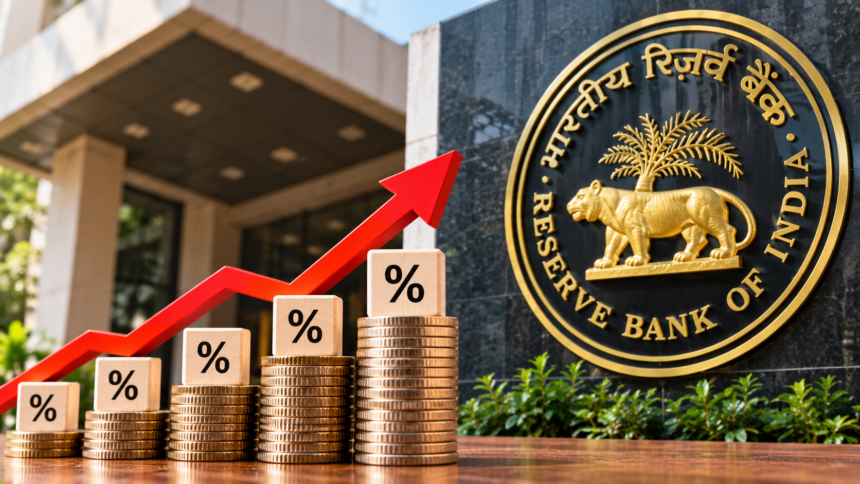
The Reserve Bank of India (RBI) has indicated that interest rate cuts are unlikely in the near future, with future monetary policy decisions likely to involve either a rate hike or a pause. According to the minutes of the October Monetary Policy Committee (MPC) meeting, geopolitical uncertainties continue to pose challenges, although the Indian economy remains resilient.
The RBI said the direction of future policy would depend on how economic conditions evolve, particularly changes in inflation, economic growth and underlying price pressures.
The central bank explained that the duration and scale of any rate-hiking cycle would depend on actual and projected growth and inflation trends. It also highlighted the importance of monitoring the spread of price pressures, the secondary effects of supply shocks and the impact of demand on inflation.
RBI Raises Repo Rate to 5.5%
The RBI’s latest position follows the October MPC meeting, where members unanimously voted to increase the repo rate by 25 basis points to 5.5%.
The central bank’s assessment suggests that monetary policy will remain dependent on incoming economic data and the inflation outlook. The next RBI MPC meeting is scheduled to take place from December 2 to 4.
Inflation Outlook Remains a Concern
According to the RBI, the inflation outlook is less favourable than it was last year. Headline Consumer Price Index (CPI) inflation is expected to average nearly 5.8% over the next three quarters, while core inflation is projected at 4.4% for the current year.
Given these inflation risks, the central bank said recalibrating the policy rate was necessary. Its assessment indicates that policymakers remain concerned about both the direct impact of supply disruptions and the possibility that price pressures could become more widespread.
RBI Governor Explains Supply-Side Inflation Risks
RBI Governor Sanjay Malhotra explained that monetary policy primarily addresses the second-round effects of supply shocks, including changes in wage expectations and the pricing decisions made by businesses.
He noted that it can be difficult to separate these second-round effects from the indirect impact of supply-side pressures, such as higher energy and other input costs. Both can influence core inflation.
The governor also pointed to potential demand-side inflation risks arising from growth in monetary and credit aggregates.
The RBI’s assessment indicates that future policy decisions will depend on how inflation, demand and economic growth develop. For now, the central bank has signalled that an immediate shift towards rate cuts is not expected.
Disclaimer: This article is intended for general informational purposes only and is based on the RBI’s October MPC meeting minutes and the statements provided. Monetary policy decisions may change as economic conditions evolve. Readers should refer to official RBI announcements for the latest updates.