
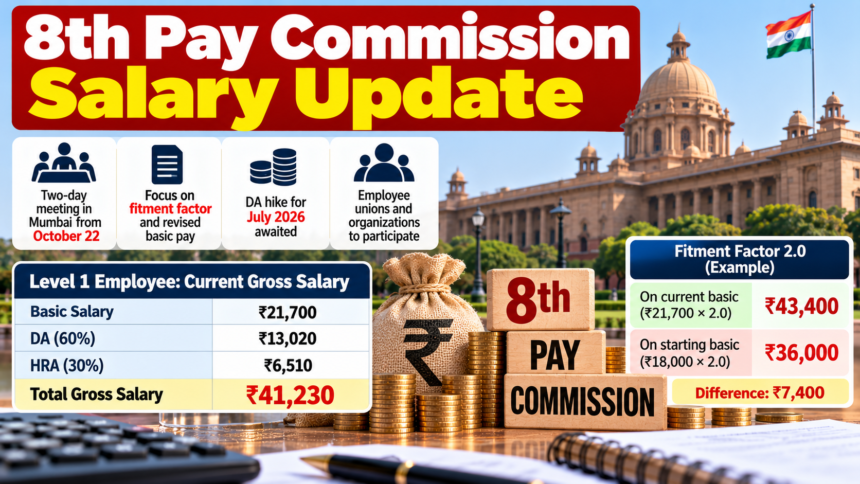
Preparations for the Eighth Pay Commission (8th CPC) are progressing, with a two-day meeting scheduled in Mumbai from October 22. Representatives of employee organisations, institutions and central government employee unions are expected to participate in the discussions.
Meanwhile, central government employees are waiting for the July 2026 dearness allowance (DA) revision. Employees are also closely watching the fitment factor, as it will play an important role in determining revised basic pay under the 8th Pay Commission.
Although the final recommendations have not been confirmed, hypothetical calculations can help explain how a change in basic salary could affect an employee’s overall pay.
How Do DA and HRA Affect Gross Salary?
An employee’s gross salary includes basic pay along with applicable allowances, such as dearness allowance (DA), house rent allowance (HRA) and transport allowance.
If the 8th Pay Commission recommends a fitment factor of 2.0, the basic salary could double under that illustrative calculation. However, the total salary package would not necessarily double because allowances and other benefits may be recalculated under the revised pay structure.
Gross salary is the total amount earned before deductions. Contributions towards the National Pension System (NPS) or Unified Pension Scheme (UPS), income tax and professional tax, where applicable, may reduce the amount an employee receives.
The take-home salary is the amount left after these deductions. The Old Pension Scheme (OPS), by contrast, is a pension arrangement rather than a salary deduction.
Level 1 Employee Salary Calculation Under the Current Pay Structure
Consider a Level 1 central government employee working in an X-category city, with a basic salary of ₹21,700.
Assuming DA at 60% and HRA at 30%, the estimated salary would be calculated as follows:
| Salary component | Amount |
|---|---|
| Basic salary | ₹21,700 |
| DA at 60% | ₹13,020 |
| HRA at 30% | ₹6,510 |
| Total gross salary | ₹41,230 |
Under these assumptions, the employee’s gross monthly salary would be ₹41,230.
This calculation excludes transport allowance and other applicable benefits, which could increase the total amount. The figures are illustrative and depend on the applicable allowance rates.
How Much Could Basic Salary Increase Under the 8th Pay Commission?
The fitment factor is an important element in calculating revised basic pay. However, the outcome depends on the salary figure used as the starting point.
For example, if a fitment factor of 2.0 is applied to the current basic salary of ₹21,700, the calculation would be:
₹21,700 × 2.0 = ₹43,400
If the same factor is applied to the starting basic salary of ₹18,000, the result would be:
₹18,000 × 2.0 = ₹36,000
The difference between these two hypothetical calculations is ₹7,400.
These examples demonstrate why the reference salary matters when estimating a possible pay revision. They do not represent confirmed salary figures under the Eighth Pay Commission.
When Will the Final 8th Pay Commission Salary Be Known?
Central government employees will need to wait for the commission’s recommendations and the government’s subsequent decisions to understand the revised pay structure.
The final fitment factor, revised pay levels, allowances and implementation arrangements will depend on the recommendations and the government’s approval. Until then, salary projections should be treated as estimates rather than confirmed increases.
Disclaimer: This article is for general informational purposes only. The fitment factor and salary figures discussed are hypothetical examples and do not represent official recommendations or confirmed pay revisions. Employees should refer to official government notifications for the final rules, salary calculations and implementation details.