
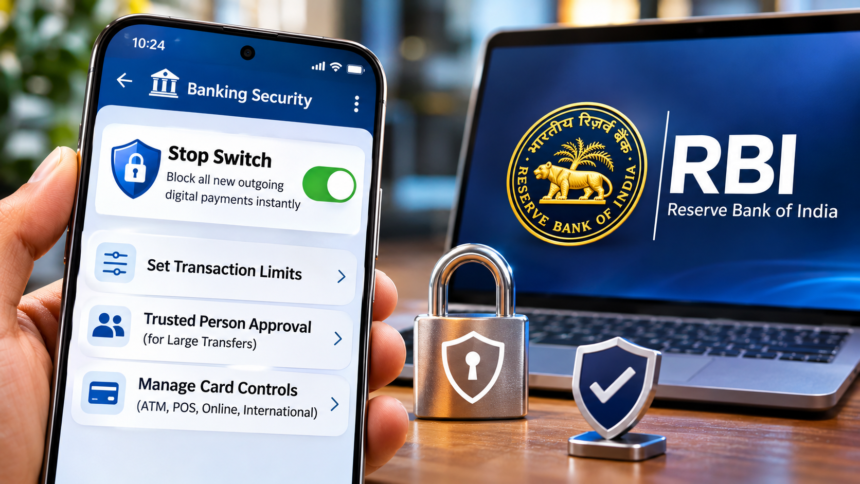
The Reserve Bank of India (RBI) is planning several measures to strengthen protection against online banking fraud. Under its latest proposals, bank customers may soon be able to stop all new outgoing digital transactions instantly through a single feature called the ‘Stop Switch’.
The central bank has also proposed giving customers greater control over digital payment limits and introducing an optional system in which a trusted person must approve high-value transactions.
These measures are aimed at helping customers respond quickly when they suspect their bank accounts or payment credentials have been compromised.
What Is the RBI’s Stop Switch Feature?
Under the proposed system, banks would be required to provide customers with a Stop Switch facility that can temporarily block new outgoing digital payments.
Currently, customers who suspect fraud may need to disable different payment services individually or contact their bank for assistance. The proposed feature would make this process simpler by allowing them to suspend new digital debit transactions through one action.
Once activated, the Stop Switch would prevent new UPI registrations on third-party applications, standing instructions and payment mandates. Incoming payments would continue to be credited to the account as usual.
However, existing scheduled deductions, including EMIs, automatic payments and bank charges, would not be affected by this facility.
Customers wishing to restore digital payment services would have to complete an identity verification process through their bank. A compulsory waiting period may also apply before outgoing digital transactions are reactivated.
Customers May Get More Control Over Digital Payment Limits
The RBI has also proposed allowing customers to decide how much money they can transfer through different digital payment channels.
Under this arrangement, account holders could establish limits for individual transactions, payments to specific beneficiaries and their overall daily transaction value. They may also be able to set a combined daily limit covering multiple digital payment methods.
Customers could temporarily switch off selected payment channels whenever required.
These controls would also cover debit cards, credit cards and prepaid cards. Users could set separate transaction restrictions for ATM withdrawals, point-of-sale (POS) payments, online purchases and contactless transactions.
Additionally, customers may be able to activate or deactivate domestic and international transactions separately.
For newly opened bank accounts, digital payment facilities would remain disabled by default. Customers would need to provide explicit consent and complete the required verification before these services could be activated.
Trusted Person Approval May Be Required for Large Transfers
Another important proposal is the Trusted Person Mechanism (TPM), which would introduce an additional approval step for high-value transactions.
Under this optional facility, customers could nominate a trusted individual aged 18 or above. They would also decide the transaction amount beyond which approval from this person would be necessary.
Whenever a payment meeting or exceeding the selected limit is initiated, the nominated individual would receive information about the transaction, including the amount and recipient details.
The trusted person would have one hour to approve or reject the request. If they decline it or fail to respond within the specified period, the transaction would automatically be cancelled.
Activating this facility would require the consent of both the account holder and the nominated person. A 24-hour waiting period would also apply before the mechanism becomes operational.
The trusted individual would have limited responsibilities and access. They would not be able to view the customer’s bank balance, fixed deposits, investments or insurance details. They would also have no authority to initiate transactions independently and would not be responsible for payments approved or rejected through the mechanism.
The proposed system would not cover UPI transfers, merchant payments or automatic transactions that have already been scheduled.
When Could the New RBI Banking Rules Be Implemented?
The RBI has invited comments and suggestions from the public and relevant stakeholders on these proposals until December 14, 2026.
If the proposals receive final approval, the new measures could come into effect from July 1, 2027. Banks may also introduce the facilities earlier if they choose to do so.
Apart from payment security, the RBI has suggested expanding the definition of negligence by banks in cases involving digital fraud.
The proposed definition could include failures such as not implementing multi-factor authentication, failing to send transaction alerts, not providing a 24-hour facility for reporting fraud and delays in responding to customer complaints.
These proposals aim to strengthen digital banking security and give customers more control over their money. However, the final provisions and implementation requirements will depend on the RBI’s decisions after considering the feedback received.
Disclaimer: This article is intended for general informational purposes only. The Stop Switch, Trusted Person Mechanism and other measures discussed are proposals from the Reserve Bank of India and should not be treated as fully implemented banking facilities. The final rules, eligibility requirements and implementation dates may change following the RBI’s review and official notifications. Customers should refer to RBI announcements and their respective banks for confirmed information.