
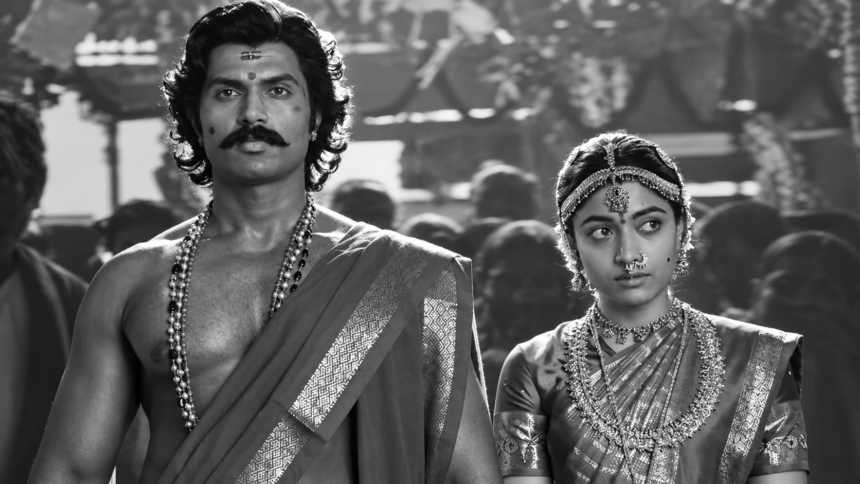
Telugu period action drama Ranabaali, starring Vijay Deverakonda and Rashmika Mandanna, has arrived in theatres worldwide, receiving mixed reactions from critics and audiences. Directed by Rahul Sankrityan, the film explores a historical conflict set in colonial India during the late 19th century.
While the movie has earned appreciation for its lead performances, production design and ambitious storytelling, its slow narrative, lengthy second half and limited emotional depth have emerged as major points of criticism. Despite several engaging moments, the film struggles to maintain a consistent pace throughout its runtime.
Ranabaali Review: Performances and Storytelling
One of the strongest aspects of Ranabaali is the on-screen pairing of Vijay Deverakonda and Rashmika Mandanna. Their chemistry and performances bring warmth to the period drama, offering some of its more engaging moments amid the heavier historical narrative.
The film also receives credit for recreating the atmosphere of colonial India through its production design and settings. However, critics have pointed out that these strengths are not consistently supported by the screenplay.
The storytelling loses momentum as the film progresses, particularly in the second half. Predictable character arcs, underdeveloped emotional sequences and an extended runtime make it difficult for the narrative to sustain audience interest. The background score has also been criticised for failing to add sufficient impact to some important dramatic moments.
Another concern raised in reviews is the film’s use of graphic violence and familiar pre-climax sequences. Some critics have also noted that scenes often build anticipation but conclude before delivering the expected payoff, reducing their overall impact.
What Critics Are Saying About Ranabaali
Several reviews have acknowledged the film’s sincere attempt to bring a lesser-known historical story to the screen, while pointing out shortcomings in its writing and editing.
One review observed that the first half works better than the second, praising the effort to tell an overlooked story but noting that repetitive narrative developments and excessive length make the latter portion feel drawn out.
Another review appreciated Rahul Sankrityan’s attempt to present the forgotten historical account and highlighted Vijay Deverakonda’s commitment to his role. However, the review identified the slow narration as a significant drawback for a commercial entertainer.
A separate assessment described Ranabaali as an authentic but uneven period action drama. It praised the engaging first half, the chemistry between the lead actors, Ajay-Atul’s music and the cave fight sequence. At the same time, predictable storytelling, insufficient emotional development and the lengthy runtime were identified as weaknesses.
Critics have also highlighted the film’s inconsistent rhythm. Even action sequences that initially build excitement sometimes end before delivering a satisfying climax, while frequent dramatic moments leave little room for audiences to absorb the impact of individual scenes.
Overall, the critical response suggests that tighter editing and a more focused screenplay could have strengthened the film’s theatrical appeal.
Ranabaali Cast, Director and Production
Ranabaali marks another collaboration between Vijay Deverakonda and director Rahul Sankrityan after their earlier film Taxiwala. The project is backed by Mythri Movie Makers and mounted on a massive budget.
Despite the divided critical response, the film has attracted attention because of its prominent cast, historical subject and ambitious period setting. While the performances and production elements have received appreciation, the screenplay and pacing remain its principal weaknesses.
Ranabaali delivers several engaging moments, particularly in its first half, but its slow narration and lengthy second half prevent it from making the most of its historical premise.