
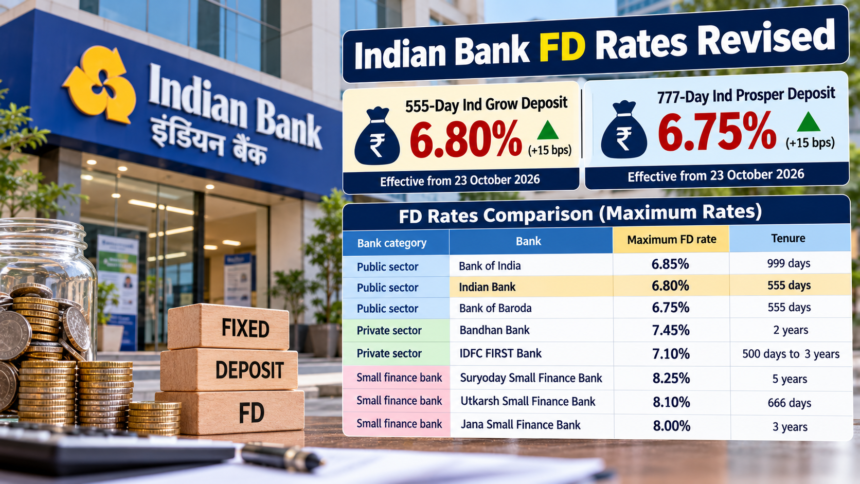
Indian Bank has increased interest rates on two special fixed deposit schemes by 15 basis points, giving depositors revised returns on its Ind Grow and Ind Prosper deposits. The new rates took effect on October 23, 2026.
Under the revision, the 555-day Ind Grow deposit now offers an interest rate of 6.80%, while the 777-day Ind Prosper deposit provides 6.75%. The change comes as savers compare fixed deposit returns offered by public sector banks, private banks and small finance banks.
The revised rate places Indian Bank among the competitive public sector lenders for selected deposit tenures. However, some private banks and small finance banks advertise higher maximum rates on deposits with different maturity periods.
Indian Bank FD Rates Compared With Other Banks
Bank-rate comparison data dated October 21, 2026, shows that interest rates vary across lenders and investment periods. The following table lists selected maximum advertised rates for specific tenures.
| Bank category | Bank | Maximum FD rate | Applicable tenure |
|---|---|---|---|
| Public sector | Bank of India | 6.85% | 999 days |
| Public sector | Indian Bank | 6.80% | 555 days |
| Public sector | Bank of Baroda | 6.75% | 555 days |
| Private sector | Bandhan Bank | 7.45% | 2 years |
| Private sector | IDFC FIRST Bank | 7.10% | 500 days to 3 years |
| Small finance bank | Suryoday Small Finance Bank | 8.25% | 5 years |
| Small finance bank | Utkarsh Small Finance Bank | 8.10% | 666 days |
| Small finance bank | Jana Small Finance Bank | 8.00% | 3 years |
Source: Bank-rate comparison data dated October 21, 2026, and Indian Bank’s revised rates effective October 23, 2026. Rates and tenure conditions should be confirmed with the respective banks before investing.
Among the public sector banks listed, Bank of India offers a maximum rate of 6.85% on its 999-day deposit, while Bank of Baroda offers 6.75%. Punjab National Bank and Canara Bank have maximum rates of 6.60% each, according to the supplied comparison.
Small Finance Banks Offer Higher Rates on Selected Tenures
The comparison shows that some small finance banks offer higher headline interest rates than Indian Bank. Suryoday Small Finance Bank’s listed rate of 8.25%, for example, applies to a five-year deposit, while Indian Bank’s 6.80% rate is available on its 555-day Ind Grow scheme.
Private lenders also offer higher maximum rates on certain deposits. Bandhan Bank’s listed maximum rate is 7.45% for a two-year tenure, while IDFC FIRST Bank offers up to 7.10% across specified deposit periods.
These rates are not directly comparable without considering the investment duration. A higher advertised rate may require keeping money invested for a longer period, which may not suit every depositor.
Before booking an FD, customers should check the rate applicable to their chosen tenure, premature withdrawal rules and available interest payout options.
How Much Interest Can You Earn on an FD?
The difference between interest rates can affect the returns earned on a fixed deposit. For illustration, a deposit of ₹1 lakh at an annual interest rate of 6.80% would generate approximately ₹6,800 over one year under a simple-interest calculation.
At an annual rate of 8.25%, the corresponding amount would be ₹8,250, creating a difference of ₹1,450 over the same illustrative period.
These figures are estimates rather than actual FD maturity calculations. The final return depends on the deposit tenure, compounding frequency, interest payout method and applicable tax.
What Depositors Should Check Before Investing
Interest rates are only one factor to consider when selecting a fixed deposit. Customers should also assess their liquidity requirements, the consequences of withdrawing funds early and the total return available for their preferred tenure.
Deposit protection is another important consideration. Eligible deposits with insured banks are covered by the Deposit Insurance and Credit Guarantee Corporation (DICGC) up to ₹5 lakh per depositor per bank, including principal and interest, subject to applicable rules.
Indian Bank’s revised rates make its special-tenure deposits competitive among the public sector banks listed. However, savers looking for higher returns should compare the rates available for their intended investment period and consider deposit conditions and insurance limits before making a decision.
Disclaimer: This article is intended for general informational purposes only and does not constitute financial or investment advice. Fixed deposit rates, eligibility conditions and withdrawal rules may change. The examples provided are illustrative and may not reflect actual maturity proceeds. Please verify the latest terms directly with the relevant bank and consult a qualified financial adviser if needed.