
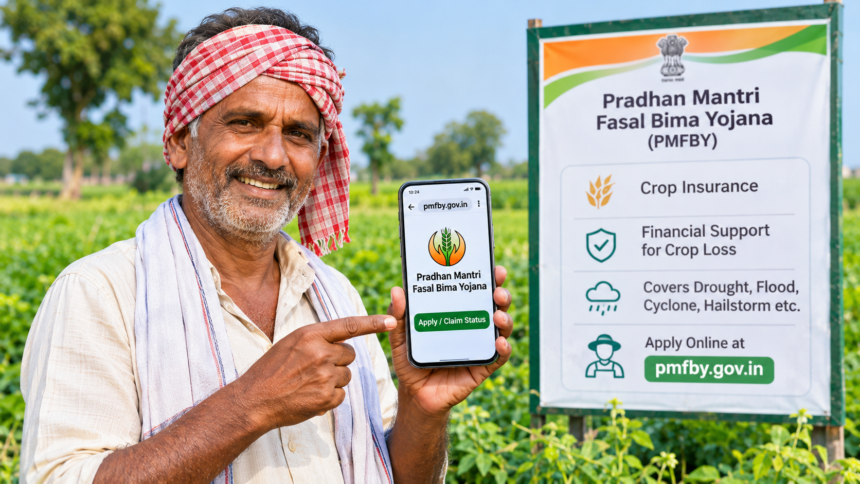
The Pradhan Mantri Fasal Bima Yojana (PMFBY) was introduced by the Central Government to provide financial protection to farmers against crop losses caused by natural disasters and other unforeseen events. The scheme covers losses resulting from incidents such as floods, droughts, cyclones, earthquakes and other specified agricultural risks.
Farmers who suffer crop damage can report their losses through the official PMFBY website, pmfby.gov.in, and apply for eligible insurance compensation. Once a claim is approved, the payment is transferred directly to the farmer’s bank account through the Direct Benefit Transfer (DBT) system.
The online portal also allows farmers to check their application and claim status without having to visit government offices repeatedly.
PM Fasal Bima Yojana 2026: Key Features and Benefits
As of August 2026, PMFBY provides insurance protection against several agricultural risks, including drought, floods, cyclones, hailstorms, pest attacks, crop diseases, unseasonal rainfall, inundation, prevented sowing and specified post-harvest losses.
The scheme operates under the principle of “One Nation, One Crop, One Premium”, which aims to maintain uniformity in farmers’ premium contributions across the country.
For the financial year 2026-27, the government has allocated ₹12,200 crore to the scheme. PMFBY is currently being implemented in 25 states and Union Territories for the Kharif 2026 season.
Over the past 10 years, more than 92.46 crore farmer applications have been insured under the scheme. During this period, claims have been paid against over 26.33 crore farmer applications, with total claim payments exceeding ₹2.06 lakh crore.
How Much Premium Do Farmers Have to Pay?
One of the major benefits of PMFBY is that farmers pay only a limited portion of the insurance premium. The applicable rates are:
| Crop Category | Farmer’s Premium |
|---|---|
| Kharif food and oilseed crops | 2% |
| Rabi food and oilseed crops | 1.5% |
| Annual commercial and horticultural crops | 5% |
The remaining actuarial premium, ranging from 95% to 98.5%, is shared by the Central and State Governments.
In most states, the Centre and state governments share the subsidy equally in a 50:50 ratio. For North Eastern states, this arrangement changed to 90:10 from Kharif 2020, while the same 90:10 sharing ratio was introduced for Himalayan states from Kharif 2023.
The scheme also aims to settle eligible claims within two months of harvesting so that farmers can receive compensation without unnecessary delays. Technologies such as satellite images, drones and mobile applications are being used to improve crop-loss assessment and support more accurate claim settlements.
Which Crop Losses Are Covered Under PMFBY?
PMFBY provides insurance protection at different stages of farming, from sowing to harvesting and certain post-harvest periods.
1. Losses to Standing Crops
The scheme provides area-based coverage for notified crops against non-preventable risks. These include drought, dry spells, floods, inundation, cyclones, hailstorms, lightning, pest attacks and crop diseases.
2. Prevented Sowing
Farmers who have already incurred cultivation expenses but cannot sow their crops because of adverse weather conditions may qualify for compensation. Under this provision, the claim can be up to 25% of the insured sum.
3. Post-Harvest Losses
Crops left in the field in a cut-and-spread condition for drying after harvesting receive protection for up to 14 days. This cover applies to specified losses caused by cyclonic events and unseasonal rainfall.
4. Localised Calamities
The scheme also covers certain individual farm-level losses caused by events such as hailstorms, landslides, inundation, cloudbursts and damage from natural fires, subject to the prescribed conditions.
However, PMFBY does not cover every type of loss. Exclusions include damage caused by war, nuclear risks, riots, theft, specified post-harvest conditions and other preventable risks.
Meri Policy Mere Haath Campaign for Kharif 2026
The government is also conducting the Meri Policy Mere Haath (MPMH) campaign for the Kharif 2026 season under PMFBY. Several insurance companies, including SBI General Insurance, are participating in the initiative.
The campaign aims to provide crop insurance policy documents directly to farmers and improve awareness about the benefits and provisions of the scheme.
Policy distribution activities are planned across nine states: Madhya Pradesh, Uttar Pradesh, Uttarakhand, Maharashtra, Assam, Odisha, Tamil Nadu, Karnataka and Jharkhand.
SBI General Insurance has said it will support policy distribution camps along with Fasal Bima Pathshalas, Kisan Melas and Kisan Goshtis to reach farmers at the local level.
Naveen Chandra Jha, Managing Director and CEO of SBI General Insurance, said the campaign would help farmers understand their insurance protection and build confidence in the crop insurance system. He added that the company’s outreach across nine states aims to ensure farmers feel informed and supported during uncertain agricultural conditions.
Disclaimer: This article is intended for general informational purposes and is based on the PMFBY details provided. Insurance coverage, premium rates, claim eligibility, exclusions and settlement procedures are subject to official scheme guidelines and government notifications. Farmers should check the latest information on the official PMFBY portal or contact their authorised insurance provider before submitting a claim or making decisions related to crop insurance.