
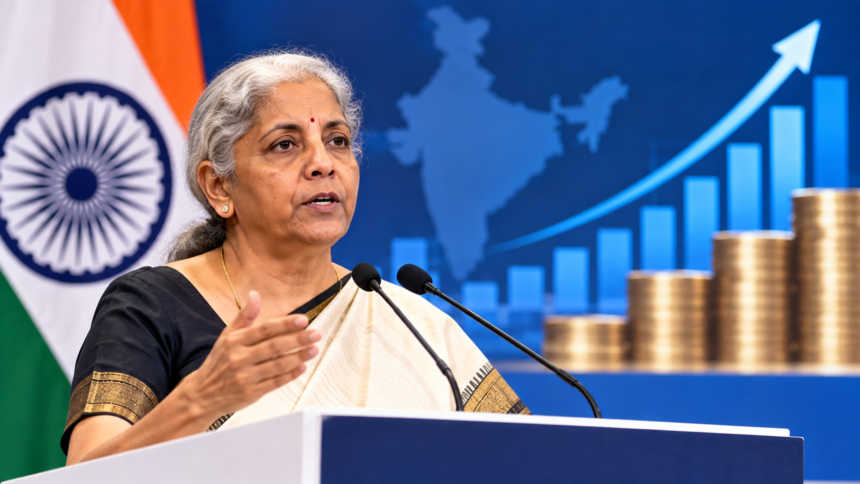
Finance Minister Nirmala Sitharaman said India’s economic resilience has been built over the past decade through a combination of fiscal discipline, infrastructure development, banking reforms, stronger delivery systems and continued policy changes.
Speaking at the 5th Kautilya Economic Conclave in New Delhi, Sitharaman said the government has strengthened the country’s economic framework through major reforms, including the Goods and Services Tax (GST), the Insolvency and Bankruptcy Code and the four labour codes.
India Maintains Strong Economic Fundamentals
The Finance Minister said India has managed to withstand the economic shocks of the past four years while maintaining its underlying strength. She pointed to real GDP growth of 7.8% in the first quarter of fiscal year 2026-27 as an indication of the economy’s continued momentum.
Sitharaman also highlighted the country’s fiscal position, saying the International Monetary Fund (IMF) expects India’s general government debt to decline from 83.4% of GDP in 2026 to 77.7% by 2031. She noted that this projection comes against a broader global trend of rising government debt.
Infrastructure Spending Remains a Key Focus
On infrastructure development, Sitharaman said the government has allocated ₹12.22 lakh crore for capital expenditure in the current financial year.
She also pointed to the expansion of the national highway network, which has grown by around 61% since 2014. During the same period, the number of operational airports in the country has more than doubled.
Welfare Schemes Supporting Economic Participation
The Finance Minister also highlighted the role of government welfare and financial inclusion programmes in strengthening households and expanding economic opportunities.
More than 52 crore collateral-free loans have been sanctioned under the Pradhan Mantri MUDRA Yojana, she said.
Sitharaman also cited schemes including PM Awas Yojana, PM Ujjwala Yojana, Ayushman Bharat and PM Garib Kalyan Anna Yojana. According to the Finance Minister, these initiatives have helped strengthen people’s ability to participate in economic growth while improving their capacity to deal with challenges.
Disclaimer: This article is based on statements and information presented at the 5th Kautilya Economic Conclave. Economic indicators, government policies and official projections may change over time. Readers should refer to official government and institutional sources for the latest information.