
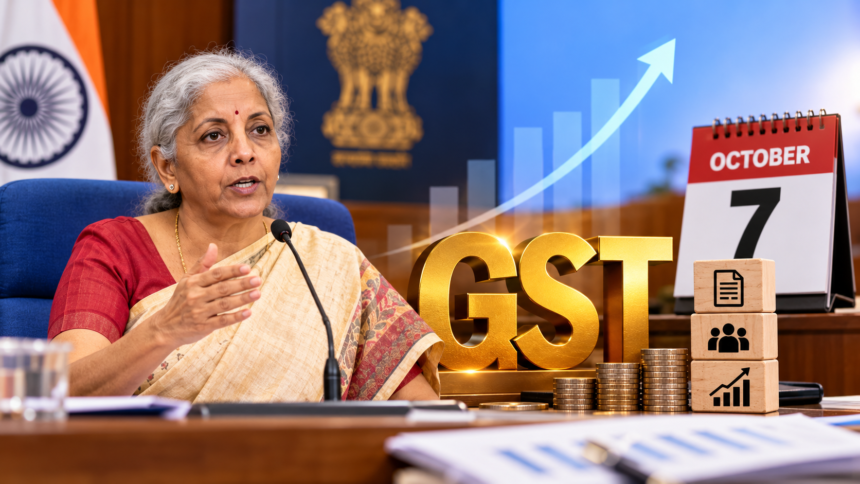
Union Finance Minister Nirmala Sitharaman has announced that the next set of process reforms under the Next-Gen GST framework will be placed before the GST Council on October 7. The proposed changes are aimed at making GST compliance simpler, reducing operational costs for businesses and making the tax system easier to navigate, particularly for smaller enterprises.
The reforms have been prepared in consultation with state governments and are expected to cover several areas, including GST registration, return filing, refunds, dispute resolution and input tax credit processing.
Government Focuses on Simpler GST Compliance
Sitharaman said the Next-Gen GST initiative was developed under Prime Minister Narendra Modi’s vision with two broad objectives: rationalising tax rates and making compliance more straightforward.
In a LinkedIn column titled “Next-gen GST: Taking India’s reform journey forward”, the Finance Minister said the reforms were intended to provide relief to households, greater certainty to businesses and a system that allows taxpayers to meet their obligations without unnecessary difficulties.
The upcoming process reforms are expected to take the GST framework into its next phase after the rate rationalisation that came into effect on September 22, 2025.
Taxable Supplies and GST Revenue Show Strong Growth
The Finance Minister highlighted several indicators showing growth following the implementation of the GST rate changes.
Between October 2025 and July 2026, the value of reported taxable supplies increased 25.8% compared with the corresponding period a year earlier. Reported business-to-consumer (B2C) sales also recorded a 26.7% rise.
Official figures for April to September 2026 also showed continued growth in GST collections. Gross GST revenue during the first half of the financial year reached ₹12.46 lakh crore, representing an 11.6% year-on-year increase.
GST collections recorded double-digit annual growth between June and September, with the pace accelerating to nearly 15%. Refunds released during the period stood at approximately ₹1.80 lakh crore, while net GST collections increased 10.4%.
Aggregate State GST receipts, including IGST settlements, grew by around 16%.
GST Taxpayer Base Expands
The number of active GST registrations across Central and State jurisdictions reached nearly 1.71 crore by the end of August 2026. This was around 15% higher than the level recorded a year earlier.
Compliance also improved, with timely filing of GSTR-3B returns for the April-July period increasing by 12.6%.
Sitharaman also pointed out that reported taxable supplies increased across all 11 sector groups and major states. According to the Finance Minister, this growth is helping small and medium-sized businesses, particularly those located in Tier-2 and Tier-3 cities, expand their reach into national markets.
Next Phase of GST Reforms
The government believes the growing maturity of the GST system provides a stronger base for further reforms. The next proposals are therefore focused not only on tax rates but also on making everyday compliance more efficient and predictable.
Sitharaman said the principles of clarity and certainty would remain central to the government’s approach as it continues to improve the tax system. These principles, she added, will also guide work on direct taxes as part of the broader vision of building a Viksit Bharat.
Disclaimer: This article is intended for general informational purposes only. GST policies, proposals and official decisions may change following discussions and decisions by the GST Council. Readers should refer to official government notifications and consult a qualified tax professional for advice related to their individual tax matters.