
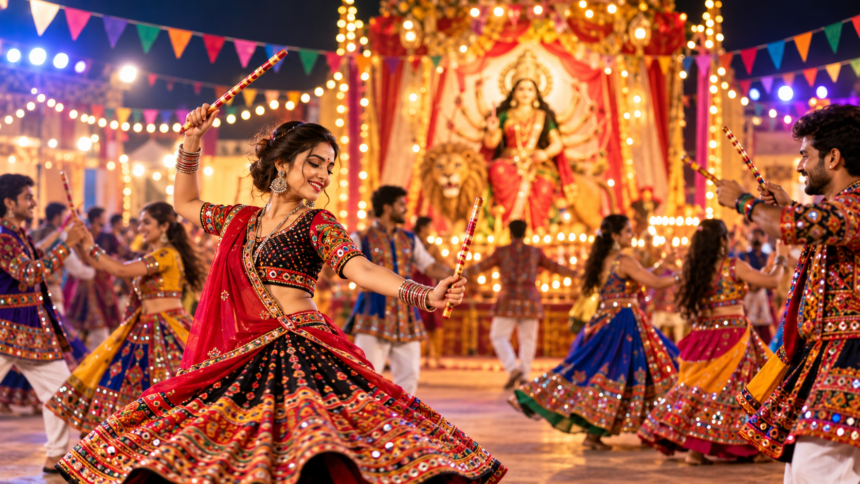
Navratri is among India’s most colourful and widely celebrated festivals, dedicated to Goddess Durga and her victory over the powerful demon king Mahishasura. The festival represents the triumph of good over evil and is observed over nine nights, with devotees worshipping the nine forms of Goddess Durga.
From Kaalratri, known for her fierce form, to Kushmanda, associated with nurturing energy, each manifestation of the Goddess holds a special place in Navratri traditions. Along with prayers and fasting, music and traditional dance bring communities together during the celebrations.
Garba and Dandiya Raas are two of the most popular cultural expressions associated with Navratri. Beyond their energetic movements and colourful celebrations, these dances carry deep spiritual and cultural meanings that have been passed down through generations.
Spiritual Meaning Behind Garba
The name Garba is derived from the Sanskrit word garbha, which means womb. Traditionally, dancers move in a circle around a clay lamp containing a flame, known as the Garbha Deep. The lamp represents the womb of creation and the eternal energy of the Goddess.
The traditional lamp also symbolises the human body as a vessel for divine energy. In modern celebrations, the lamp may sometimes be replaced by an image or idol of Goddess Durga.
The circular formation of Garba carries another important meaning. It represents the cyclical nature of existence, including birth, life, death and rebirth. At the centre of this constantly moving circle, the Goddess represents the eternal and unchanging divine force.
Dancing barefoot is also considered significant in traditional Garba. Since the earth is revered as a form of the Mother Goddess, dancing with bare feet symbolically connects participants with the earth and its energy.
Why Dandiya Represents the Battle of Good and Evil
Dandiya Raas has a stronger martial character and is traditionally associated with the battle between Goddess Durga and Mahishasura. The decorated wooden sticks used during the dance, known as dandiyas, are believed to symbolise the swords carried by the Goddess.
The rhythmic striking of the sticks represents the power and courage of Durga in her battle against evil. It also carries a symbolic message about overcoming ignorance, negativity and ego.
While the sticks create an energetic and festive atmosphere, the circular movements represent balance and cosmic harmony. As a result, Dandiya is not simply a form of entertainment but also carries a devotional significance during Navratri.
Garba and Dandiya: Different Styles, Shared Spirit
Garba and Dandiya Raas have distinct styles, but both are closely connected with devotion, community and celebration. Garba generally involves coordinated claps, graceful movements, spins and rhythmic footwork, while Dandiya incorporates the use of decorated sticks and has a more energetic, martial character.
Over the years, both dance forms have moved beyond traditional community and temple celebrations. They are now widely performed at weddings, social gatherings and large cultural events in India and around the world.
Their growing popularity reflects the ability of these traditional dances to combine spirituality, music, movement and social togetherness while keeping the cultural essence of Navratri alive.
Navratri 2026 Celebrations
As Navratri 2026 approaches, Garba and Dandiya will once again become an important part of celebrations. For devotees and participants, these dances offer more than colourful performances—they provide a way to express devotion, celebrate community and connect with traditions that have continued for generations.
Disclaimer: This article is intended for general informational and cultural purposes. Religious beliefs, traditions and interpretations may vary across regions, communities and individuals.