
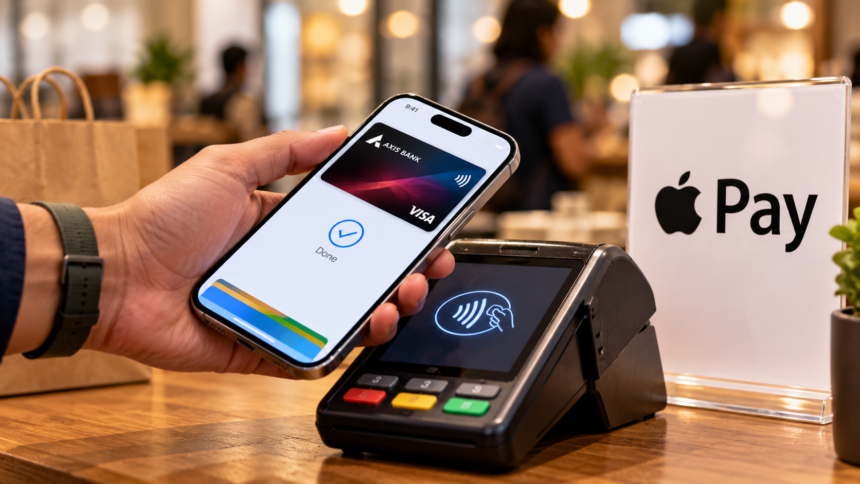
Apple Pay has officially entered India’s digital payments market, giving iPhone and Apple Watch users access to Apple’s contactless payment system. The service allows users to add eligible credit cards to Apple Wallet and make payments by simply tapping their device at supported contactless payment terminals.
However, Apple Pay’s initial rollout in India is limited. Its long-term growth will depend on wider bank support, increasing credit card usage and how effectively it can establish itself in a market where UPI already dominates digital payments.
How Apple Pay Works in India
Apple Pay is designed to make contactless card payments quick and convenient. Users can add an eligible credit card to Apple Wallet and verify transactions using Face ID, Touch ID or the device passcode.
Once a card has been added, users can pay at compatible contactless terminals by holding their iPhone or Apple Watch near the payment machine. The service can also be used to simplify payments for supported online purchases.
At the time of its India launch, Apple Pay supports only eligible Visa and Mastercard credit cards issued by Axis Bank. Credit cards from other banks and RuPay cards are not currently supported.
Why Apple Pay Faces a Tough Competition From UPI
India’s digital payments ecosystem has changed significantly over the past few years, largely because of the rapid expansion of UPI. QR-code payments are now widely used by everyone from small merchants to major retailers.
Apple Pay follows a different payment model built around NFC technology, card tokenisation, device-level security and biometric authentication.
This makes UPI one of the biggest challenges for Apple Pay in India. According to the Reserve Bank of India’s Payment System Report released in December 2025, UPI accounted for 85.5% of digital transaction volume.
Apps such as PhonePe and Google Pay have become part of everyday payment routines for millions of users. People use UPI not only for shopping but also for paying utility bills and transferring money to friends and family.
Apple Pay currently does not offer UPI integration in India. As a result, its initial offering is more focused on contactless credit card payments rather than serving as an all-purpose digital payment platform like PhonePe or Google Pay.
Apple Pay’s Advantage for iPhone Users
NFC-based payments are not completely new to Indian consumers. Samsung Wallet, for example, already supports NFC payments on compatible Galaxy devices.
Apple’s main advantage is its close integration between its payment service and its hardware and software ecosystem. For people who already use an iPhone or Apple Watch, adding a supported credit card to Apple Wallet can provide a seamless payment experience.
However, the limited number of supported cards and banks remains an important restriction at launch. Expanding partnerships with Indian banks and increasing card compatibility will be key factors in determining how widely Apple Pay is adopted in the country.
Apple Pay’s Prospects in India
Apple Pay enters a market where UPI has already become the preferred payment method for a large number of consumers. Its initial focus on contactless credit card transactions gives it a different position from UPI-based payment apps.
The service could appeal particularly to existing Apple users who prefer using their iPhone or Apple Watch for payments. However, broader bank support and greater card availability will be important if Apple Pay is to expand beyond its limited initial rollout.
Disclaimer: This article is intended for general informational purposes only. Payment services, card eligibility and availability may change over time. Users should check the latest information from Apple and their respective banks before using the service.